$DECLASSwnMfUvY5KfUN2LbKgyHXwmh39mGpJd7bjJw5A71pumpBuy
Declassified
Releases / Release 06 / DOW-UAP-D123
Department of War

AAWSAP DIRD, Positron Aerospace Propulsion, March 2010

This is a 2010 Defense Intelligence Reference Document on using positrons (antimatter) as a fuel for aerospace propulsion. It reviews concepts for UAVs, missiles, a single-stage launch vehicle and crewed Mars missions, and discusses positron production and storage. It concludes the concept is attractive in theory but depends on unsolved production and storage problems.

Record
DOW-UAP-D123
Release
Release 06 · Sep 18, 2026
Incident
2010-03-02 · Las Vegas, Nevada
Pages
35
Verdict
New
Source
war.gov ↗
Context · why this verdict

The overlap shows only matching cover and front-matter wording shared with other AAWSAP DIRDs in the same release (D121, D122); the technical body is not matched to any earlier release.

Findings in this document

4 findings

New SIG

Mars mission concept with positron engines and storage lifetime claims

  • Verbatim
    Missions must be established that can transport astronauts to Mars in less than 180 days.
    DOW-UAP-D123 · Release 06 · page 24 · war.gov ↗
  • Verbatim
    Proprietary experiments at Positronics Research LLC show that Ps atoms in crossed magnetic and electric fields in silica aerogel with 20-nm voids live up to 10 µs.
    DOW-UAP-D123 · Release 06 · page 32 · war.gov ↗

New or already public? No overlap with earlier releases.

New SIG

Report says positron-based EMP ordnance and longer BOMARC range are possible

  • Verbatim
    The BOMARC range could be increased to 2,000 km with 1 milligram (mg) of positrons.
    DOW-UAP-D123 · Release 06 · page 13 · war.gov ↗
  • Verbatim
    positrons could act as ordnance to destroy electronics on missiles or aircraft by electromagnetic pulse (EMP) by detonation of micrograms of positrons up to hundreds of meters from the target.18
    DOW-UAP-D123 · Release 06 · page 13 · war.gov ↗

New or already public? Not matched in the overlap.

New SIG

Single-stage vehicle concept: positron mass budget of 86.9 mg and 43% lower lift-off weight

  • Verbatim
    The positron mass budget for a 60,500-kg dry mass for ascension to LEO is 86.9 mg (Table 3).
    DOW-UAP-D123 · Release 06 · page 15 · war.gov ↗
  • Verbatim
    The GLOW of the positron SSRV is 43 percent less than that of the chemical SSRV owing to reduced propellant mass.
    DOW-UAP-D123 · Release 06 · page 14 · war.gov ↗
  • Context

    The vehicle is described as taking off horizontally from Edwards Air Force Base.

New or already public? Content is not in any matched earlier page.

New SIG

Report claims 150 µg of positrons could power a UAV around the Earth

  • Verbatim
    Figure 6 shows range versus positron mass for a 60-kg UAV with lift/drag of four that can circumnavigate Earth on 150 µg of positrons.
    DOW-UAP-D123 · Release 06 · page 10 · war.gov ↗
  • Verbatim
    Within 10 years, the 150 µg of positrons required for a globe-encircling, nonstop turbojet flight could be made in 6 months at a cost of $69 million.
    DOW-UAP-D123 · Release 06 · page 32 · war.gov ↗
  • Context

    The catalogue description says the DIRD is a reference and synthesis product and that the concept remains highly speculative.

  • Inference · AI interpretation

    The cost figure appears as $96 million on page 29 per the page summary and $69 million on page 32, so the document's own numbers differ.

New or already public? No earlier release matches these pages in the overlap data.

Page by page

The pages and what the AI read on them

The transcription is the page reader's: black bars mark what the government redacted; hatched tags mark personal data we removed.

Page 25

Page 25 of 35

Page 20 of a 2010 Positron Aerospace Propulsion report listing claimed benefits of positron propulsion for a Mars mission, with launch timing, a 3.7 km/sec insertion delta-V for the manned mission, and a 180-day transit assumption. It includes four Mars trajectory diagrams (2029 cargo, 2031 manned lander, 2033 manned return, 2035 manned lander) credited to Positronics Research LLC.

•• •• UNCLASSIFIED/}FOA OFFI€1Ak Wlilii ONkY Benefits of using positrons for a Mars mission include: • The "disposable /:i.V" used to propel TMI stages into low-probability Earth or Mars intercepts can be eliminated, reducing total propellant mass. • Reduction in shielding and engine mass give lower initial mass low Earth orbit for launch vehicles or faster transits for piloted missions. • The ERV uses a positron engine instead of LOX/CH4. This gives significant mass savings or an equivalent reduction in Mars-to-Earth return time for astronauts. • The improvement in l sp translates to either a reduced launch payload mass for cargo missions or reduced transit times for piloted missions to Mars. • More chemical propellant can be stored on the lander to improve aerobraking or landing strategies that reduce hazards for astronauts. Launch dates are set for around 2030. Assuming minimum !:i.V for Mars opposition-class missions, interplanetary scenarios are illustrated in Figure 16. The !:i.V for an insertion trajectory into Mars for the manned mission (Figure 16b) is !:i.V = 3.7 km/sec. Each manned trajectory assumes a 180-day transit time . ,.• i C I • .ue 'Y' IS " -CS (a) (b) " .. i ~ n------+-1-'Y' ,a 0 § > -ts -1 --GS O VS 15 )C tOCH k lO!e (P,U) (c) (d) Figures 16. Mars Trajectories (X-coordinates defined in direction of Aries): (a) 2029 cargo mission; (b) 2031 manned lander to Mars; (c) 2033 manned return to Earth; (d) 2035 manned lander to Mars, if necessary (courtesy Positronics Research LLC) 52 UNCLASSIFIED/ /FOR. orr1e1J1tt U.!I!! or~t I 20 UNCLASSIFIED/ /FOR OFFICIAL USE ONLY
Page 26

Page 26 of 35 · 1 redaction

A page of a 2010 positron aerospace propulsion study describing a Mars mission architecture, including payload masses, launch schedule, crew timeline and spacecraft concepts shown in Figure 17. The page has a bullet list of cargo and crewed SSRV mission steps.

UNCLASSIFIED/; FOR OFFICl"L U.!I! er•tY The Mars reference mission53 , 54 considered payload masses of 60,000 kg for 2015 missions. This can be reduced to 45,000 kg assuming technological advances by 2031 with a complete interplanetary spacecraft mass of 90,000 kg. In summary, the mission scenario for a positron spacecraft is similar to that for existing studies, but with the use of less costly launch vehicles. Every 778 days, two 45,000-kg payloads are launched from Earth using a Saturn V or equivalent chemical rocket. One payload is the unmanned system or manned crew lander sent to Mars; the other contains the positron propulsion system and the propellant tank. They are assembled as a complete unit in LEO. Unmanned systems are launched in advance of the crewed system in order to ensure that the Martian habitat is well established. The crew arrives at Mars in late 2033, performs research for 1 year, and then returns home in a smaller positron spacecraft using a shorter trajectory. Artists' renditions of two possible positron spaceships previously described in this study are shown in Figure 17. (a) (b) Figure 17. Spacecraft Using Positron Engines. (a) Solid-core system enters Mars orbit; (b) Modified Sanger photon rocket system burns for landing on Mars (courtesy Positronics Research LLC).55 Architectures for Mars exploration using a positron SSRV are summarized below: • Before humans leave for Mars on initial flights, cargo ships precede them to Mars on low-energy trajectories to take the components of a Mars space station (MSS) and necessary supplies, including a Mars surface lander (MSL). The MSS will be similar to an Earth space station (ESS). The cargo ships will utilize positron rocket engines. • Manned positron SSRVs launched from Earth rendezvous in LEO with the ESS. The SSRV is a horizontal-takeoff, horizontal-landing winged-body, manned vehicle in which the first stages of flight use air-breathing engines with positrons heating the air. It switches to the rocket engine to complete the final ascent phase to LEO. • Once ready for interplanetary flights at the ESS, including refueling, the SSRV flies to Mars on a fast, high-energy trajectory, carrying a crew of five or six astronauts and powered by positron rocket engines. The SSRV conducts a rendezvous with the UNCLASSIFIED/ /FAA: AfiEICllL. Uiliii 0,.111¥ 21 UNCLASSIFIED/ /[REDACTED]
Page 27

Page 27 of 35

This page continues a report on positron production, describing current accelerator-based methods and several proposed high-intensity positron source concepts, with a schematic of a proposed undulator-based source for the International Linear Collider. The page also includes a header marked UNCLASSIFIED//FOR OFFICIAL USE ONLY, with the strikethrough as printed.

MSS, and the astronauts descend to the Mars surface on the MSL using a high-thrust variant of the positron rocket engine. Positron Production Positrons are currently produced at particle accelerators worldwide for basic and applications research. For example, the positron-emitting radioisotope Na22 (2.7 year mean lifetime) is made by bombarding targets with neutrons from a high-energy proton accelerator in the reaction Al27(n,x)Na22. Capture of these positrons is used to form beams with keV (slow) to MeV (fast) energies. Handling of large radioactive sources results in limits of 106 slow positrons/sec. For intensities up to 1010/sec, bombardment of metal targets with electron beams in the 10- to 100-MeV range is used, followed by collection and acceleration (deceleration) of positrons to form fast or slow beams. In addition, it has recently been shown that slow positron beams of up to 1011/sec can be realized by converting neutrons in reactors to electron-positron pairs in thin metal foils. Much higher positron currents are being sought in a variety of proposed solutions. Illustrated below are a few of the more promising concepts. First, in 1996, the U.S. Naval Research Laboratory56 proposed developing an intense source of fast positrons (1016/sec) utilizing compact electron betatron accelerators. Second, tabletop femtosecond laser-driven positron sources currently under development at the National Ignition Facility (Lawrence Livermore National Laboratory), the Rutherford-Appleton Laboratory (United Kingdom), and the Max Planck Institute (Munich) look promising, although more must be done to demonstrate efficient collection of positrons into beams. Finally, a most important step forward is multi-gigaelectronvolt (GeV) energy electron storage rings being developed for the high-energy physics International Linear Collider (ILC) project that uses undulators in electron beams to create intense photon beams that produce intense (1014-16/sec) positron beams by pair production.57 A schematic drawing from one proposal for the ILC is shown in Figure 18.58 Layout of ILC Positron Source Figure 18. Proposed Undulator-Based Positron Source for the International Linear Collider (courtesy KEK, Japan)59 22
Page 28

Page 28 of 35

Page 23 of a positron aerospace propulsion study covering positron and antiproton cost estimates, including Table 6 comparing sources by trap injection energy, filling rate, timeframe and dollars per joule of annihilation energy. The text concludes positrons are projected to cost far less than antiprotons per unit of energy.

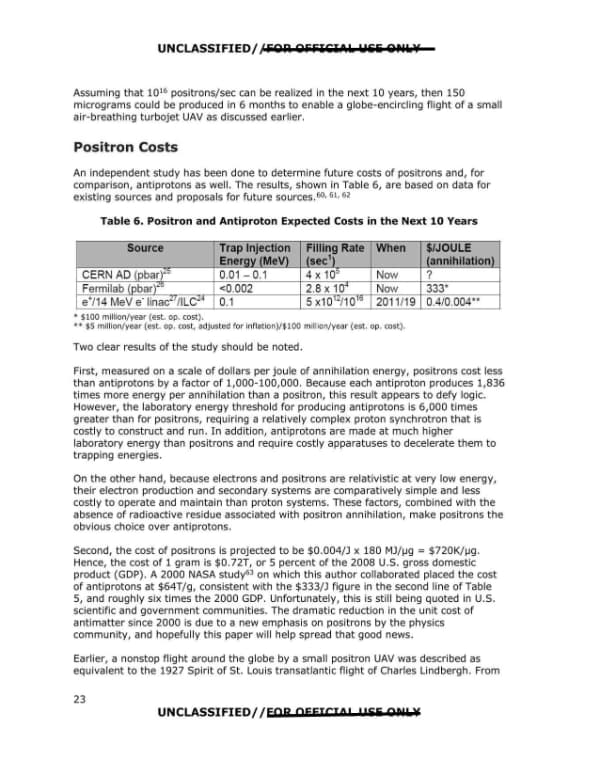
UNCLASSIFIED/FOR OFFICIAL USE ONLY Assuming that 10^16 positrons/sec can be realized in the next 10 years, then 150 micrograms could be produced in 6 months to enable a globe-encircling flight of a small air-breathing turbojet UAV as discussed earlier. Positron Costs An independent study has been done to determine future costs of positrons and, for comparison, antiprotons as well. The results, shown in Table 6, are based on data for existing sources and proposals for future sources. 60, 61, 62 Table 6. Positron and Antiproton Expected Costs in the Next 10 Years Source | Trap Injection Energy (MeV) | Filling Rate (sec^-1) | When | $/JOULE (annihilation) CERN AD (pbar) 25 | 0.01 – 0.1 | 4 x 10^5 | Now | ? Fermilab (pbar) 26 | <0.002 | 2.8 x 10^4 | Now | 333* e+/14 MeV e- linac 27/ILC 24 | 0.1 | 5 x10^12/10^16 | 2011/19 | 0.4/0.004** * $100 million/year (est. op. cost). ** $5 million/year (est. op. cost, adjusted for inflation)/$100 million/year (est. op. cost). Two clear results of the study should be noted. First, measured on a scale of dollars per joule of annihilation energy, positrons cost less than antiprotons by a factor of 1,000-100,000. Because each antiproton produces 1,836 times more energy per annihilation than a positron, this result appears to defy logic. However, the laboratory energy threshold for producing antiprotons is 6,000 times greater than for positrons, requiring a relatively complex proton synchrotron that is costly to construct and run. In addition, antiprotons are made at much higher laboratory energy than positrons and require costly apparatuses to decelerate them to trapping energies. On the other hand, because electrons and positrons are relativistic at very low energy, their electron production and secondary systems are comparatively simple and less costly to operate and maintain than proton systems. These factors, combined with the absence of radioactive residue associated with positron annihilation, make positrons the obvious choice over antiprotons. Second, the cost of positrons is projected to be $0.004/J x 180 MJ/µg = $720K/µg. Hence, the cost of 1 gram is $0.72T, or 5 percent of the 2008 U.S. gross domestic product (GDP). A 2000 NASA study 63 on which this author collaborated placed the cost of antiprotons at $64T/g, consistent with the $333/J figure in the second line of Table 5, and roughly six times the 2000 GDP. Unfortunately, this is still being quoted in U.S. scientific and government communities. The dramatic reduction in the unit cost of antimatter since 2000 is due to a new emphasis on positrons by the physics community, and hopefully this paper will help spread that good news. Earlier, a nonstop flight around the globe by a small positron UAV was described as equivalent to the PII removed. Louis transatlantic flight of Charles Lindbergh. From 23 UNCLASSIFIED//FOR OFFICIAL USE ONLY
Page 29

Page 29 of 35

Page 24 of a DIRD report on positron aerospace propulsion covering positron storage, the Penning trap, and the Brillouin density limit, with one photograph of a Penning trap apparatus. The page also notes that manufacturing the 150 µg required for an epic flight could cost $96 million over six months.

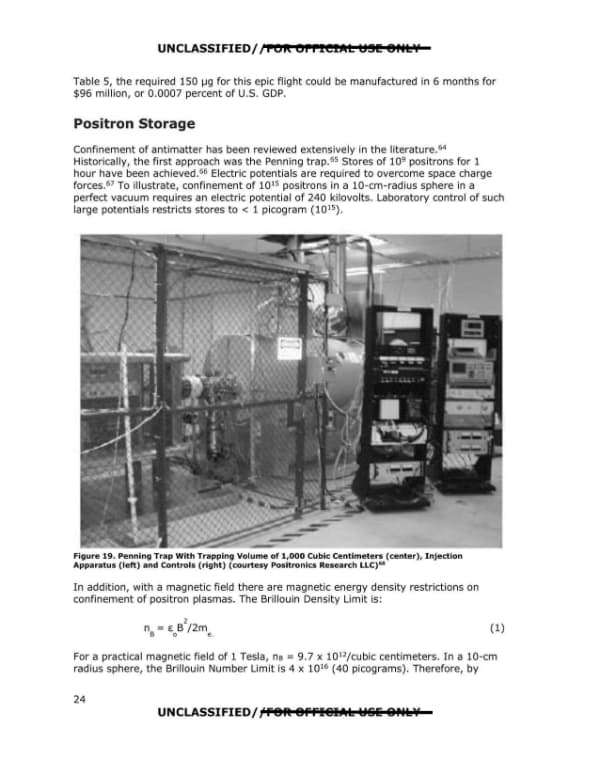
UNCLASSIFIED//FOR OFFICIAL USE ONLY Table 5, the required 150 µg for this epic flight could be manufactured in 6 months for $96 million, or 0.0007 percent of U.S. GDP. Positron Storage Confinement of antimatter has been reviewed extensively in the literature. 64 Historically, the first approach was the Penning trap. 65 Stores of 10^9 positrons for 1 hour have been achieved. 66 Electric potentials are required to overcome space charge forces. 67 To illustrate, confinement of 10^15 positrons in a 10-cm-radius sphere in a perfect vacuum requires an electric potential of 240 kilovolts. Laboratory control of such large potentials restricts stores to < 1 picogram (10^15). Figure 19. Penning Trap With Trapping Volume of 1,000 Cubic Centimeters (center), Injection Apparatus (left) and Controls (right) (courtesy Positronics Research LLC) 68 In addition, with a magnetic field there are magnetic energy density restrictions on confinement of positron plasmas. The Brillouin Density Limit is: n_B = ε_o B^2 / 2m_e. (1) For a practical magnetic field of 1 Tesla, n_B = 9.7 x 10^12/cubic centimeters. In a 10-cm radius sphere, the Brillouin Number Limit is 4 x 10^16 (40 picograms). Therefore, by 24 UNCLASSIFIED//FOR OFFICIAL USE ONLY
Page 30

Page 30 of 35

A page from a declassified positron propulsion report describing how positronium is formed and confined in porous media, with a figure showing a positron forming Ps on a void edge. The text covers storage limits, thermalization, and conditions for longer Ps lifetimes.

UNCLASSIFIED/ FOR OFFICIAL USE ONLY either space charge or magnetic energy considerations, the storage limit is tens of picograms, 7-8 orders of magnitude short of 100 micrograms, where practical uses of positrons begin to emerge, as illustrated earlier. The second approach is confinement of neutral Ps atoms in manufactured porous media of either regular lattices of atoms, such as polymers, or irregular strands of insulator material encapsulating voids, such as silica aerogel. 69, 70 Regardless of void size, Ps atoms ultimately annihilate with electrons attached to atoms on the boundaries of voids by the so-called "pickoff" process. Therefore, large, observable lifetimes require materials with extraordinarily large voids. FORMATION OF POSITRONIUM IN POROUS MEDIA Positrons are injected into a porous material at low energy (~100 keV) to ensure that they stop and form a Ps atom over a distance of a few millimeters. 71 The positron rapidly loses its energy by collisions with electrons attached to atoms in the material. As it nears 6.8 electronvolts (eV)-the binding energy of the ground state of Ps-it captures a weakly bound electron and forms Ps. It diffuses through the material, and over about 1 nanosecond, its energy is rendered to the room temperature of the material, 0.025 eV. This is called thermalization. The quantum mechanical model of Ps is remarkably similar to the hydrogen atom. The major difference is that Ps spontaneously annihilates, whereas hydrogen is stable. The "self-annihilation" of Ps due to overlap of electron and positron wave functions results in extremely short lifetimes, as noted earlier. Lifetimes against "self-annihilation" can be demonstrably increased if the following two conditions are met: (1) a way is found to isolate the electron wave function from the positron wave function, and (2) materials provide voids large enough to allow detection of lifetimes well beyond 142 nanoseconds (ns). A high vacuum is required to avoid Ps annihilation on gas molecules within the voids. The following describes how Positronics Research LLC has approached these issues in the laboratory. 72 LONG-TERM STORAGE OF POSITRONIUM Under crossed magnetic and electric fields, Ps assumes a doubly oblate shape (Figure 21), with the electron and positron separated by hundreds of nanometers to tens of micrometers, depending on the size of the fields.73 Computation of lifetimes against quantum mechanical barrier penetration reveals lifetimes in excess of 1 year over a large range of magnetic and electric fields. UNCLASSIFIED/ FOR OFFICIAL USE ONLY Figure 20. A Positron Forms Ps on the Edge of a Void, Thermalizes, and Becomes Trapped in a Void Before Annihilating (courtesy University of Michigan) 25
Page 31

Page 31 of 35

A page from a report on positron aerospace propulsion discussing magnetic field effects on Ps atoms and silica aerogel as a storage medium, with a Ps decay rate equation and two figures. The page carries UNCLASSIFIED/FOR OFFICIAL USE ONLY markings and page number 26.

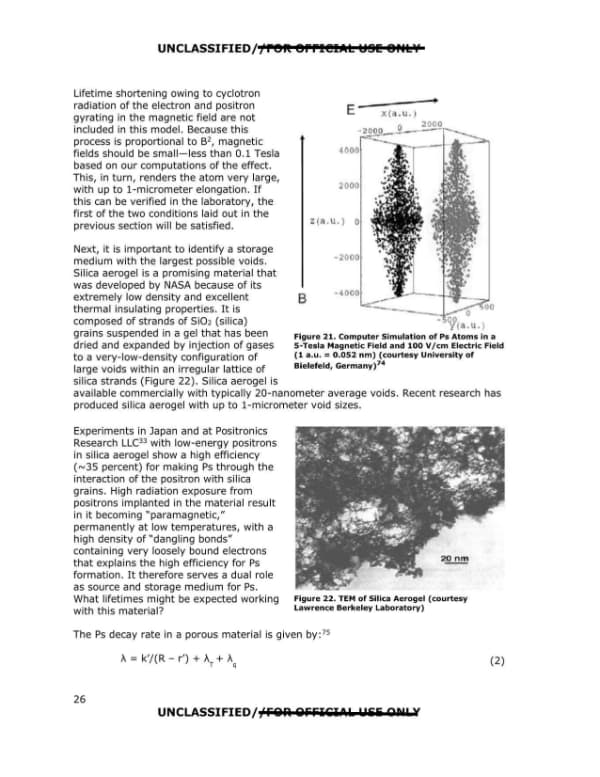
Lifetime shortening owing to cyclotron radiation of the electron and positron gyrating in the magnetic field are not included in this model. Because this process is proportional to B2, magnetic fields should be small less than 0.1 Tesla based on our computations of the effect. This, in turn, renders the atom very large, with up to 1-micrometer elongation. If this can be verified in the laboratory, the first of the two conditions laid out in the previous section will be satisfied. Next, it is important to identify a storage medium with the largest possible voids. Silica aerogel is a promising material that was developed by NASA because of its extremely low density and excellent thermal insulating properties. It is composed of strands of SiO2 (silica) grains suspended in a gel that has been dried and expanded by injection of gases to a very-low-density configuration of large voids within an irregular lattice of silica strands (Figure 22). Silica aerogel is available commercially with typically 20-nanometer average voids. Recent research has produced silica aerogel with up to 1-micrometer void sizes. Experiments in Japan and at Positronics Research LLC33 with low-energy positrons in silica aerogel show a high efficiency (~35 percent) for making Ps through the interaction of the positron with silica grains. High radiation exposure from positrons implanted in the material result in it becoming "paramagnetic," permanently at low temperatures, with a high density of "dangling bonds" containing very loosely bound electrons that explains the high efficiency for Ps formation. It therefore serves a dual role as source and storage medium for Ps. What lifetimes might be expected working with this material? The Ps decay rate in a porous material is given by:75 λ = k'/(R - r') + λT + λq (2) Figure 21. Computer Simulation of Ps Atoms in a 5-Tesla Magnetic Field and 100 V/cm Electric Field (1 a.u. = 0.052 nm) (courtesy University of Bielefeld, Germany)74 Figure 22. TEM of Silica Aerogel (courtesy Lawrence Berkeley Laboratory) UNCLASSIFIED/FOR OFFICIAL USE ONLY 26 UNCLASSIFIED/FOR OFFICIAL USE ONLY
Page 32

Page 32 of 35

A page from a positron aerospace propulsion report describing lifetime calculations for positronium in silica aerogel and future experiments at Positronics Research LLC, followed by a Conclusions section on positron-powered turbojet, missile, and rocket concepts. The page carries UNCLASSIFIED / FOR OFFICIAL USE ONLY markings and page number 27.

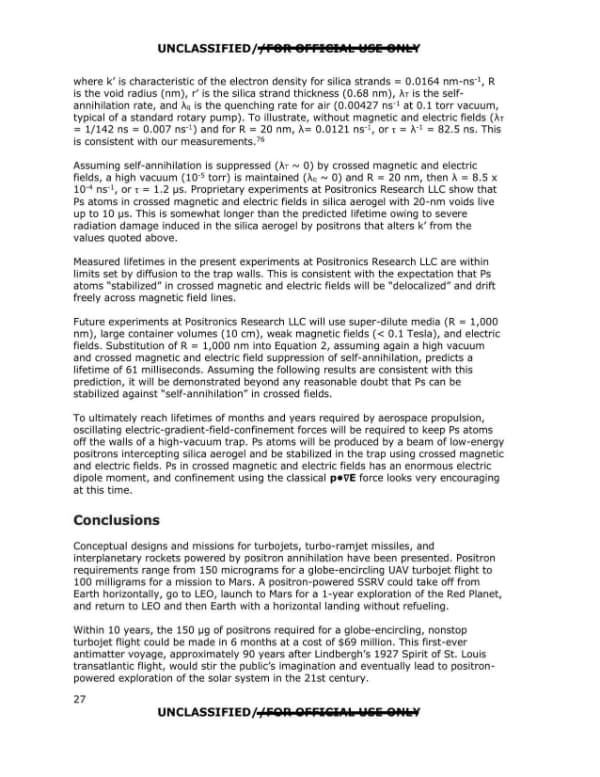
UNCLASSIFIED/;'FOR OFFl@IAL YSE OHLY where k' is characteristic of the electron density for silica strands= 0.0164 nm-ns-1, R is the void radius (nm), r' is the silica strand thickness (0.68 nm), AT is the selfannihilation rate, and Aq is the quenching rate for air (0.00427 ns-1 at 0.1 torr vacuum, typical of a standard rotary pump). To illustrate, without magnetic and electric fields (AT = 1/142 ns = 0.007 ns-1) and for R = 20 nm, A= 0.0121 ns-1, or -r = A-1 = 82.5 ns. This is consistent with our measurements.76 Assuming self-annihilation is suppressed (AT~ 0) by crossed magnetic and electric fields, a high vacuum c10-s torr) is maintained (Aq ~ 0) and R = 20 nm, then A = 8.5 x 10⁻⁴ ns-1, or t = 1.2 µs. Proprietary experiments at Positronics Research LLC show that Ps atoms in crossed magnetic and electric fields in silica aerogel with 20-nm voids live up to 10 µs. This is somewhat longer than the predicted lifetime owing to severe radiation damage induced in the silica aerogel by positrons that alters k' from the values quoted above. Measured lifetimes in the present experiments at Positronics Research LLC are within limits set by diffusion to the trap walls. This is consistent with the expectation that Ps atoms "stabilized" in crossed magnetic and electric fields will be "delocalized" and drift freely across magnetic field lines. Future experiments at Positronics Research LLC will use super-dilute media (R = 1,000 nm), large container volumes (10 cm), weak magnetic fields (< 0.1 Tesla), and electric fields. Substitution of R = 1,000 nm into Equation 2, assuming again a high vacuum and crossed magnetic and electric field suppression of self-annihilation, predicts a lifetime of 61 milliseconds. Assuming the following results are consistent with this prediction, it will be demonstrated beyond any reasonable doubt that Ps can be stabilized against "self-annihilation" in crossed fields. To ultimately reach lifetimes of months and years required by aerospace propulsion, oscillating electric-gradient-field-confinement forces will be required to keep Ps atoms off the walls of a high-vacuum trap. Ps atoms will be produced by a beam of low-energy positrons intercepting silica aerogel and be stabilized in the trap using crossed magnetic and electric fields. Ps in crossed magnetic and electric fields has an enormous electric dipole moment, and confinement using the classical p•VE force looks very encouraging at this time. Conclusions Conceptual designs and missions for turbojets, turbo-ramjet missiles, and interplanetary rockets powered by positron annihilation have been presented. Positron requirements range from 150 micrograms for a globe-encircling UAV turbojet flight to 100 milligrams for a mission to Mars. A positron-powered SSRV could take off from Earth horizontally, go to LEO, launch to Mars for a 1-year exploration of the Red Planet, and return to LEO and then Earth with a horizontal landing without refueling. Within 10 years, the 150 µg of positrons required for a globe-encircling, nonstop turbojet flight could be made in 6 months at a cost of $69 million. This first-ever antimatter voyage, approximately 90 years after Lindbergh's PII removed. Louis transatlantic flight, would stir the public's imagination and eventually lead to positronpowered exploration of the solar system in the 21st century. UNCLASSIFIED/fFOA OFFICiIAk Wlilii 0PU.Y 27
Page 33

Page 33 of 35

This page is a printed page numbered 28 from a report on positronium atom storage and positron-based propulsion, containing a short introductory paragraph followed by a numbered list of 32 references. The page carries UNCLASSIFIED//FOR OFFICIAL USE ONLY markings at the top and bottom.

UNCLASSIFIED/ /FOR OFFICIAL USE ONLY New developments in stabilizing and storing positronium atoms in a matrix of dilute materials are encouraging. Lifetimes of 10 µs have been achieved, and tens-of-millisecond lifetimes are expected in the next round of experiments. Present limits are due to interactions on the walls of the trap container. Application of oscillating gradient electric fields to the huge electric dipole moment of the stable Ps atom should mitigate this problem. With the issue of stabilization in crossed fields now settled, very long lifetimes are but a matter of engineering! 1 P. A. M. Dirac, Proc. Roy. Soc. A .126, 360 (1930). 2 C. D. Anderson, Phys. Rev. 43, 491 (1933). 3 O. Chamberlain, E. Segre, C. Wiegand and T. Ypsilantis, Phys. Rev. 100, 947 (1955). 4 G. Luders, Ann. Phys. 2, 1-15 (1957). 5 P. Hill and C. Peterson, Mechanics of Thermodynamics of Propulsion, 2nd ed., Addison - Wesley Publishing Co. (1992). 6 G. Herken, "The Flying Crowbar", Air and Space Magazine, Vol. 5 (#1), p. 28, April/May (1990) (http://www.merkle.com/pluto/pluto.html). 7 R. W. Bussard and R. D. DeLauer, Fundamentals of Nuclear Flight, McGraw-Hill Book Co. (1965) 8 G. A. Smith et al., "Revolutionary Positron Conversion", Final Technical Report, AFRL Contract F08630-00-C-0010, Eglin AFB, FL, March (2002). 9 O. Chamberlain, E. Segre, C. Wiegand and T. Ypsilantis, Phys. Rev. 100, 947 (1955) 10 G. Luders, Ann. Phys. 2, 1-15 (1957). 11 G. A. Smith et al., "Revolutionary Positron Conversion", Final Technical Report, AFRL Contract F08630-00-C-0010, Eglin AFB, FL, March (2002). 12 Ibid. 13 Ibid. 14 Ibid. 15 Ibid. 16 Ibid. 17 Ibid. 18 Ibid. 19 Northrop-Grumman Corp: Report to Kaiser-Marquardt for HTHL blended-body SSTO engine, "Vision Vehicle Final Report," April 30 (1998). 20 G. A. Smith et al., "A Revolutionary Positron Based SSRV Vehicle for Application to Human Exploration and Development of Space", The Advanced Space Propulsion Workshop, NASA Marshall Space Flight Center, Huntsville, AL, April 2-6 (2001). 21 Northrop-Grumman Corp: Report to Kaiser-Marquardt for HTHL blended-body SSTO engine, "Vision Vehicle Final Report, " April 30 (1998). 22 G. A. Smith et al., "A Revolutionary Positron Based SSRV Vehicle for Application to Human Exploration and Development of Space", The Advanced Space Propulsion Workshop, NASA Marshall Space Flight Center, Huntsville, AL, April 2-6 (2001). 23 Ibid. 24 Ibid. 25 Ibid. 26 Ibid. 27 G. A. Smith, "Positron Propelled and Powered Space Transport Vehicle for Planetary Missions", NIAC Phase I Final Report, Research Subaward No. 07605-003-048, September 1, 2005 - March 31, 2006. 28 Ibid. 29 D. R. Koenig, "Experience Gained from the Space Nuclear Rocket Program (Rover)," LA-10062-H, Los Alamos National Laboratory, Los Alamos, NM., May (1986). 30 G. A. Smith, "Positron Propelled and Powered Space Transport Vehicle for Planetary Missions", NIAC Phase I Final Report, Research Subaward No. 07605-003-048, September 1, 2005 - March 31, 2006. 31 L. E. Thode et al., J. Propulsion and Power 14, 4 (1998). 32 D. I. Poston and T. Kammash, Nuclear Science and Engineering 122, 32 (1996). UNCLASSIFIED//FOR OFFICIAL USE ONLY 28 UNCLASSIFIED//FOR OFFICIAL USE ONLY
Page 34

Page 34 of 35

This page is a continuation of a reference list of numbered citations (33 through 66) for a propulsion study, consisting of technical reports, theses, conference papers and web sources. It is printed as page 29 with UNCLASSIFIED // FOR OFFICIAL USE ONLY markings at top and bottom.

UNCLASSIFIED// FOR OFFICIAL USE ONLY 33 S. K. Borowski et al., "Nuclear Thermal Rocket/Vehicle Design Options for Future NASA Missions to the Moon and Mars," AIAA-93-4170 (NASA Tech Memorandum 107071), (1993). 34 D. I. Poston and T. Kammash, Nuclear Science and Engineering 122, 32 (1996). 35 S. K. Borowski et al., "Nuclear Thermal Rocket/Vehicle Design Options for Future NASA Missions to the Moon and Mars," AIAA-93-4170 (NASA Tech Memorandum 107071), (1993). 36 G. A. Smith, "Positron Propelled and Powered Space Transport Vehicle for Planetary Missions", NIAC Phase I Final Report, Research Subaward No. 07605-003-048, September 1, 2005 - March 31, 2006. 37 E. Sanger, Ing. Arch. 21, 213 (1953). 38 G. A. Smith, "Positron Propelled and Powered Space Transport Vehicle for Planetary Missions", NIAC Phase I Final Report, Research Subaward No. 07605-003-048, September 1, 2005 - March 31, 2006. 39 Ibid. 40 G. Gaidos et al., "Antiproton-Catalyzed Microfission/fusion Propulsion Systems for Exploration of the Outer Solar System and Beyond," AIAA-98-3589, Presented at the 34th AIAA/ASME/SAE/ASEE Joint Propulsion Conference & Exhibit (1998). 41 W. Lance Werthman, "Antiproton-Catalyzed Microfission/fusion Space Propulsion," MS Thesis, Dept. of Aerospace Engineering, Penn State University (1995). 42 G. A. Smith, "High Density Storage of Antimatter", Advanced High Energy Storage Conference, MITRE Corp., McLean, VA, Aug. 1 (2005). 43 S. J. Hoffman and D. I. Kaplan, eds. "Human Exploration of Mars: The Reference Mission of the NASA Mars Exploration Study Team," NASA Special Publication 6107, JSC (1997). 44 B. G. Drake, ed. "Reference Mission Version 3.0: Addendum to the Human Exploration of Mars: The Reference Mission of the NASA Mars Exploration Study Team," http://ares.jsc.nasa.gov/HumanExplore/Exploration/EXLibrary/docs/MarsRef/addendum/index.htm, June (1998). 45 G. A. Smith, "High Density Storage of Antimatter", Advanced High Energy Storage Conference, MITRE Corp., McLean, VA, Aug. 1 (2005). 46 J. Dion, "Stirling Radioisotope Generator", NASA Glenn Research Center, ME 388R.2, Spring (2005). 47 Ibid. 48 G. A. Smith, "High Density Storage of Antimatter", Advanced High Energy Storage Conference, MITRE Corp., McLean, VA, Aug. 1 (2005). 49 S. J. Hoffman and D. I. Kaplan, eds. "Human Exploration of Mars: The Reference Mission of the NASA Mars Exploration Study Team," NASA Special Publication 6107, JSC (1997). 50 B. G. Drake, ed. "Reference Mission Version 3.0: Addendum to the Human Exploration of Mars: The Reference Mission of the NASA Mars Exploration Study Team," http://ares.jsc.nasa.gov/HumanExplore/Exploration/EXLibrary/docs/MarsRef/addendum/index.htm, June (1998). 51 S. K. Borowski et al., "Nuclear Thermal Rocket/Vehicle Design Options for Future NASA Missions to the Moon and Mars," AIAA-93-4170 (NASA Tech Memorandum 107071), (1993). 52 G. A. Smith, "Positron Propelled and Powered Space Transport Vehicle for Planetary Missions", NIAC Phase I Final Report, Research Subaward No. 07605-003-048, September 1, 2005 - March 31, 2006. 53 S. J. Hoffman and D. I. Kaplan, eds. "Human Exploration of Mars: The Reference Mission of the NASA Mars Exploration Study Team," NASA Special Publication 6107, JSC (1997). 54 B. G. Drake, ed. "Reference Mission Version 3.0: Addendum to the Human Exploration of Mars: The Reference Mission of the NASA Mars Exploration Study Team," http://ares.jsc.nasa.gov/HumanExplore/Exploration/EXLibrary/docs/MarsRef/addendum/index.htm, June (1998). 55 G. A. Smith, "Positron Propelled and Powered Space Transport Vehicle for Planetary Missions", NIAC Phase I Final Report, Research Subaward No. 07605-003-048, September 1, 2005 - March 31, 2006. 56 C.A. Kapatanakos, J. Synchrotron Rad. 3, 268-271 (1996). 57 ILC undulator-based source, www.ippp.dur.ac.uk/~gudrid/source/BCD-source. ILC capitalization is estimated at $9B (see www.linearcollider.org). 58 Ibid. 59 Ibid. 60 R. Landua, CERN, "Precision Experiments with Antiprotons", Feb. 24 (2003). 61 S. Howe et al., AIP Conf. Proc. 746, 520 (2005). 62 14 MeV Electron Linac @ $5M capitalization cost and $5M/yr operating cost (A. Herer et al., "Applications of High Voltage High Powered Electron Beams", IBA, Belgium, 1997). 63 G. R. Schmidt et al., J. Propulsion and Power, 16, 923 (2000). 64 J. Rejcek et al., Rad. Phys. Chem. 68, 655 (2003). 65 G. A. Smith, "High Density Storage of Antimatter", Advanced High Energy Storage Conference, MITRE Corp., McLean, VA, Aug. 1 (2005). 66 C. M. Surko and R. G. Greaves, Phys. Plasmas 11, 2333 (2004). 29 UNCLASSIFIED// FOR OFFICIAL USE ONLY
Page 35

Page 35 of 35

This page is the endnotes section (notes 67 to 76) of a report on positron propulsion, listing citations to technical reports, a conference presentation, a NASA publication, a dissertation and a journal article. It is marked UNCLASSIFIED//FOR OFFICIAL USE ONLY and numbered page 30.

UNCLASSIFIED// FOR OFFICIAL USE ONLY 67 G. A. Smith, "Long-Term Confinement of Dense Positron Plasmas", Final Technical Report, AFRL Contract F08630-02-C-0017, Eglin AFB, FL, January 23 (2007). 68 Ibid. 69 G. A. Smith, "Positron Energy Conversion (PEC)", 53th JANNAF Propulsion Meeting, Subcommittee on Future Technologies for Spacecraft Propulsion (2005 0356 EA), CPIAC JSC CD43 December (2005). 70 G. A. Smith, "Stabilization and Long Term Confinement of Atomic Positronium", Final Technical Report, AFRL Contract F08630-02-C-0018, Eglin AFB, FL, January 23 (2007). 71 S. J. Hoffman and D. I. Kaplan, eds. "Human Exploration of Mars: The Reference Mission of the NASA Mars Exploration Study Team," NASA Special Publication 6107, JSC (1997). 72 G. A. Smith, "Stabilization and Long Term Confinement of Atomic Positronium", Final Technical Report, AFRL Contract F08630-02-C-0018, Eglin AFB, FL, January 23 (2007). 73 J. Lu, "Classical Trajectory Monte Carlo Simulation of Ion-Rydberg Atom Collisions", Ph. D. Dissertation, University of Bielefeld, Germany, May (2003). 74 Ibid. 75 K. Sudarshan et al., J. Phys: Condens. Matter 19, 386 (2007). 76 G. A. Smith, "Stabilization and Long Term Confinement of Atomic Positronium", Final Technical Report, AFRL Contract F08630-02-C-0018, Eglin AFB, FL, January 23 (2007). UNCLASSIFIED/ FOR OFFICIAL USE ONLY 30 UNCLASSIFIED/ FOR OFFICIAL USE ONLY