$DECLASSwnMfUvY5KfUN2LbKgyHXwmh39mGpJd7bjJw5A71pumpBuy
Declassified
Releases / Release 06 / DOW-UAP-D123
Department of War

AAWSAP DIRD, Positron Aerospace Propulsion, March 2010

This is a 2010 Defense Intelligence Reference Document on using positrons (antimatter) as a fuel for aerospace propulsion. It reviews concepts for UAVs, missiles, a single-stage launch vehicle and crewed Mars missions, and discusses positron production and storage. It concludes the concept is attractive in theory but depends on unsolved production and storage problems.

Record
DOW-UAP-D123
Release
Release 06 · Sep 18, 2026
Incident
2010-03-02 · Las Vegas, Nevada
Pages
35
Verdict
New
Source
war.gov ↗
Context · why this verdict

The overlap shows only matching cover and front-matter wording shared with other AAWSAP DIRDs in the same release (D121, D122); the technical body is not matched to any earlier release.

Findings in this document

4 findings

New SIG

Mars mission concept with positron engines and storage lifetime claims

  • Verbatim
    Missions must be established that can transport astronauts to Mars in less than 180 days.
    DOW-UAP-D123 · Release 06 · page 24 · war.gov ↗
  • Verbatim
    Proprietary experiments at Positronics Research LLC show that Ps atoms in crossed magnetic and electric fields in silica aerogel with 20-nm voids live up to 10 µs.
    DOW-UAP-D123 · Release 06 · page 32 · war.gov ↗

New or already public? No overlap with earlier releases.

New SIG

Report says positron-based EMP ordnance and longer BOMARC range are possible

  • Verbatim
    The BOMARC range could be increased to 2,000 km with 1 milligram (mg) of positrons.
    DOW-UAP-D123 · Release 06 · page 13 · war.gov ↗
  • Verbatim
    positrons could act as ordnance to destroy electronics on missiles or aircraft by electromagnetic pulse (EMP) by detonation of micrograms of positrons up to hundreds of meters from the target.18
    DOW-UAP-D123 · Release 06 · page 13 · war.gov ↗

New or already public? Not matched in the overlap.

New SIG

Single-stage vehicle concept: positron mass budget of 86.9 mg and 43% lower lift-off weight

  • Verbatim
    The positron mass budget for a 60,500-kg dry mass for ascension to LEO is 86.9 mg (Table 3).
    DOW-UAP-D123 · Release 06 · page 15 · war.gov ↗
  • Verbatim
    The GLOW of the positron SSRV is 43 percent less than that of the chemical SSRV owing to reduced propellant mass.
    DOW-UAP-D123 · Release 06 · page 14 · war.gov ↗
  • Context

    The vehicle is described as taking off horizontally from Edwards Air Force Base.

New or already public? Content is not in any matched earlier page.

New SIG

Report claims 150 µg of positrons could power a UAV around the Earth

  • Verbatim
    Figure 6 shows range versus positron mass for a 60-kg UAV with lift/drag of four that can circumnavigate Earth on 150 µg of positrons.
    DOW-UAP-D123 · Release 06 · page 10 · war.gov ↗
  • Verbatim
    Within 10 years, the 150 µg of positrons required for a globe-encircling, nonstop turbojet flight could be made in 6 months at a cost of $69 million.
    DOW-UAP-D123 · Release 06 · page 32 · war.gov ↗
  • Context

    The catalogue description says the DIRD is a reference and synthesis product and that the concept remains highly speculative.

  • Inference · AI interpretation

    The cost figure appears as $96 million on page 29 per the page summary and $69 million on page 32, so the document's own numbers differ.

New or already public? No earlier release matches these pages in the overlap data.

Page by page

The pages and what the AI read on them

The transcription is the page reader's: black bars mark what the government redacted; hatched tags mark personal data we removed.

Page 13

Page 13 of 35

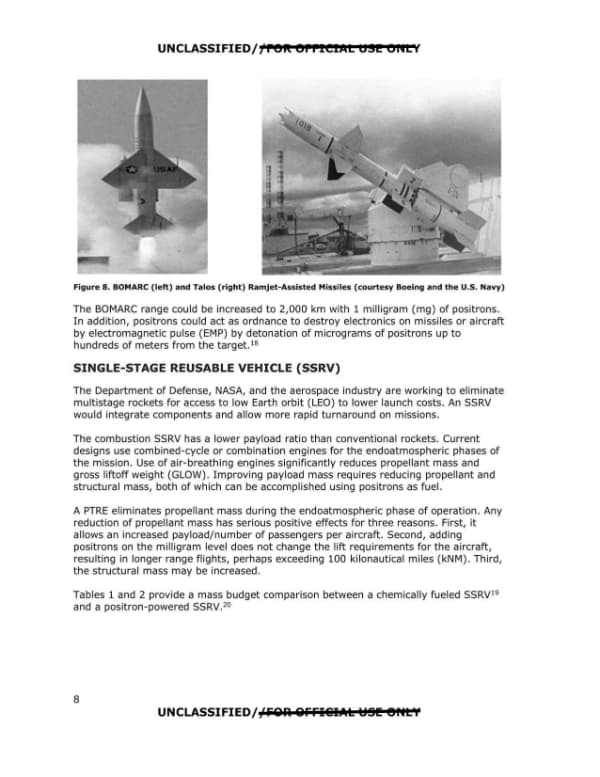
Page 8 of the report presents two photographs of BOMARC and Talos ramjet-assisted missiles and text on positron applications for missile range, electromagnetic pulse effects, and single-stage reusable vehicle (SSRV) propulsion. It states that positrons could extend BOMARC range to 2,000 km and that a PTRE eliminates propellant mass during the endoatmospheric phase.

UNCLASSIFIED//FOR OFFICIAL USE ONLY Figure 8. BOMARC (left) and Talos (right) Ramjet-Assisted Missiles (courtesy Boeing and the U.S. Navy) The BOMARC range could be increased to 2,000 km with 1 milligram (mg) of positrons. In addition, positrons could act as ordnance to destroy electronics on missiles or aircraft by electromagnetic pulse (EMP) by detonation of micrograms of positrons up to hundreds of meters from the target.18 SINGLE-STAGE REUSABLE VEHICLE (SSRV) The Department of Defense, NASA, and the aerospace industry are working to eliminate multistage rockets for access to low Earth orbit (LEO) to lower launch costs. An SSRV would integrate components and allow more rapid turnaround on missions. The combustion SSRV has a lower payload ratio than conventional rockets. Current designs use combined-cycle or combination engines for the endoatmospheric phases of the mission. Use of air-breathing engines significantly reduces propellant mass and gross liftoff weight (GLOW). Improving payload mass requires reducing propellant and structural mass, both of which can be accomplished using positrons as fuel. A PTRE eliminates propellant mass during the endoatmospheric phase of operation. Any reduction of propellant mass has serious positive effects for three reasons. First, it allows an increased payload/number of passengers per aircraft. Second, adding positrons on the milligram level does not change the lift requirements for the aircraft, resulting in longer range flights, perhaps exceeding 100 kilonautical miles (kNM). Third, the structural mass may be increased. Tables 1 and 2 provide a mass budget comparison between a chemically fueled SSRV19 and a positron-powered SSRV.20 UNCLASSIFIED//FOR OFFICIAL USE ONLY 8
Page 14

Page 14 of 35

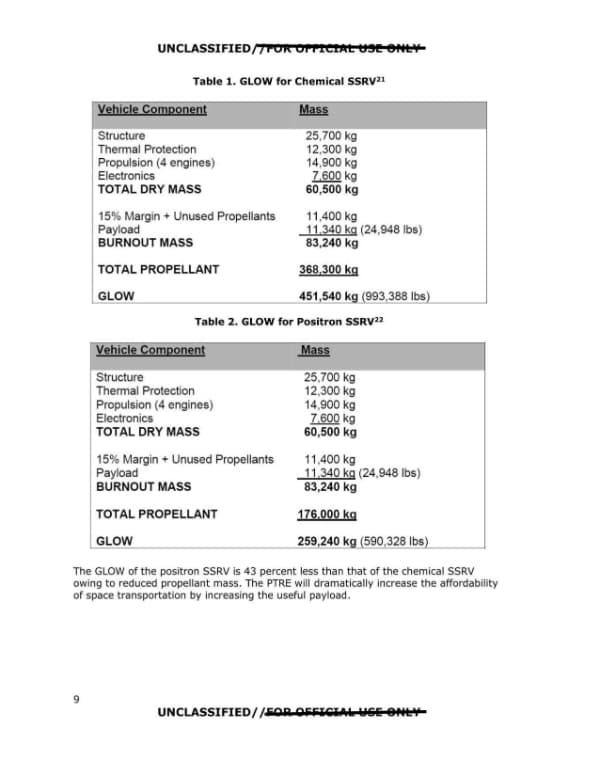
A page of mass tables comparing gross lift-off weight (GLOW) for a chemical SSRV21 and a positron SSRV22 vehicle, followed by a short paragraph stating the positron vehicle's GLOW is 43 percent less owing to reduced propellant mass.

UNCLASSIFIED/} FOR OFFICIICL tl.!l!!! 8HLY Table 1. GLOW for Chemical SSRV21 Vehicle Component | Mass Structure | 25,700 kg Thermal Protection | 12,300 kg Propulsion (4 engines) | 14,900 kg Electronics | 7,600 kg TOTAL DRY MASS | 60,500 kg 15% Margin + Unused Propellants | 11,400 kg Payload | 11.340 kg (24,948 lbs) BURNOUT MASS | 83,240 kg TOTAL PROPELLANT | 368,300 kg GLOW | 451,540 kg (993,388 lbs) Table 2. GLOW for Positron SSRV22 Vehicle Component | Mass Structure | 25,700 kg Thermal Protection | 12,300 kg Propulsion (4 engines) | 14,900 kg Electronics | 7,600 kg TOTAL DRY MASS | 60,500 kg 15% Margin + Unused Propellants | 11,400 kg Payload | 11,340 kg (24,948 lbs) BURNOUT MASS | 83,240 kg TOTAL PROPELLANT | 176,000 kg GLOW | 259,240 kg (590,328 lbs) The GLOW of the positron SSRV is 43 percent less than that of the chemical SSRV owing to reduced propellant mass. The PTRE will dramatically increase the affordability of space transportation by increasing the useful payload. UNCLASSIFIED//EOR OfifilEIAk W&li 8HLY 9 UNCLASSIFIED/ /FOR OFFICIAL USE ONLY
Page 15

Page 15 of 35

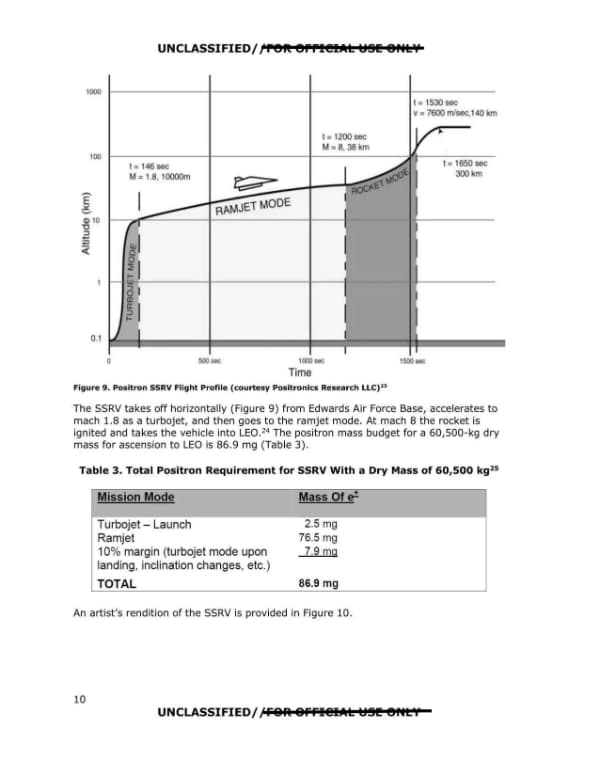
This page is a report page containing a Positron SSRV flight profile figure and a table of positron mass requirements for the vehicle's ascent to LEO. It states the SSRV takes off from Edwards Air Force Base, transitions from turbojet to ramjet to rocket modes, and gives a total positron mass budget of 86.9 mg for a 60,500-kg dry mass.

UNCLASSIFIED/ /FOR OFFICIAL USE ONLY 1000 -E 0.1 t = 1530 sec v = 7600 m/sec,140 km 1= 1200 sec l= 146 sec M = 1.8, 10000m M =8, 38 km I= 1650sec 300km 0 500 sec 1000sec 1500sec Time Figure 9. Positron SSRV Flight Profile (courtesy Positronics Research LLC) 23 The SSRV takes off horizontally (Figure 9) from Edwards Air Force Base, accelerates to mach 1.8 as a turbojet, and then goes to the ramjet mode. At mach 8 the rocket is ignited and takes the vehicle into LEO. 24 The positron mass budget for a 60,500-kg dry mass for ascension to LEO is 86.9 mg (Table 3). Table 3. Total Positron Requirement for SSRV With a Dry Mass of 60,500 kg25 Mission Mode | Mass Of e! Turbojet - Launch | 2.5 mg Ramjet | 76.5 mg 10% margin (turbojet mode upon landing, inclination changes, etc. ) | 7.9 mg TOTAL | 86.9 mg An artist's rendition of the SSRV is provided in Figure 10. 10 UNCLASSIFIED//FOR OFFICIAL USE ONLY
Page 16

Page 16 of 35

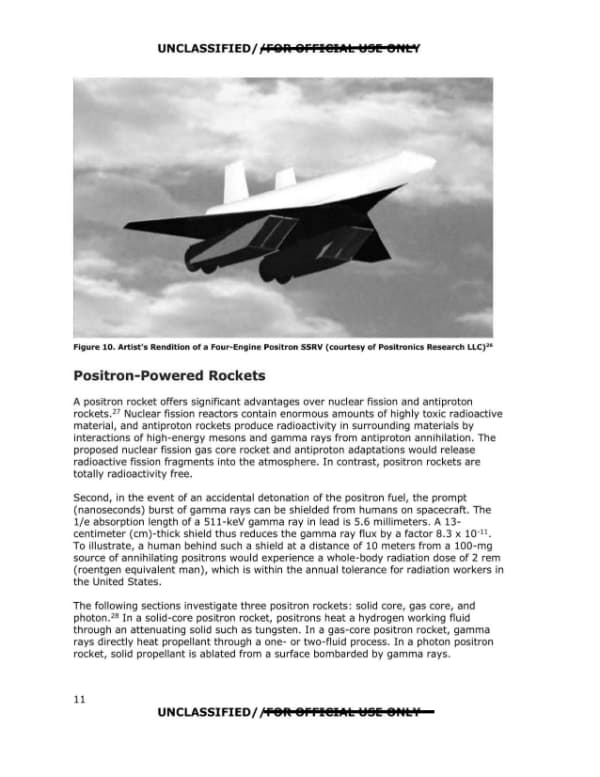
Page 11 of a 2010 AAWSAP DIRD report on positron aerospace propulsion, containing a figure of a four-engine positron SSRV and text comparing positron rockets with nuclear fission and antiproton rockets, plus a shielding calculation and an outline of three positron rocket designs.

UNCLASSIFIED/ /FOR OFFICIAL USE ONLY Figure 10. Artist's Rendition of a Four-Engine Positron SSRV (courtesy of Positronics Research LLC) 26 Positron-Powered Rockets A positron rocket offers significant advantages over nuclear fission and antiproton rockets. 27 Nuclear fission reactors contain enormous amounts of highly toxic radioactive material, and antiproton rockets produce radioactivity in surrounding materials by interactions of high-energy mesons and gamma rays from antiproton annihilation. The proposed nuclear fission gas core rocket and antiproton adaptations would release radioactive fission fragments into the atmosphere. In contrast, positron rockets are totally radioactivity free. Second, in the event of an accidental detonation of the positron fuel, the prompt (nanoseconds) burst of gamma rays can be shielded from humans on spacecraft. The 1/e absorption length of a 511-keV gamma ray in lead is 5.6 millimeters. A 13-centimeter (cm)-thick shield thus reduces the gamma ray flux by a factor 8.3 x 10⁻¹¹ . To illustrate, a human behind such a shield at a distance of 10 meters from a 100-mg source of annihilating positrons would experience a whole-body radiation dose of 2 rem (roentgen equivalent man), which is within the annual tolerance for radiation workers in the United States. The following sections investigate three positron rockets: solid core, gas core, and photon. 28 In a solid-core positron rocket, positrons heat a hydrogen working fluid through an attenuating solid such as tungsten. In a gas-core positron rocket, gamma rays directly heat propellant through a one- or two-fluid process. In a photon positron rocket, solid propellant is ablated from a surface bombarded by gamma rays. 11 UNCLASSIFIED/ /FOR OFFICIAL USE ONLY
Page 17

Page 17 of 35

Page 12 of the AAWSAP DIRD report describes a solid-core positron rocket concept, with a diagram of the engine and text on its propellant flow, thermal limits, and a predicted specific impulse of 920 seconds at 3,000 Kelvin. The page ends mid-sentence about Mars trip burn times.

UNCLASSIFIED/ /FOR OFFICIAL USE ONLY THE SOLID-CORE POSITRON ROCKET Figure 11 depicts a solid-core positron-powered rocket, similar in many regards to the NERVA nuclear-thermal concept. 29 [Figure 11 diagram labels: H2 Flow; Turbopump; H2 Tank; Attenuating HX; Positron Trap; Hot Bleed Line; Inlet Plenum; Turbine & Exhaust Nozzle] Figure 11. Solid-Core Positron Rocket Engine With a Hot-Bleed Configuration (courtesy Positronics Research LLC) 30 The cryogenic hydrogen propellant is supplied from a storage tank through a high-pressure pump and routed to cool the regenerative nozzle, the casing of the heat exchanger, and the central positron target tubes. Ps enters the inlet plenum to the attenuator that is heated by gamma rays to high temperature. Hydrogen propellant passes through the attenuating matrix and is heated and exhausted through a nozzle to generate thrust. A small fraction of the hot exit propellant is bled off to a turbine that drives the high-pressure feed pump. The high-temperature bleed can either be mixed with cold hydrogen to reduce its temperature or directly fed to the turbine. If it is directly fed to the turbine, it must be made of materials that can withstand high temperatures. The bleed flow is exhausted from a turbine exit nozzle to space after driving the turbine. As with the NERVA system, the positron solid-core concept is thermally limited by materials in the heating chamber. The difference is that the fission system requires a reactor and complex machinery, whereas the positron system relies on Ps atoms injected upstream from a storage unit. This has two advantages. First, a reduction in the engine mass for a given thrust is realized; second, there is greater choice in materials to be used in the heating chamber. A thermal-fluids analysis was conducted to predict performance. A specific impulse of 920 seconds is attainable with chamber temperatures at 3,000 Kelvin. The corresponding thrust and power emulate fission systems. Mars trip burn times are on 12 UNCLASSIFIED/ /FOR OFFICIAL USE ONLY
Page 18

Page 18 of 35

A page from a 2010 DIRD report comparing solid-core fission-based and positron-powered space propulsion systems, including a Table 4 comparing technology, performance, operation, materials, payload integration and post-operation characteristics. The page header and footer carry UNCLASSIFIED markings with a strike-through of the legacy 'FOR OFFICIAL USE ONLY' caveat.

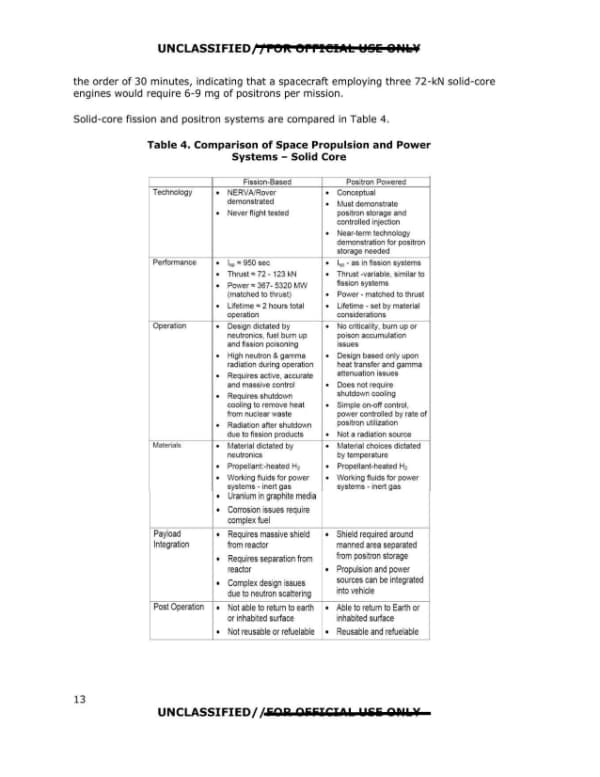
the order of 30 minutes, indicating that a spacecraft employing three 72-kN solid-core engines would require 6-9 mg of positrons per mission. Solid-core fission and positron systems are compared in Table 4. Table 4. Comparison of Space Propulsion and Power Systems – Solid Core | Fission-Based | Positron Powered Technology | • NERVA/Rover demonstrated • Never flight tested | • Conceptual • Must demonstrate positron storage and controlled injection • Near-term technology demonstration for positron storage needed Performance | • Isp ≈ 950 sec • Thrust ≈ 72 - 123 kN • Power ≈ 367- 5320 MW (matched to thrust) • Lifetime ≈ 2 hours total operation | • Isp - as in fission systems • Thrust -variable, similar to fission systems • Power - matched to thrust • Lifetime - set by material considerations Operation | • Design dictated by neutronics, fuel burn up and fission poisoning • High neutron & gamma radiation during operation • Requires active, accurate and massive control • Requires shutdown cooling to remove heat from nuclear waste • Radiation after shutdown due to fission products | • No criticality, burn up or poison accumulation issues • Design based only upon heat transfer and gamma attenuation issues • Does not require shutdown cooling • Simple on-off control, power controlled by rate of positron utilization • Not a radiation source Materials | • Material dictated by neutronics • Propellant-heated H2 • Working fluids for power systems - inert gas • Uranium in graphite media • Corrosion issues require complex fuel | • Material choices dictated by temperature • Propellant-heated H2 • Working fluids for power systems - inert gas Payload Integration | • Requires massive shield from reactor • Requires separation from reactor • Complex design issues due to neutron scattering | • Shield required around manned area separated from positron storage • Propulsion and power sources can be integrated into vehicle Post Operation | • Not able to return to earth or inhabited surface • Not reusable or refuelable | • Able to return to Earth or inhabited surface • Reusable and refuelable 13
Page 19

Page 19 of 35

A page from a report titled 'The Gas-Core Positron Rocket' describing a gas-core propulsion concept, including its heating mechanism, computational fluid dynamics results, and predicted thrust, burn time and specific impulse. The page is marked UNCLASSIFIED/FOR OFFICIAL USE ONLY and numbered 14.

UNCLASSIFIED/ /FOR OFFICIAL USE ONLY THE GAS-CORE POSITRON ROCKET The gas-core positron concept follows nuclear gas-core concepts, 31, 32, 33 which are different from the solid-core concept in that gamma rays directly heat a fluid under pressure. The limit of the solid-core approach is melting temperatures of the solid matrix gamma ray attenuator. By direct heating, temperatures can increase significantly as long as the gas does not appreciably heat the walls. Four versions of the gas-core concept are illustrated in Figure 12. Synchronous with pulsed Ps injection are (a-c) pulses of LN2 or LNe or LH 2 with LXe gamma ray attenuator and (d) pulses of LH2 where Ps is encapsulated in lead, a gamma ray converter. For fluid injection, a turbo-pump (not shown) is located upstream, with power obtained from a positron Brayton cycle system described later in this paper. Results from computational fluid dynamics codes reveal that high-density regions of the fluid move away from the gamma ray source when the power in the system exceeds 300 megawatts. Under these conditions, the propellant does not efficiently absorb gamma rays. Furthermore, calculations of heat required for continuous operation suggest the vortex configuration of (b) breaks down and reverts to two-fluid flow. However, both the two-fluid, flow-through model and the Ps lead-cartridge concepts show promise if the mass flow rate of the hydrogen propellant exceeds that of the xenon or lead by a factor of five. By operating in a pulsed mode, one should be able to control the positron delivery into the chamber core. With complete absorption of gamma rays in the 2-cm lead casing, performance of the system matches that of previously examined systems. 34, 35 Thrusts of 130 kN (1,000 atmospheres) are predicted for a single-engine system with an efficiency of 85 percent. Burn times are 30 minutes for dV = 3. 7 km/second (sec) with 25 mg of positrons consumed for a 50,000-kg burnout mass. The limit of the gascore concept occurs near the thresholds for ionization of hydrogen, corresponding to I sp of ~ 2,500 sec. 14 UNCLASSIFIED/ /FOR OFFICIAL USE ONLY
Page 20

Page 20 of 35

This page presents Figure 12, a set of four schematic diagrams of positron-based fluid propulsion systems, with a caption describing each configuration. The diagrams show one-fluid and two-fluid arrangements involving LN2, Ne, H2 and LXe propellants, with a positron trap, heating chamber and nozzle.

UNCLASSIFIED//FOR OFFICIAL USE ONLY Positron Trap (a) (b) H2 LXe Positron Trap (c) H2 Positron Trap Pb ENCASED e+ (d) Figure 12. Fluid Systems. (a) One-fluid system of LN2 or Ne propellant; (b) Two-fluid system of LH 2 and LXe ; (c) Two-fluid flow-through system with LH2 at higher mass flow rates than LXe; and (d) One-fluid LH 2 system with lead encapsulated Ps (courtesy Positronics Research LLC) 36 UNCLASSIFIED//FAR OFFICIO~ 11&5 QNla:¥ 15 UNCLASSIFIED//FOR OFFICIAL USE ONLY
Page 21

Page 21 of 35

Page 16 of a document on propulsion concepts, describing the Sänger photon positron rocket, its proposed mechanism, and a schematic figure (Figure 13). The text states the predicted Isp results in fast transit times to Mars and describes a Brayton-cycle positron energy conversion system.

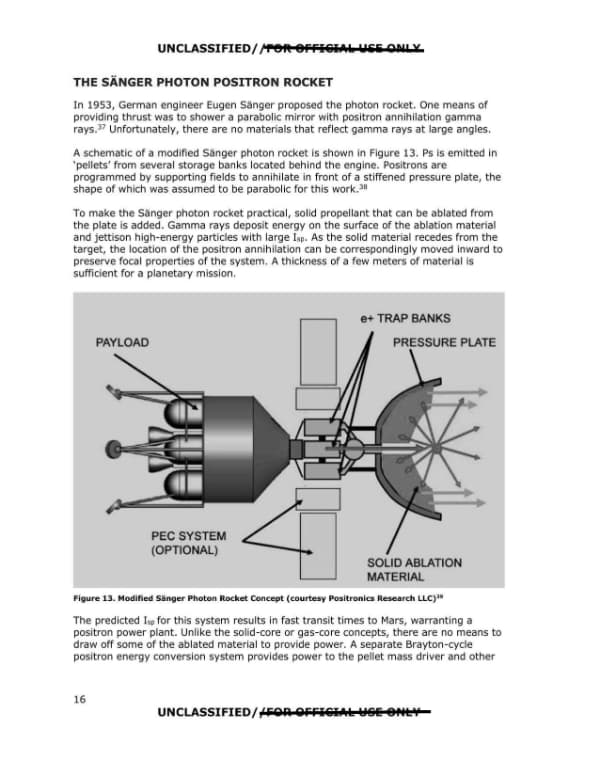
UNCLASSIFIED/ /FOR OFFICIAL USE ONLY THE SÄNGER PHOTON POSITRON ROCKET In 1953, German engineer Eugen Sänger proposed the photon rocket. One means of providing thrust was to shower a parabolic mirror with positron annihilation gamma rays.37 Unfortunately, there are no materials that reflect gamma rays at large angles. A schematic of a modified Sänger photon rocket is shown in Figure 13. Ps is emitted in 'pellets' from several storage banks located behind the engine. Positrons are programmed by supporting fields to annihilate in front of a stiffened pressure plate, the shape of which was assumed to be parabolic for this work.38 To make the Sänger photon rocket practical, solid propellant that can be ablated from the plate is added. Gamma rays deposit energy on the surface of the ablation material and jettison high-energy particles with large Isp. As the solid material recedes from the target, the location of the positron annihilation can be correspondingly moved inward to preserve focal properties of the system. A thickness of a few meters of material is sufficient for a planetary mission. Figure 13. Modified Sänger Photon Rocket Concept (courtesy Positronics Research LLC)39 The predicted Isp for this system results in fast transit times to Mars, warranting a positron power plant. Unlike the solid-core or gas-core concepts, there are no means to draw off some of the ablated material to provide power. A separate Brayton-cycle positron energy conversion system provides power to the pellet mass driver and other 16 UNCLASSIFIED/ /FOR OFFICIAL USE ONLY
Page 22

Page 22 of 35

A page from a positron aerospace propulsion study describing wavelength-shifted annihilation gamma ray ablation, performance estimates for a pellet-driven rocket, and Table 5 comparing three positron propulsion concepts for a Mars mission.

UNCLASSIFIED//FOR OFFICIAL USE ONLY components. Alternatively, solar collectors or closed-loop nuclear reactors could be employed. To improve ablation efficiency, annihilation gamma rays must be wavelength shifted (WLS) by passing them through a high-Z WLS material. The material of choice, lead, also serves as the shell of the Ps pellet. The pellet vaporizes into high-energy plasma, and the WLS photons propagate to the pressure plate. Silicon carbide ablation material has been adopted from the antiproton catalyzed microfission/fusion concept40, 41 developed at Penn State University by the author and coworkers. Photon energy distributions are shifted through 2 cm of lead to 1-10 keV from 511 keV with 85 percent efficiency. Performance depends primarily on the energy of the WLS photons and the energy per pellet. At 8 keV, Isp is in the range 1,200-3,000 sec. Thrust is 40-145 kN, the latter at a pellet injection rate of 1 hertz. The total quantity of positrons consumed for a one-way trip to Mars over this range of Isp is 15-40 mg with 50 percent of gamma rays striking the plate and a 85 percent WLS efficiency. POSITRON ROCKET SYSTEM COMPARISON A side-by-side comparison of three positron rocket propulsion concepts is presented in Table 5 for a one-way transit to Mars using ΔV = 3.7 km/sec. Table 5. Comparison of Three Positron Propulsion Concepts for Mars Mission Solid-Core | Gas-Core | Sanger Ablation Isp 650 - 920 sec | 1000 - 2500 sec | 1200 - 3000 sec Thrust 72 kN, small class | 130 kN (1000 atm) | 40 -145 kN (1 Hz) Limits • Wall and nozzle temperature | • Wall and nozzle temperature • H Ionization | • Positron density per pellet e+ mass • 6-9 mg (100% efficiency) | • < 25 mg (85% efficiency) | • 15 - 40 mg (42.5% efficiency) Special Notes • Continuous burn • Multiple engines may be possible • Hot-bleed line possible | • Pulsed burn • Multiple engines may be possible • Hot-bleed line possible • Engine can be throttled | • Pulsed burn • Multiple engines may be possible • No direct onboard power • Engine can be throttled Future work • Efficiency study | • Efficiency study • Lower pressure possible? | • Further WLS and radiation transport study UNCLASSIFIED//FOR OFFICIAL USE ONLY 17
Page 23

Page 23 of 35

A page from a 2010 positron aerospace propulsion report describing research on a closed-loop positron energy conversion system, including a 100 kW Brayton cycle engine concept and a 110-watt positron-driven generator, with two figures. The page contains no redactions.

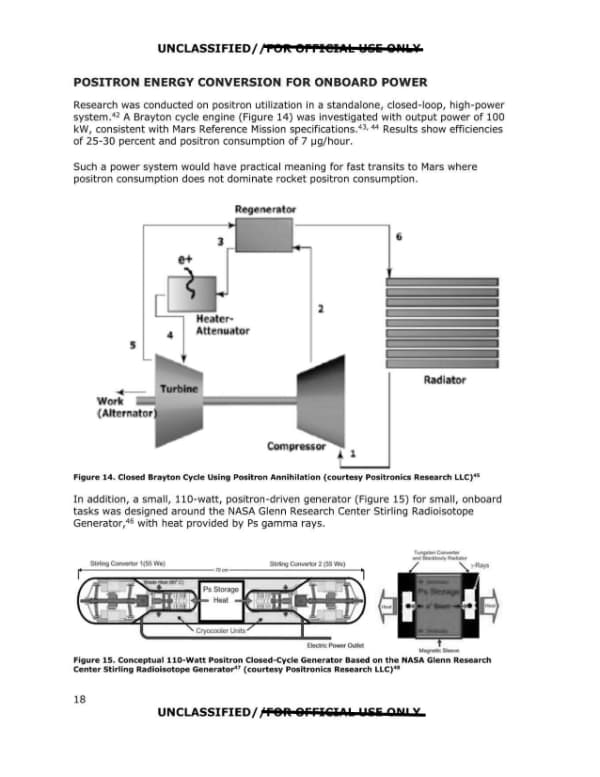
UNCLASSIFIED//FOR OFFICIAL USE ONLY POSITRON ENERGY CONVERSION FOR ONBOARD POWER Research was conducted on positron utilization in a standalone, closed-loop, high-power system. 42 A Brayton cycle engine (Figure 14) was investigated with output power of 100 kW, consistent with Mars Reference Mission specifications. 43, 44 Results show efficiencies of 25-30 percent and positron consumption of 7 µg/hour. Such a power system would have practical meaning for fast transits to Mars where positron consumption does not dominate rocket positron consumption. Figure 14. Closed Brayton Cycle Using Positron Annihilation (courtesy Positronics Research LLC)45 In addition, a small, 110-watt, positron-driven generator (Figure 15) for small, onboard tasks was designed around the NASA Glenn Research Center Stirling Radioisotope Generator,46 with heat provided by Ps gamma rays. Figure 15. Conceptual 110-Watt Positron Closed-Cycle Generator Based on the NASA Glenn Research Center Stirling Radioisotope Generator47 (courtesy Positronics Research LLC)48 18 UNCLASSIFIED//FOR OFFICIAL USE ONLY
Page 24

Page 24 of 35

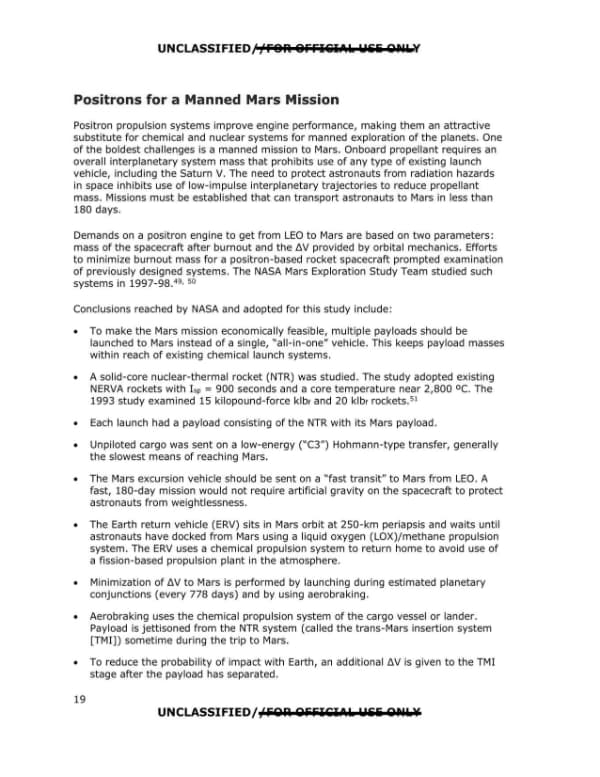
This page, numbered 19, is a section titled "Positrons for a Manned Mars Mission" that describes positron propulsion for crewed Mars travel and lists conclusions adopted from earlier NASA Mars studies. It is marked UNCLASSIFIED/FOR OFFICIAL USE ONLY and contains no redactions.

UNCLASSIFIED/FOR OFFICIAL USE ONLY Positrons for a Manned Mars Mission Positron propulsion systems improve engine performance, making them an attractive substitute for chemical and nuclear systems for manned exploration of the planets. One of the boldest challenges is a manned mission to Mars. Onboard propellant requires an overall interplanetary system mass that prohibits use of any type of existing launch vehicle, including the Saturn V. The need to protect astronauts from radiation hazards in space inhibits use of low-impulse interplanetary trajectories to reduce propellant mass. Missions must be established that can transport astronauts to Mars in less than 180 days. Demands on a positron engine to get from LEO to Mars are based on two parameters: mass of the spacecraft after burnout and the ΔV provided by orbital mechanics. Efforts to minimize burnout mass for a positron-based rocket spacecraft prompted examination of previously designed systems. The NASA Mars Exploration Study Team studied such systems in 1997-98.49, 50 Conclusions reached by NASA and adopted for this study include: • To make the Mars mission economically feasible, multiple payloads should be launched to Mars instead of a single, "all-in-one" vehicle. This keeps payload masses within reach of existing chemical launch systems. • A solid-core nuclear-thermal rocket (NTR) was studied. The study adopted existing NERVA rockets with Isp = 900 seconds and a core temperature near 2,800 °C. The 1993 study examined 15 kilopound-force klbf and 20 klbf rockets.51 • Each launch had a payload consisting of the NTR with its Mars payload. • Unpiloted cargo was sent on a low-energy ("C3") Hohmann-type transfer, generally the slowest means of reaching Mars. • The Mars excursion vehicle should be sent on a "fast transit" to Mars from LEO. A fast, 180-day mission would not require artificial gravity on the spacecraft to protect astronauts from weightlessness. • The Earth return vehicle (ERV) sits in Mars orbit at 250-km periapsis and waits until astronauts have docked from Mars using a liquid oxygen (LOX)/methane propulsion system. The ERV uses a chemical propulsion system to return home to avoid use of a fission-based propulsion plant in the atmosphere. • Minimization of ΔV to Mars is performed by launching during estimated planetary conjunctions (every 778 days) and by using aerobraking. • Aerobraking uses the chemical propulsion system of the cargo vessel or lander. Payload is jettisoned from the NTR system (called the trans-Mars insertion system [TMI]) sometime during the trip to Mars. • To reduce the probability of impact with Earth, an additional ΔV is given to the TMI stage after the payload has separated. UNCLASSIFIED/FOR OFFICIAL USE ONLY 19