Page 14 of 35
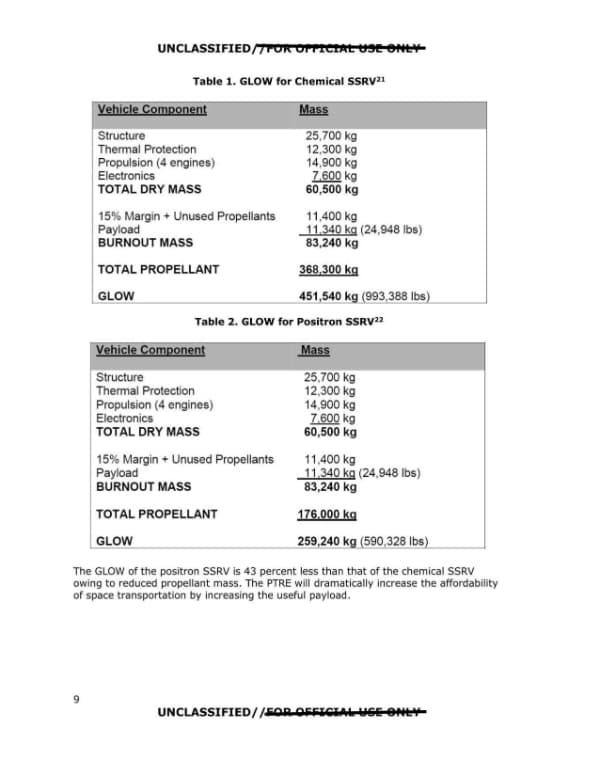
A page of mass tables comparing gross lift-off weight (GLOW) for a chemical SSRV21 and a positron SSRV22 vehicle, followed by a short paragraph stating the positron vehicle's GLOW is 43 percent less owing to reduced propellant mass.
UNCLASSIFIED/} FOR OFFICIICL tl.!l!!! 8HLY
Table 1. GLOW for Chemical SSRV21
Vehicle Component | Mass
Structure | 25,700 kg
Thermal Protection | 12,300 kg
Propulsion (4 engines) | 14,900 kg
Electronics | 7,600 kg
TOTAL DRY MASS | 60,500 kg
15% Margin + Unused Propellants | 11,400 kg
Payload | 11.340 kg (24,948 lbs)
BURNOUT MASS | 83,240 kg
TOTAL PROPELLANT | 368,300 kg
GLOW | 451,540 kg (993,388 lbs)
Table 2. GLOW for Positron SSRV22
Vehicle Component | Mass
Structure | 25,700 kg
Thermal Protection | 12,300 kg
Propulsion (4 engines) | 14,900 kg
Electronics | 7,600 kg
TOTAL DRY MASS | 60,500 kg
15% Margin + Unused Propellants | 11,400 kg
Payload | 11,340 kg (24,948 lbs)
BURNOUT MASS | 83,240 kg
TOTAL PROPELLANT | 176,000 kg
GLOW | 259,240 kg (590,328 lbs)
The GLOW of the positron SSRV is 43 percent less than that of the chemical SSRV owing to reduced propellant mass. The PTRE will dramatically increase the affordability of space transportation by increasing the useful payload.
UNCLASSIFIED//EOR OfifilEIAk W&li 8HLY
9
UNCLASSIFIED/ /FOR OFFICIAL USE ONLY