$DECLASSwnMfUvY5KfUN2LbKgyHXwmh39mGpJd7bjJw5A71pumpBuy
Declassified
Releases / Release 06 / DOW-UAP-D122
Department of War

AAWSAP DIRD, Invisibility Cloaking Theory and Experiments, March 2010

A 2010 Defense Intelligence Agency reference document produced under AAWSAP that surveys camouflage, transparency and metamaterial-based cloaking theory and early microwave experiments. It concludes that imperfect cloaking is feasible for microwaves, that perfect cloaking is impossible, and that visible-light cloaking is uncertain. It cites published journal literature and contains no redactions in the body.

Record
DOW-UAP-D122
Release
Release 06 · Sep 18, 2026
Incident
2010-03-02 · Las Vegas, Nevada
Pages
29
Verdict
Nothing new
Source
war.gov ↗
Context · why this verdict

This is a technical literature survey of invisibility cloaking, summarizing published academic work. Only its administrative page 2 overlaps with another AAWSAP DIRD (DOW-UAP-D118, same release), and the substance is standard published physics rather than new records about any incident.

Findings in this document

2 findings

Already public SIG

Document states single-frequency limit is an inevitable design flaw of cloaks

  • Verbatim
    The demonstrated microwave-cloaking device only works correctly for microwave radiation of a specific frequency (wavelength),
    DOW-UAP-D122 · Release 06 · page 20 · war.gov ↗
  • Context

    The 'Fundamental Problem' section describes why transformation-based cloaks do not work across multiple colors.

New or already public? The point is from published academic literature that the document itself cites (reference notes on pages 28-29).

Unclear if new SIG

DIRD concludes perfect cloaking is impossible, microwave cloaking within reach

  • Verbatim
    Perfect cloaking devices are impossible because they require materials where t he speed of light approaches infinity.
    DOW-UAP-D122 · Release 06 · page 28 · war.gov ↗
  • Verbatim
    For electromagnetic microwaves, cloaking devices are definitely within reach of the present technology.
    DOW-UAP-D122 · Release 06 · page 28 · war.gov ↗
  • Context

    The Summary page of a DIA reference document dated 2 March 2010, one of the AAWSAP DIRD series; it reviews published academic work.

  • Inference · AI interpretation

    This suggests the document is a synthesis of open scientific literature and not an original assessment of any observed phenomenon.

New or already public? No earlier archive pages match this content; however, the conclusions reflect widely published physics literature cited in the document's own references.

Page by page

The pages and what the AI read on them

The transcription is the page reader's: black bars mark what the government redacted; hatched tags mark personal data we removed.

Page 25

Page 25 of 29

This page is page 20 of a document on invisibility cloaking theory, discussing non-Euclidean cloaking devices, with a header and footer marked UNCLASSIFIED//FOR OFFICIAL USE ONLY and a figure of three-dimensional ray trajectories. The text describes the optical properties and limitations of such devices and begins an implementation discussion.

hemisphere invisible and creating the same illusion as shown in A. Alternatively (D), one could expand the red line that light never crosses to create a hidden space. Why are such curved optical spaces of any practical advantage? They seem more complicated, but the distortion of space in such spaces is always finite, never infinite as in the conventional Euclidean cloaking devices. As the spatial distortions directly correspond to the required refractive indices, the required optical properties are never infinite, and hence such devices can, in principle, operate in a broad band of the spectrum. Curved space is more practical than flat space, although the theory is more complicated. These ideas can be extended from the two-dimensional toy model to the three-dimensional world, but they can no longer be visualized. Figure 21 below shows some ray trajectories in three-dimensional non-Euclidean cloaking devices. Figure 21. Three-Dimensional Cloaking. One can extrapolate the ideas illustrated in the previous figure to three-dimensional space, replacing the plane by flat space and the sphere by a hypersphere. The lentil-shaped object indicates the hidden interior of the device; the partly shaded grid, the boundary of the invisibility device. For better contrast, light rays are shown in red. A: Rays are bent around the invisible region. B: In three dimensions, some rays turn out to perform two loops in hyperspace that appear in physical space as light wrapped around the invisible interior. Such non-Euclidean cloaking devices are imperfect because they delay the light traveling through the cloak. With sensitive timing or wave-front sensing one could, in principle, detect the presence of the cloaking device. Perfect cloaking is impossible, but as long as time delays and wave-front dislocations are of no concern, invisibility could become reality. Implementation Non-Euclidean cloaking devices do not have an obvious symmetry like the Euclidean microwave-cloaking device. 36 They require materials with an electromagnetic response that varies from cell to cell and is anisotropic. Most probably, such cloaking structures can be made for microwaves. A precursor of the necessary technology is the recently demonstrated ground-plate cloak. 37 This device implements the coordinate transformation shown below (that already appeared in the first paper on cloaking by 20 UNCLASSIFIED//FOR OFFICIAL USE ONLY
Page 26

Page 26 of 29

A page from the AAWSAP DIRD report on invisibility cloaking theory, discussing a coordinate transformation diagram (Figure 22) and the implementation of a ground-plate cloak with split-ring resonator cells (Figure 23). The page is marked UNCLASSIFIED/FOR OFFICIAL USE ONLY and numbered 21.

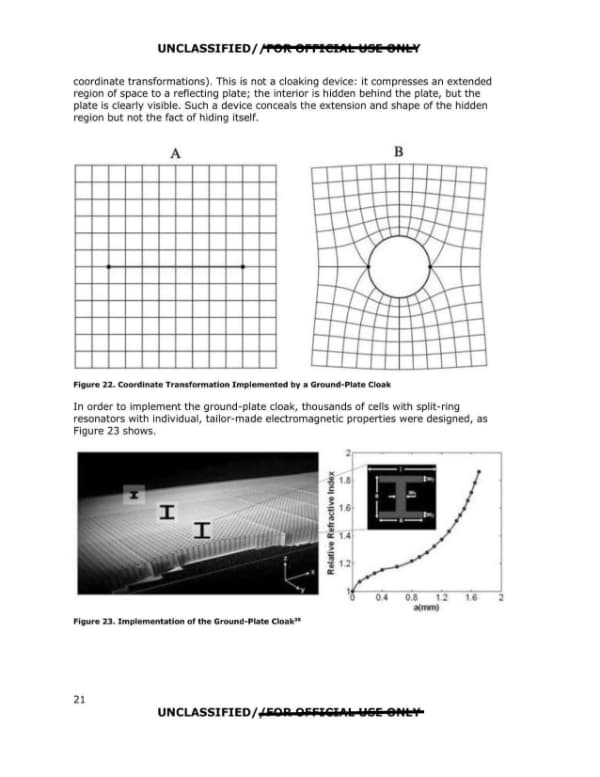
coordinate transformations). This is not a cloaking device: it compresses an extended region of space to a reflecting plate; the interior is hidden behind the plate, but the plate is clearly visible. Such a device conceals the extension and shape of the hidden region but not the fact of hiding itself. B Figure 22. Coordinate Transformation Implemented by a Ground-Plate Cloak In order to implement the ground-plate cloak, thousands of cells with split-ring resonators with individual, tailor-made electromagnetic properties were designed, as Figure 23 shows. 0. 0.8 12 6 mm) Figure 23. Implementation of the Ground-Plate Cloak38 UNCLASSIFIED//EOR QFFIEIAk WS& 8HLY 21
Page 27

Page 27 of 29

Page 22 of a document titled Optical Cloaking, discussing technical challenges for optical invisibility cloaking, including non-Euclidean designs, metamaterials, impedance matching and flexibility of rigid shells. The page is marked UNCLASSIFIED//FOR OFFICIAL USE ONLY and contains no redactions.

UNCLASSIFIED//FOR OFFICIAL USE ONLY Optical Cloaking Cloaking in the optical range of the spectrum poses several challenges. The present design of non-Euclidean cloaking devices still requires materials where, in some parts of the device, the speed of light is larger than in the environment of the device, which, in practice, means larger than the speed of light in vacuum. Most probably, this problem can be circumvented by inventing new designs and new geometrical forms of suitable curved spaces, because there is no mathematical reason why non-Euclidean cloaking should be limited in this way. However, solving this problem takes imagination and mathematical creativity; it cannot be planned by a clear roadmap, but it can be encouraged and stimulated. It could take 1 or 2 years or a much longer time until such designs are invented; truly imaginative research is unpredictable. This research takes a specific mindset, clear mathematical thinking combined with playfulness and physical intuition, a stimulating environment, and freedom. The greatest challenge for turning invisibility from an idea into a workable device is not technology but imagination. The only way to solve this problem is to follow the Solomonic advice to invest in the right people. The technology for cloaking will depend on the design of such advanced cloaking devices. Probably they will require highly anisotropic materials, but perhaps liquid crystals could be sufficient. Maybe metamaterials are not needed after all. In this case, invisibility could become a feasible technology within a generation. If optical metamaterials are needed, they will rely on structuring on extremely short scales, possibly on sub-nanometer distances. The technology for making such structures will be developed because the silicon-electronics industry will need them; but whether large-scale devices with sub-nanometer structures can be made remains to be seen. Another practical challenge is impedance managing. Ideal cloaking devices require materials with equal electric and magnetic response because they implement geometries and geometries are universal-they act on both the electric and the magnetic fields of electromagnetic waves like light. In practice, broadband optical materials mostly respond to the electric field but not to the magnetic one. Optical magnetism has been demonstrated with metamaterials, 39 but only in narrow regions of the spectrum. If the electric response differs from the magnetic response, the electromagnetic impedance is mismatched, which results in reflections. One could reduce such reflections by using smooth refractive-index profiles as appropriate antireflection coatings. Most probably, cloaking devices will be rigid shells; to make them flexible like wearable invisibility cloaks poses a significant challenge. The reason is that their optical properties must be adjusted to their geometrical shapes, as the refractive-index profile of a cloaking device depends on its shape. If the shape changes, the index-profile must follow suit. The required optical properties should be calculated in real time, and the material should change accordingly. Liquid crystals could adjust their optical properties, but controlling a large, complicated array of liquid crystals with possibly several layers appears to be difficult, despite the progress made in liquid-crystal displays. 22 UNCLASSIFIED//FOR OFFICIAL USE ONLY
Page 28

Page 28 of 29

This page is the 'Summary' page of a document on invisibility cloaking, stating that a cloaking device is a passive transparent device that guides light around an object and that perfect cloaks are impossible while imperfect ones could be made, followed by a list of numbered references (1 to 26) and the page number 23.

UNCLASSIFIED/ /FOR OFFI@IAL l::ISE OHL¥ Summary A cloaking device is a passive device made of a transparent material that guides light around any object in its interior as if the light has passed through empty space. The cloaking device conceals the object and hides the act of hiding itself. Perfect cloaking devices are impossible because they require materials where t he speed of light approaches infinity. Imperfect cloaking devices could be made. Such devices implement suitable curved-space geometries. For electromagnetic microwaves, cloaking devices are definitely within reach of the present technology. Whether invisibility in the visible range of t he spectrum will become a reality is not entirely clear yet. Most probably, this will depend more on the new theoretical research than on advances in new materials, and on the application of mathematical intelligence, intuition, and imagination. 1 A. Alu and N. Engheta, Achieving transparency with plasmonic and metamaterial coatings, Physical Review E 72, 016623 (2005). 2 G. W. Milton and N.-A. P. Nicorovici, On the cloaking effects associated with anomalous localized resonance, Proceed ings of the Royal Society London A 462, 3027 (2006). 3 Y. Lai, H. Chen, Z-Q. Zhang, and C. T. Cha n, Complementary Media Invisibility Cloak that Cloaks Objects at a Distance Outside the Cloaking Shell, Physical Review Letters 102, 093901 (2009). 4 U. Leonhardt, Optical Conformal Mapping, Science 312, 1777 (2006). 5 J. B. Pendry, D. Schurig, and D. R. Smith, Controlling Electromagnetic Fields, Science 312, 1780 (2006). 6 J. B. Pendry, D. Schurig, and D. R. Smith, Controlling Electromagnetic Fields, Science 312, 1780 (2006). 7 U. Leonhardt and T. G. Phi lbin, Transformation Optics and the Geometry of Light, preprint arXiv:0805.4778, to appear in Progress in Optics. 8 U. Leonhardt and T. G. Philbin, Transformation Optics and the Geometry of Light, preprint arXiv :0805.4778, to appear in Progress in Optics. 9 U. Leonhardt, Optical Conformal Mapping, Science 312, 1777 (2006). 10 J. B. Pendry, D. Schurig, and D. R. Smith, Controlling Electromagnetic Fields, Science 312, 1780 (2006) . 11 D. Schurig, J. J. Mock, B. J. Justice, S. A. Cummer, J. B. Pendry, A. F. Starr, and D. R. Smith, Metamaterial Electromagnetic Cloak at Microwave Frequencies, Science 314, 977 (2006). 12 U. Leonhardt, Optical Conformal Mapping, Science 312, 1777 (2006). 13 D. Schurig, J. J. Mock, B. J. Justice, S. A. Cummer, J. B. Pendry, A. F. Starr, and D. R. Smith, Metamaterial Electromagnetic Cloak at Microwave Frequencies, Science 314, 977 (2006). 14 D. Schurig, J. J. Mock, B. J. Justice, S. A. Cummer, J. B. Pendry, A. F. Starr, and D. R. Smith, Metamaterial Electromagnetic Cloak at Microwave Frequencies, Science 314, 977 (2006). 15 D. Schurig, J. J. Mock, B. J. Justice, S. A. Cummer, J. B. Pendry, A. F. Starr, and D. R. Smith, Metamaterial Electromagnetic Cloak at Microwave Frequencies, Science 314, 977 (2006). 16 D. Schurig, J. J. Mock, B. J. Justice, S. A. Cummer, J.B. Pendry, A. F. Starr, and D. R. Smith, Metamaterial Electromagnetic Cloak at Microwave Frequencies, Science 314, 977 (2006). 17 F. E. Wagner, S. Haslbeck, L. Stievano, S. Ca logero, Q. A. Pan khurst, and P. Martinek, Before striking gold in gold-ruby glass, Nature 407, 691 (2000). 18 D. Schurig, J. J. Mock, B. J. Justice, S. A. Cummer, J.B. Pendry, A. F. Starr, and D.R. Smith, Metamaterial Electromagnetic Cloak at Microwave Frequencies, Science 314, 977 (2006). 19 W. Cai, U. K. Chettiar, A. V. Kildishev, and V. M. Shalaev, Optical cloaking with metamaterials, Nature Photonics 1, 224 (2007). 20 W. Cai, U. K. Chettiar, A. V. Kildishev, and V. M. Shalaev, Optical cloaking with metamaterials, Nature Photonics 1, 224 (2007). 21 C. M. Soukoulis, S. Linden, and M. Wegener, Costas M. Soukoulis, Stefan Linden, and Martin Wegener, Negative Refractive Index at Optical Wavelengths, Science 315, 47 (2007). 22 C. M. Soukoulis, S. Linden, and M. Wegener, Costas M. Soukoulis, Stefan Linden, and Martin Wegener, Negative Refractive Index at Optical Wavelengths, Science 315, 47 (2007). 23 J. Yao, Z. Liu, Y. Liu, Y. Wang, C. Sun, G. Barta!, A. M. Stacy, and X. Zhang, Optical Negative Refraction in Bulk Metamaterials of Nanowires, Science 321 , 930 (2008). 24 J. Valentine, S. Zhang, T. Zentgraf, E. Ulin-Avila, D. A. Genov, G. Barta!, and X. Zhang, Three-dimensional optica l metamaterial with a negative refractive index, Nature 455, 376 (2008). 25 U. Leonhardt and T. G. Philbin, General relativity in electrical engineering, New Journal of Physics 8, 247 (2006). 26 (11 ) J. Yao, Z. Liu, Y. Liu, Y. Wang, C. Sun, G. Barta!, A. M. Stacy, and X. Zhang, Optical Negative Refraction in Bulk Metamaterials of Nanowires, Science 321, 930 (2008). 23 UNCLASSIFIED/,CFOA OFFI&I.t.L l::ISE OHL¥
Page 29

Page 29 of 29

This page is a continuation of a reference list of numbered citations (notes 27 to 39) to journal articles and a book on metamaterials, optics and invisibility cloaking, with the page number 24 at the bottom. Strikethrough marks appear over the classification banners.

UNCLASSIFIED// FOR OFFICIAL USE ONLY 27 J. Valentine, S. Zhang, T. Zentgraf, E. Ulin-Avila, D. A. Genov, G. Bartal, and X. Zhang, Three-dimensional optical metamaterial with a negative refractive index, Nature 455, 376 (2008). 28 U. Leonhardt and T. G. Philbin, General relativity in electrical engineering, New Journal of Physics 8, 247 (2006). 29 U. Leonhardt and T. Tyc, Broadband Invisibility by Non-Euclidean Cloaking, Science 323, 110 (2009). 30 U. Leonhardt and T. Tyc, Broadband Invisibility by Non-Euclidean Cloaking, Science 323, 110 (2009). 31 H. Chen and C. T. Chan, Time delays and energy transport velocities in three dimensional ideal cloaking devices, Journal of Applied Physics 104, 033113 (2008). 32 U. Leonhardt and T. Tyc, Broadband Invisibility by Non-Euclidean Cloaking, Science 323, 110 (2009). 33 M. Born and E. Wolf, Principles of Optics (Cambridge University Press, Cambridge, 1999). 34 U. Leonhardt and T. Tyc, Broadband Invisibility by Non-Euclidean Cloaking, Science 323, 110 (2009). 35 U. Leonhardt and T. Tyc, Broadband Invisibility by Non-Euclidean Cloaking, Science 323, 110 (2009). 36 D. Schurig, J. J. Mock, B. J. Justice, S. A. Cummer, J. B. Pendry, A. F. Starr, and D. R. Smith, Metamaterial Electromagnetic Cloak at Microwave Frequencies, Science 314, 977 (2006). 37 R. Liu, C. Ji, J. J. Mock, J. Y. Chin, T. J. Cui, and D. R. Smith, Broadband Ground-Plane Cloak, Science 323, 366 (2009). 38 R. Liu, C. Ji, J. J. Mock, J. Y. Chin, T. J. Cui, and D. R. Smith, Broadband Ground-Plane Cloak, Science 323, 366 (2009). 39 C. M. Soukoulis, S. Linden, and M. Wegener, Costas M. Soukoulis, Stefan Linden, and Martin Wegener, Negative Refractive Index at Optical Wavelengths, Science 315, 47 (2007). UNCLASSIFIED//509 OEEICI0 .. Uili QPUEY 24 UNCLASSIFIED//FOR OFFICIAL USE ONLY