Page 21 of 29
Page 16 of the AAWSAP DIRD report on invisibility cloaking theory, containing Figure 17 (a diagram of virtual and real space for a transformation-based cloak) and explanatory text on light speed, phase velocity and group velocity.
UNCLASSIFIED//FOR OFFICIAL USE ONLY
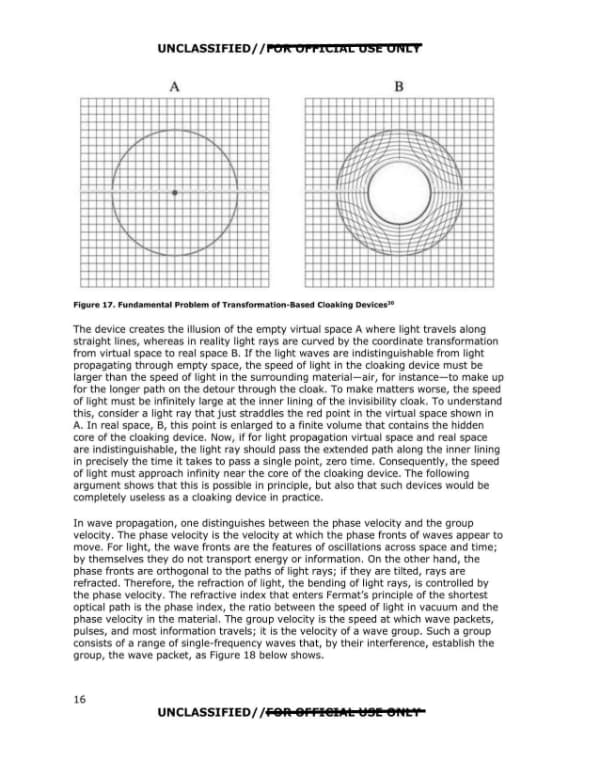
Figure 17. Fundamental Problem of Transformation-Based Cloaking Devices30
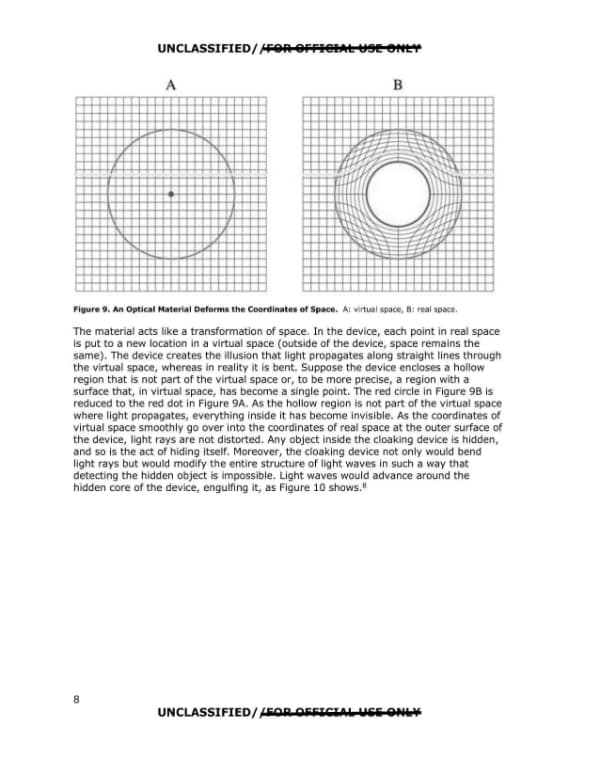
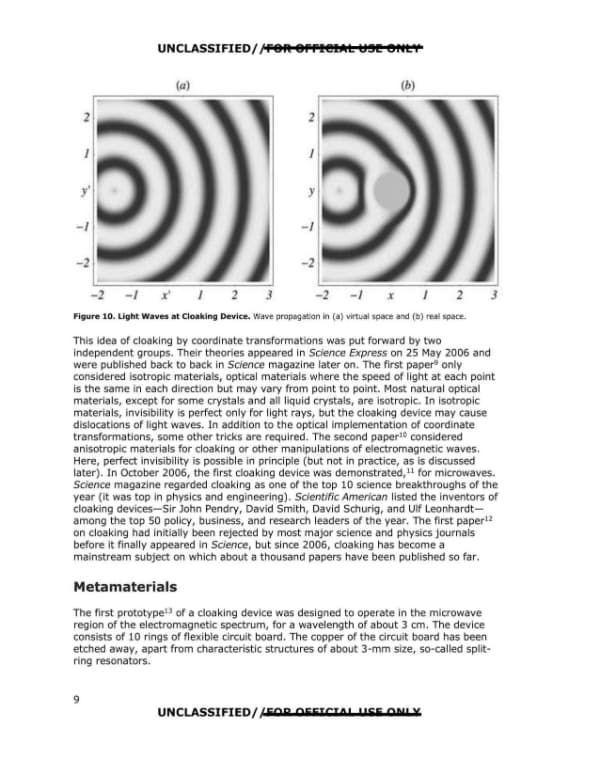
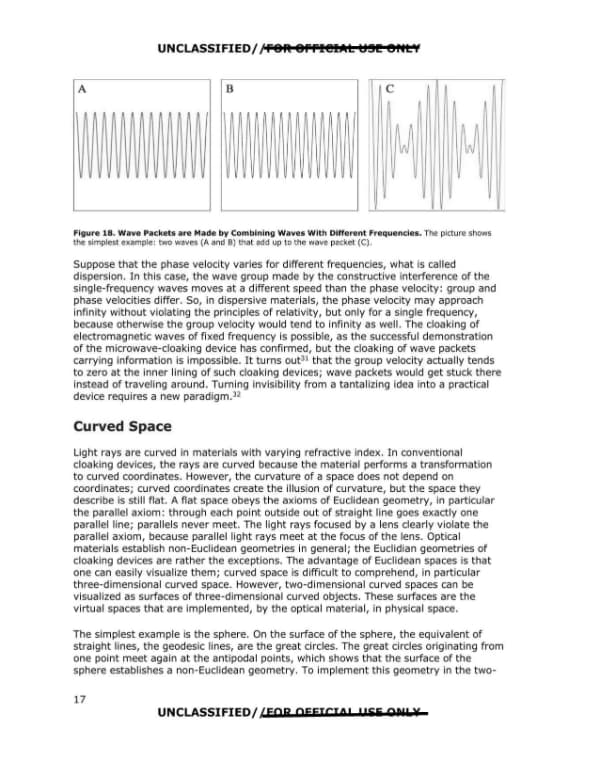
The device creates the illusion of the empty virtual space A where light travels along straight lines, whereas in reality light rays are curved by the coordinate transformation from virtual space to real space B. If the light waves are indistinguishable from light propagating through empty space, the speed of light in the cloaking device must be larger than the speed of light in the surrounding material—air, for instance—to make up for the longer path on the detour through the cloak. To make matters worse, the speed of light must be infinitely large at the inner lining of the invisibility cloak. To understand this, consider a light ray that just straddles the red point in the virtual space shown in A. In real space, B, this point is enlarged to a finite volume that contains the hidden core of the cloaking device. Now, if for light propagation virtual space and real space are indistinguishable, the light ray should pass the extended path along the inner lining in precisely the time it takes to pass a single point, zero time. Consequently, the speed of light must approach infinity near the core of the cloaking device. The following argument shows that this is possible in principle, but also that such devices would be completely useless as a cloaking device in practice.
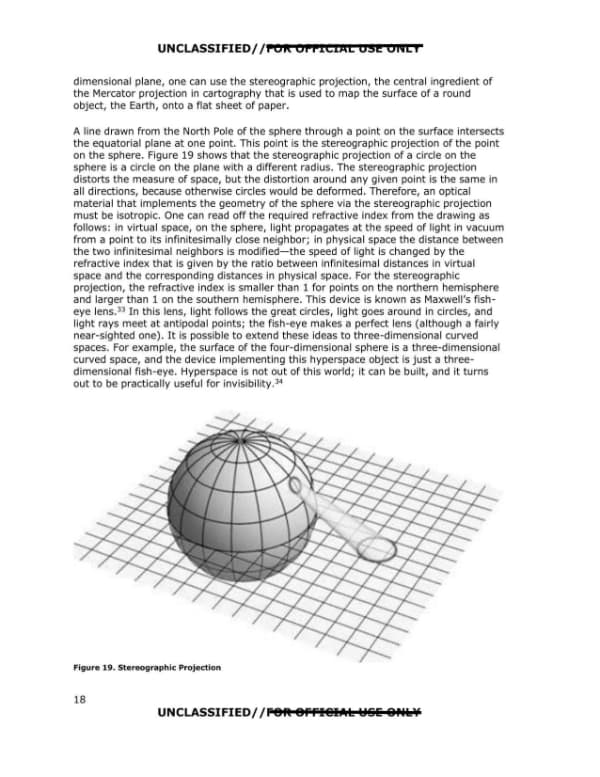
In wave propagation, one distinguishes between the phase velocity and the group velocity. The phase velocity is the velocity at which the phase fronts of waves appear to move. For light, the wave fronts are the features of oscillations across space and time; by themselves they do not transport energy or information. On the other hand, the phase fronts are orthogonal to the paths of light rays; if they are tilted, rays are refracted. Therefore, the refraction of light, the bending of light rays, is controlled by the phase velocity. The refractive index that enters Fermat's principle of the shortest optical path is the phase index, the ratio between the speed of light in vacuum and the phase velocity in the material. The group velocity is the speed at which wave packets, pulses, and most information travels; it is the velocity of a wave group. Such a group consists of a range of single-frequency waves that, by their interference, establish the group, the wave packet, as Figure 18 below shows.
16
UNCLASSIFIED//FOR OFFICIAL USE ONLY