AAWSAP DIRD, Pulsed High-Power Microwave Source Technology, January 2010
This document is a Defense Intelligence Reference Document (DIRD), a technical reference format used by the Defense Intelligence Agency (DIA) to capture baseline knowledge on a specific topic for later analytic use. DIRDs are best understood as reference and synthesis products rather than as original research. It is one of 38 DIRDs produced under the Advanced Aerospace Weapon System Applications Program (AAWSAP) between 2009 and 2011. Because AAWSAP’s scope permitted a broad range of supporting topics, not every DIRD in the series directly concerns aerospace systems or future threat assessment. The following summary reflects the DIRD’s scope and framing at the time of writing and should…
Catalogue description by the publishing agency.
- Record
- DOW-UAP-D121
- Release
- Release 06 · Sep 18, 2026
- Incident
- 2010-01-28 · Las Vegas, Nevada
- Pages
- 37
- Verdict
- not judged yet
- Source
- war.gov ↗
The pages and what the AI read on them
The transcription is the page reader's: black bars mark what the government redacted; hatched tags mark personal data we removed.
Page 1 of 37
This is the cover page of a Defense Intelligence Reference Document titled "Pulsed High-Power Microwave Source Technology", dated 28 January 2010 with ICOD 1 December 2009 and document number DIA-08-0912-005. The page is marked UNCLASSIFIED//FOR OFFICIAL USE ONLY and bears a DIA seal.
Page 2 of 37 · 1 redaction
This is the front matter page of a Defense Intelligence Agency advanced technology report on pulsed high-power microwave source technology, prepared by the Acquisition Support Division under the AAWSA Program. It contains an administrative note, a copyright warning, and contact instructions for the AAWSA Program Manager, whose name is redacted.
Page 3 of 37
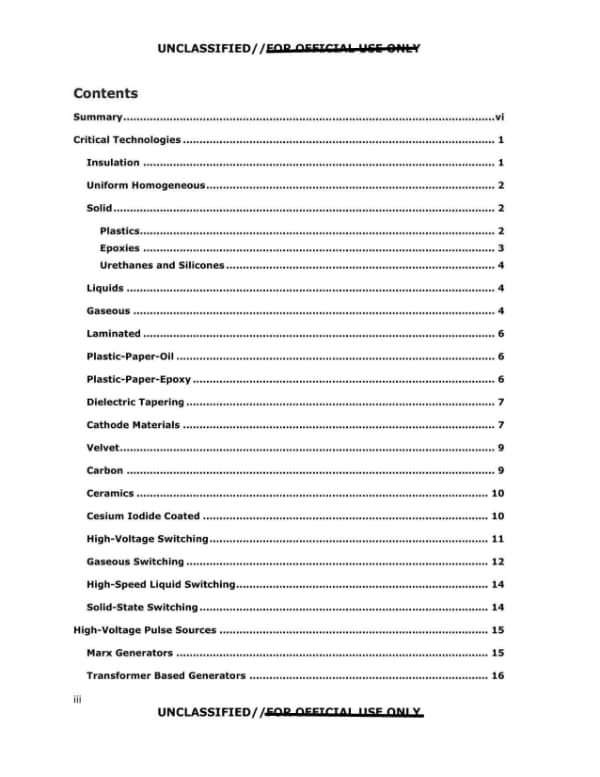
This is the table of contents page of a document, listing section titles and page numbers from Summary through Transformer Based Generators. It bears UNCLASSIFIED//FOR OFFICIAL USE ONLY markings at top and bottom, with the 'FOR OFFICIAL USE ONLY' portion struck through.
Page 4 of 37
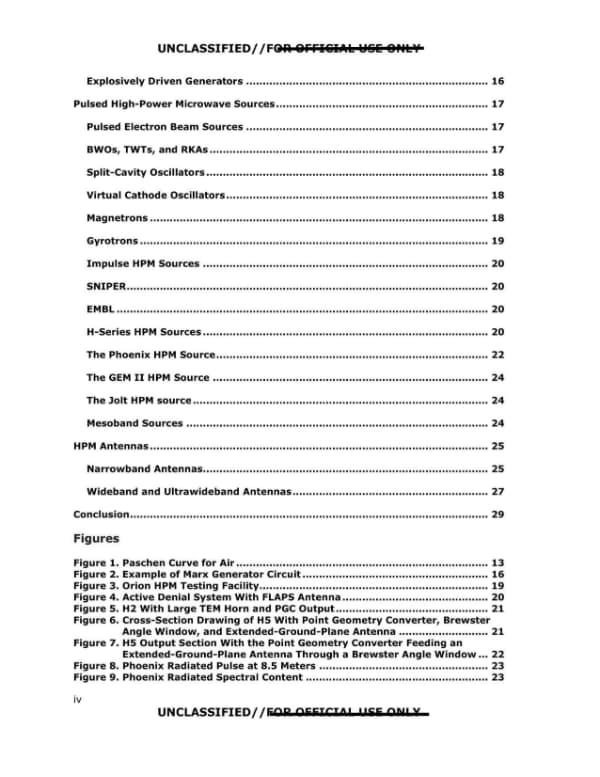
This is page iv of a report's table of contents and list of figures, listing section headings and page numbers for Explosively Driven Generators through Conclusion and Figures 1 through 9. The page is marked UNCLASSIFIED//FOR OFFICIAL USE ONLY with a strikethrough on part of the marking.
Page 5 of 37
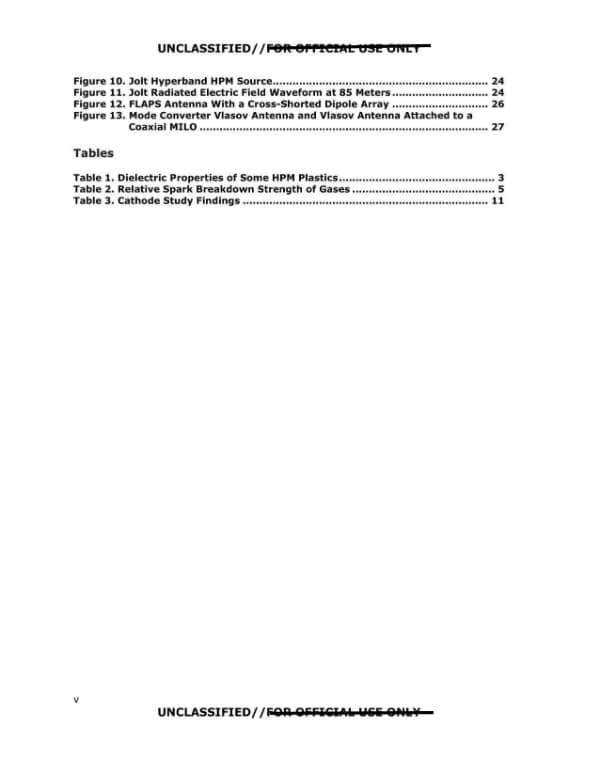
This page is the list of figures and tables from the front matter of a Pulsed High-Power Microwave Source Technology report, marked UNCLASSIFIED//FOR OFFICIAL USE ONLY. It lists figure and table titles with their page numbers.
Page 6 of 37
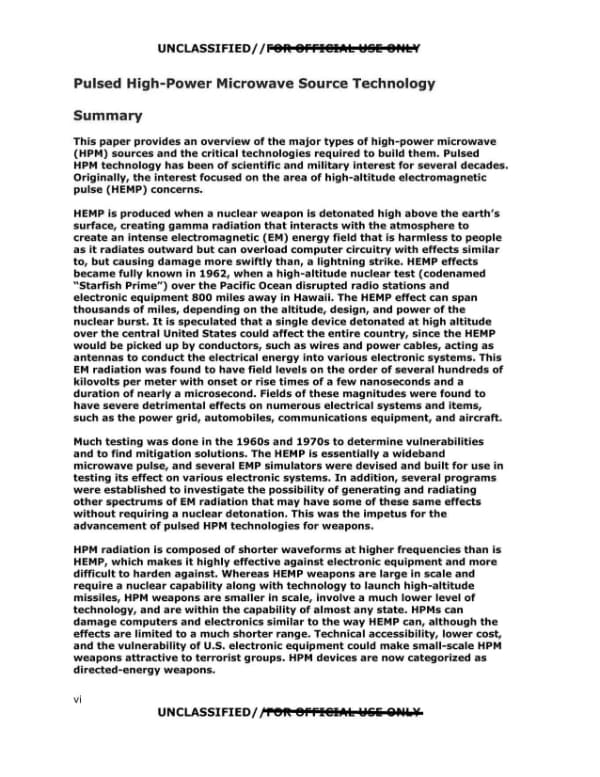
This is the summary page of a paper overviewing pulsed high-power microwave source technology, describing HEMP origins, the 1962 Starfish Prime test, and the emergence of HPM weapons. The page is marked UNCLASSIFIED//FOR OFFICIAL USE ONLY and is numbered vi.
Page 7 of 37
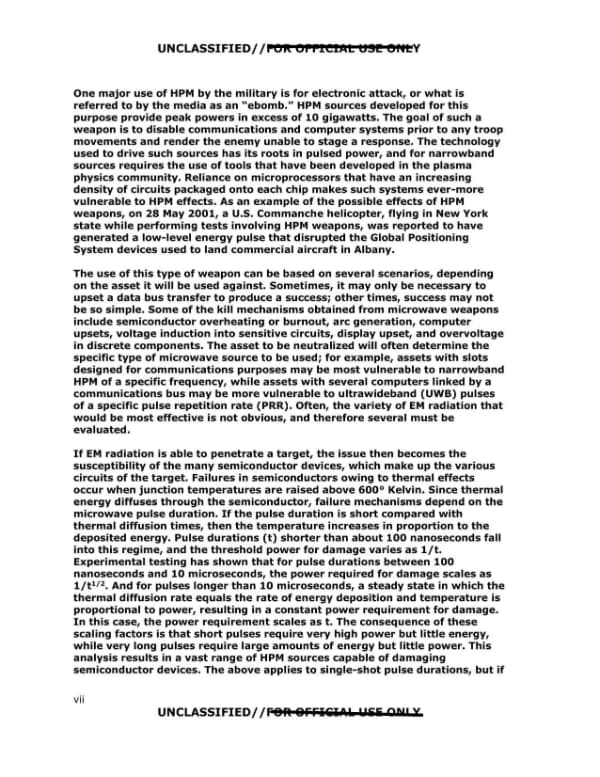
Page vii of a US government report on pulsed high-power microwave (HPM) source technology, discussing HPM use for electronic attack and how semiconductor damage thresholds scale with pulse duration. The page states that a U.S. Commanche helicopter performing HPM tests in New York state on 28 May 2001 was reported to have generated a pulse that disrupted GPS devices used to land aircraft in Albany.
Page 8 of 37
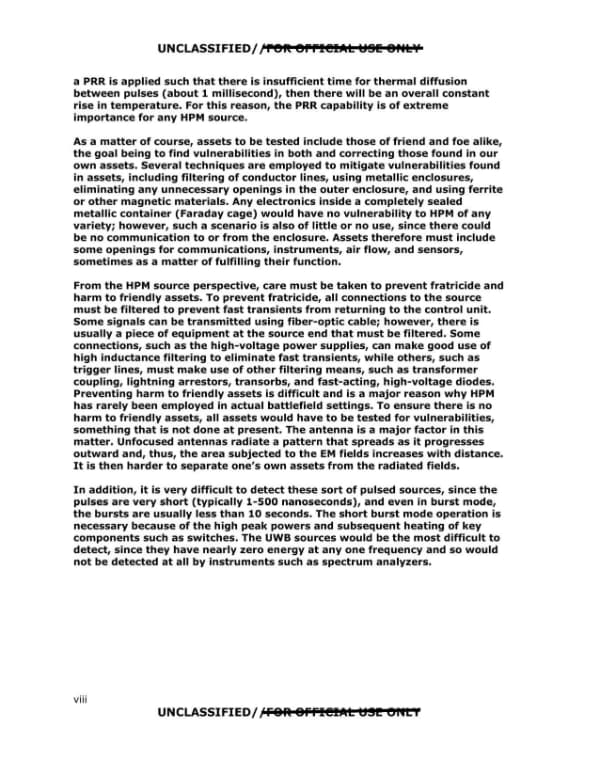
Page viii of a 2010 AAWSAP DIRD report on pulsed high-power microwave sources, discussing pulse repetition rate and thermal effects, vulnerability mitigation for friendly and foe assets, fratricide prevention through filtering, and the difficulty of detecting pulsed and UWB sources.
Page 9 of 37
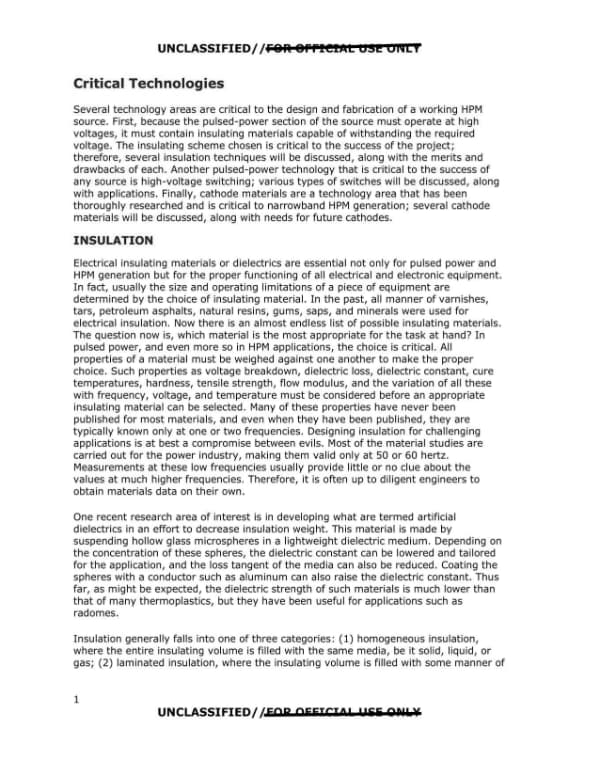
This is page 1 of a technical discussion titled 'Critical Technologies' covering insulation, high-voltage switching, and cathode materials for HPM sources. The page's insulation section describes electrical insulating materials and artificial dielectrics.
Page 10 of 37
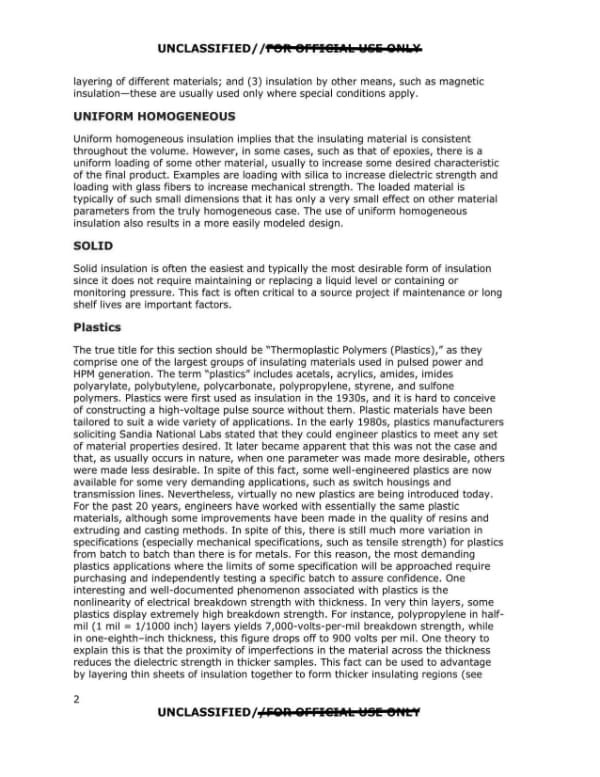
This is page 2 of a technical report section on insulation materials for pulsed power and high-power microwave sources, covering uniform homogeneous insulation, solid insulation, and plastics. The page has the running header and footer marked UNCLASSIFIED//FOR OFFICIAL USE ONLY and contains no redactions.
Page 11 of 37
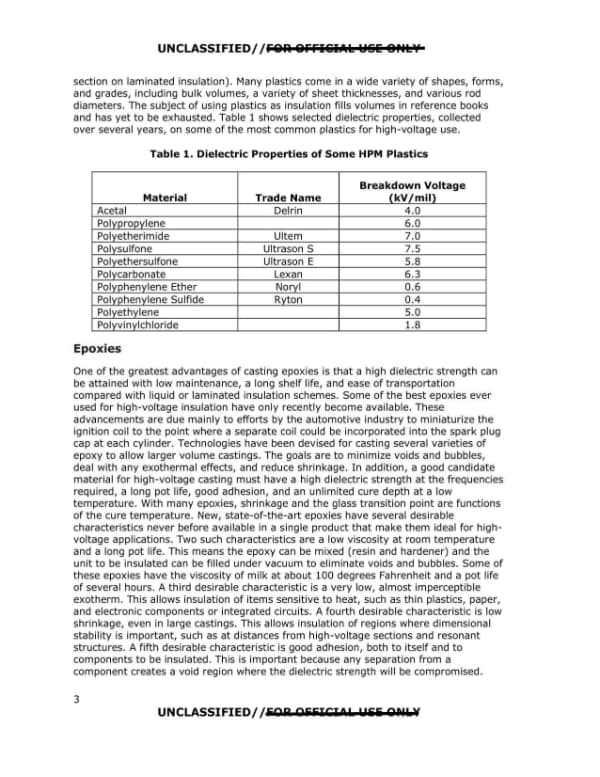
A technical page on high-voltage insulation, covering dielectric breakdown voltages of common plastics in a table and the properties desired in epoxy castings. It is page 3 of the document, with the header and footer marked FOR OFFICIAL USE ONLY.
Page 12 of 37
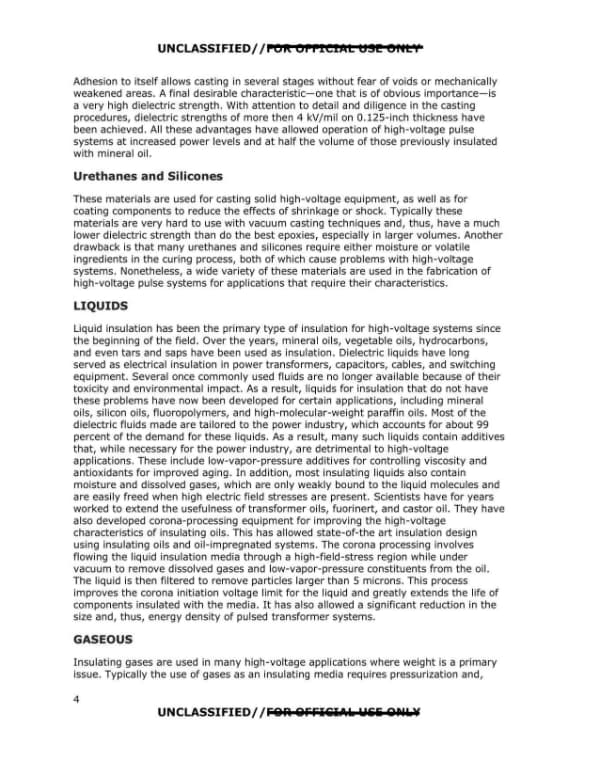
Page 4 of a report on high-voltage insulation materials, covering epoxies, urethanes and silicones, liquid insulators, and the start of a section on gaseous insulation. It describes material properties and processing methods without reporting test program results.