AAWSAP DIRD, Materials for Advanced Aerospace Platforms, January 2010
This document is a Defense Intelligence Reference Document (DIRD), a technical reference format used by the Defense Intelligence Agency (DIA) to capture baseline knowledge on a specific topic for later analytic use. DIRDs are best understood as reference and synthesis products rather than as original research. It is one of 38 DIRDs produced under the Advanced Aerospace Weapon System Applications Program (AAWSAP) between 2009 and 2011. Because AAWSAP’s scope permitted a broad range of supporting topics, not every DIRD in the series directly concerns aerospace systems or future threat assessment. The following summary reflects the DIRD’s scope and framing at the time of writing and should…
Catalogue description by the publishing agency.
- Record
- DOW-UAP-D120
- Release
- Release 06 · Sep 18, 2026
- Incident
- 2010-01-12 · Las Vegas, Nevada
- Pages
- 27
- Verdict
- not judged yet
- Source
- war.gov ↗
The pages and what the AI read on them
The transcription is the page reader's: black bars mark what the government redacted; hatched tags mark personal data we removed.

Page 13 of 27
Page 8 of the AAWSAP materials report discusses titanium alloys for launch vehicles, covering beta-Ti strength and toughness trade-offs, stiffness and buckling concerns, oxidation at high temperatures and manufacturing practices, and concludes with a summary of material selection considerations. The page has no visible redactions.

Page 14 of 27
A page titled "Reusable Crew Modules" discusses the evolution of manned orbital crew modules, the space shuttle's thermal protection system, and the materials challenges of metallic and refractory alloys for reentry structures. The page is marked UNCLASSIFIED//FOR OFFICIAL USE ONLY and is numbered 9.

Page 15 of 27
A page from a 2010 AAWSAP DIRD materials report discussing metallic materials for reusable single-stage-to-orbit vehicles and a table of potential materials by temperature regime and property. The page is marked UNCLASSIFIED//FOR OFFICIAL USE ONLY and is numbered 10.

Page 16 of 27
Page 11 of a materials assessment for a reusable SSO vehicle, covering advanced aluminum alloys and polymer matrix composites, their temperature limits, stiffness, and ultraviolet exposure concerns. The page is marked UNCLASSIFIED//FOR OFFICIAL USE ONLY at top and bottom and contains no redactions.

Page 17 of 27
This page is a continuation of a technical materials review covering aluminum matrix composites and the early discussion of titanium alloys. It describes AMC fabrication, machining difficulties, alloy choices, and the oxygen-stabilized alpha case that forms on titanium surfaces.
Page 18 of 27
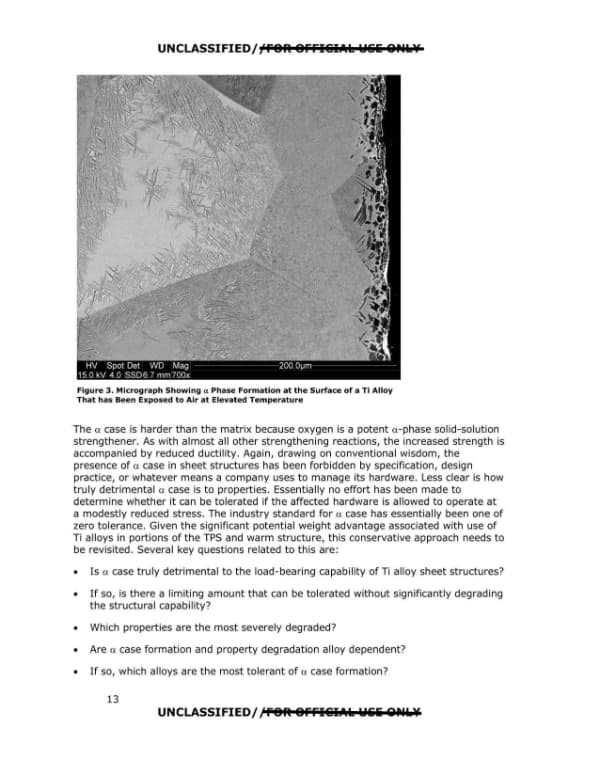
This page is page 13 of a document discussing alpha case formation in titanium alloys, with a micrograph of alpha phase formation at the surface of a Ti alloy exposed to air at elevated temperature. It states that alpha case is harder than the matrix and has been forbidden by specification in sheet structures, and lists open questions about its effect on load-bearing capability.
Page 19 of 27
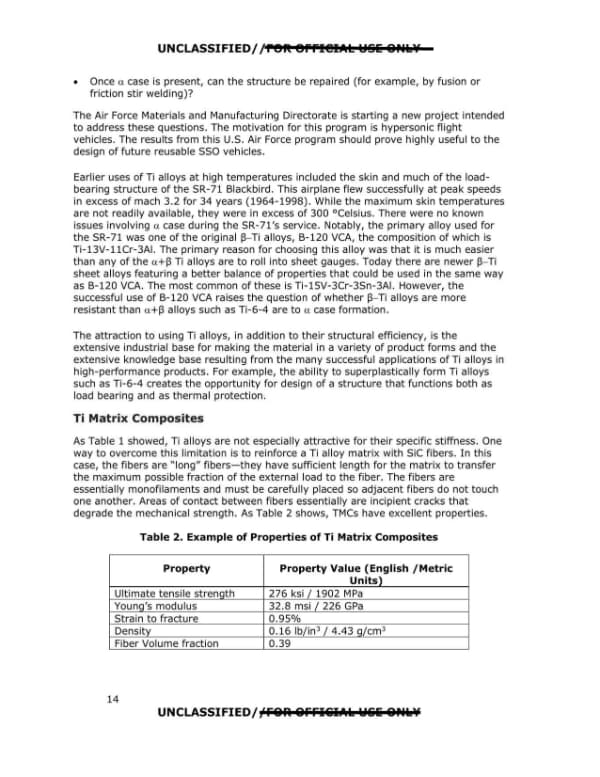
A page from an Air Force materials study discussing titanium alloys, including the SR-71's use of B-120 VCA, and titanium matrix composites with a property table (Table 2). It also outlines a planned Air Force Materials and Manufacturing Directorate project on alpha case repair for hypersonic vehicles.

Page 20 of 27
A report page discussing titanium matrix composites (TMCs), including a cross-section micrograph figure, the cost and SiC fiber availability as reasons for limited use, and TSM's business decisions. The page is marked UNCLASSIFIED/FOR OFFICIAL USE ONLY with no redactions visible.

Page 21 of 27
A report page discussing setbacks in the development of TMC (titanium matrix composite) materials, including fiber availability problems, cost study findings, and the halting of work on TMCs, followed by the start of a section on Ni-base alloys. The page is numbered 16 and bears UNCLASSIFIED / FOR OFFICIAL USE ONLY markings.
Page 22 of 27
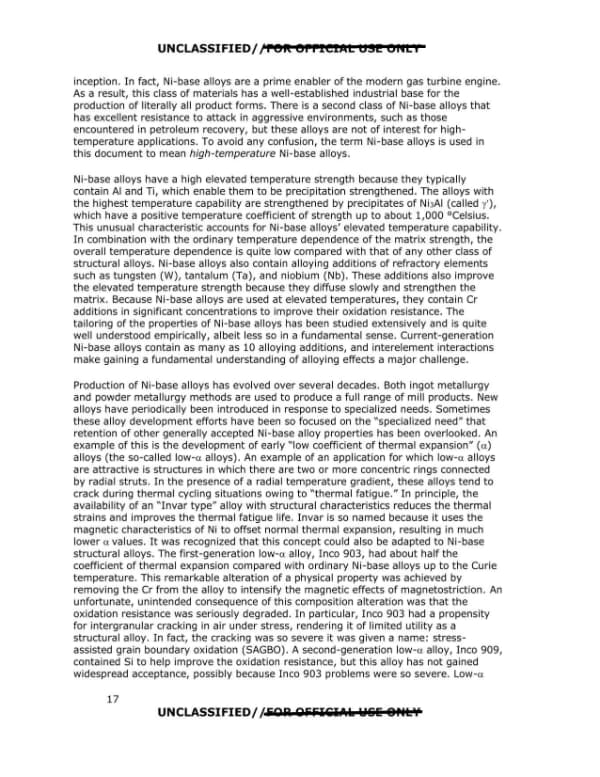
Page 17 of a technical report describing the history and properties of high-temperature nickel-base alloys, including the development of low-coefficient-of-thermal-expansion alloys Inco 903 and Inco 909 and the stress-assisted grain boundary oxidation problem. The page is marked UNCLASSIFIED / FOR OFFICIAL USE ONLY with the handling marking partly struck through.

Page 23 of 27
This page is a page from a technical report discussing nickel-base alloys, refractory metal alloys, and ceramic matrix composites for thermal protection structures in a reusable vehicle. It describes weldability, oxidation behavior, coating durability, and the tension-loading behavior of CMCs.

Page 24 of 27
A technical page from a materials report discussing ceramic matrix composites (CMCs) toughening mechanisms, fiber-matrix interfaces, and carbon-carbon composites. It describes material properties, temperature limits, and oxidation behavior, and mentions the Columbia accident.