$DECLASSwnMfUvY5KfUN2LbKgyHXwmh39mGpJd7bjJw5A71pumpBuy
Declassified
Releases / Release 06 / DOW-UAP-D118
Department of War

AAWSAP DIRD, Aerospace Applications of Programmable Matter, December 2009

This is a December 2009 Defense Intelligence Reference Document prepared under AAWSAP. It surveys smart materials, quantum dots, metamaterials, dynamic windows, thermal and energy harvesting for spacecraft, and speculates about applications out to 2050. It carries no UAP incident reporting.

Record
DOW-UAP-D118
Release
Release 06 · Sep 18, 2026
Incident
2009-12-14 · Las Vegas, Nevada
Pages
20
Verdict
Partly new
Source
war.gov ↗
Context · why this verdict

A 20-page technical reference paper on programmable matter that has no overlap with earlier releases beyond a shared boilerplate title page with DOW-UAP-D120, so the content is new to the archive but is a speculative literature synthesis, not an event record.

Findings in this document

4 findings

New SIG

Report warns of hackers gaining control over programmable matter

  • Verbatim
    We must be extremely cautious about handing malicious hackers the keys to matter itself!
    DOW-UAP-D118 · Release 06 · page 10 · war.gov ↗
  • Inference · AI interpretation

    This may reflect that the authors treated cybersecurity of reconfigurable materials as a significant obstacle.

New or already public? No matching text in earlier releases per the overlap data.

New SIG

Paper cites 2003 LBNL/ASHRAE dynamic-window energy savings study

  • Verbatim
    The ASHRAE study found that across all eight climate zones, buildings with low-emissivity ("low-E") glass saved an average of 8-15 percent on their total annual energy (heating, cooling, and ventilation) costs, whereas the addition of dynamic window systems saved an additional 6-19 percent.
    DOW-UAP-D118 · Release 06 · page 11 · war.gov ↗
  • Context

    The paper uses this study to support its case for near-term smart-window applications.

New or already public? No earlier archive pages match this text.

New SIG

Document describes 2050 scenarios as partly speculative

  • Verbatim
    Many elements of the preceding scenario are based on current and emerging technologies; others are speculative.
    DOW-UAP-D118 · Release 06 · page 20 · war.gov ↗
  • Verbatim
    by 2050 it seems likely that our grandchildren will have difficulty imagining a world where these objects are made from traditional, inert materials.
    DOW-UAP-D118 · Release 06 · page 19 · war.gov ↗

New or already public? No overlap with earlier releases for these pages.

New SIG

DIRD judges smart windows most promising programmable-matter research for next 5 years

  • Verbatim
    near-term applications such as smart windows and energy-saving metapolarizers, which offer direct and immediate economic advantages (namely energy savings) and which dovetail neatly with existing infrastructure, should be considered the most promising for research over the next 5 years.
    DOW-UAP-D118 · Release 06 · page 19 · war.gov ↗
  • Context

    The DIRD is a DIA reference product dated 14 December 2009 and prepared under AAWSAP.

  • Inference · AI interpretation

    This suggests the authors ranked commercially viable applications above the more ambitious aerospace concepts discussed elsewhere in the paper.

New or already public? Only the title page overlaps with DOW-UAP-D120 (Release 06); the body text has no match in the archive.

Page by page

The pages and what the AI read on them

The transcription is the page reader's: black bars mark what the government redacted; hatched tags mark personal data we removed.

Page 13

Page 13 of 20

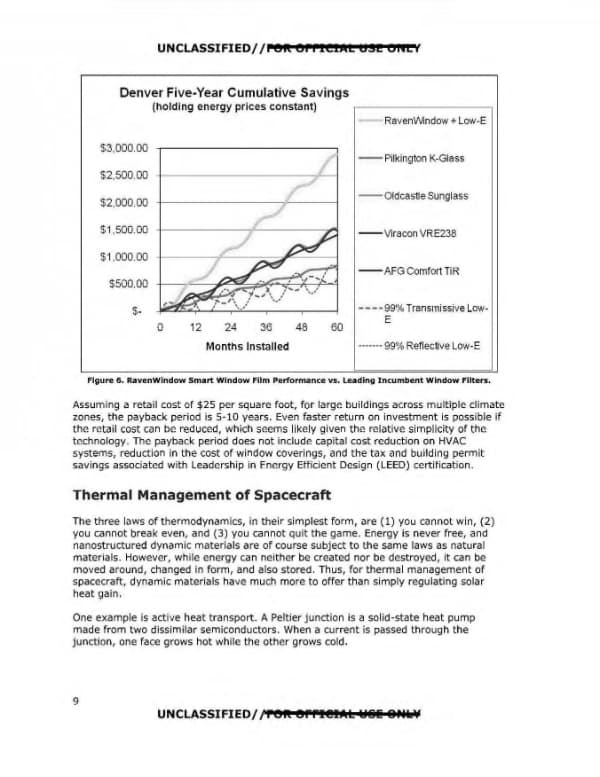
Page 9 of a report on programmable matter contains a chart comparing five-year cumulative savings of window films in Denver and text on payback periods for large buildings and thermal management of spacecraft. The text states the payback period is 5-10 years assuming a $[PII REMOVED] foot retail cost.

UNCLASSIFIED//FOR OFFICIAL USE ONLY Denver Five-Year Cumulative Savings (holding energy prices constant) RavenWindow + Low-E Pilkington K-Glass Oldcastle Sunglass Viracon VRE238 AFG Comfort TiR 99% Transmissive Low-E 99% Reflective Low-E Figure 6. RavenWindow Smart Window Film Performance vs. Leading Incumbent Window Filters. Assuming a retail cost of $PII removed foot, for large buildings across multiple climate zones, the payback period is 5-10 years. Even faster return on investment is possible if the retail cost can be reduced, which seems likely given the relative simplicity of the technology. The payback period does not include capital cost reduction on HVAC systems, reduction in the cost of window coverings, and the tax and building permit savings associated with Leadership in Energy Efficient Design (LEED) certification. Thermal Management of Spacecraft The three laws of thermodynamics, in their simplest form, are (1) you cannot win, (2) you cannot break even, and (3) you cannot quit the game. Energy is never free, and nanostructured dynamic materials are of course subject to the same laws as natural materials. However, while energy can neither be created nor be destroyed, it can be moved around, changed in form, and also stored. Thus, for thermal management of spacecraft, dynamic materials have much more to offer than simply regulating solar heat gain. One example is active heat transport. A Peltier junction is a solid-state heat pump made from two dissimilar semiconductors. When a current is passed through the junction, one face grows hot while the other grows cold. 9 UNCLASSIFIED//FOR OFFICIAL USE ONLY
Page 14

Page 14 of 20

Page 10 of an AAWSAP DIRD report on aerospace applications of programmable matter, describing Peltier junction heat pumps, thermoelectric materials, and spacecraft thermal management. It includes a figure of a Peltier junction heat pump with its caption.

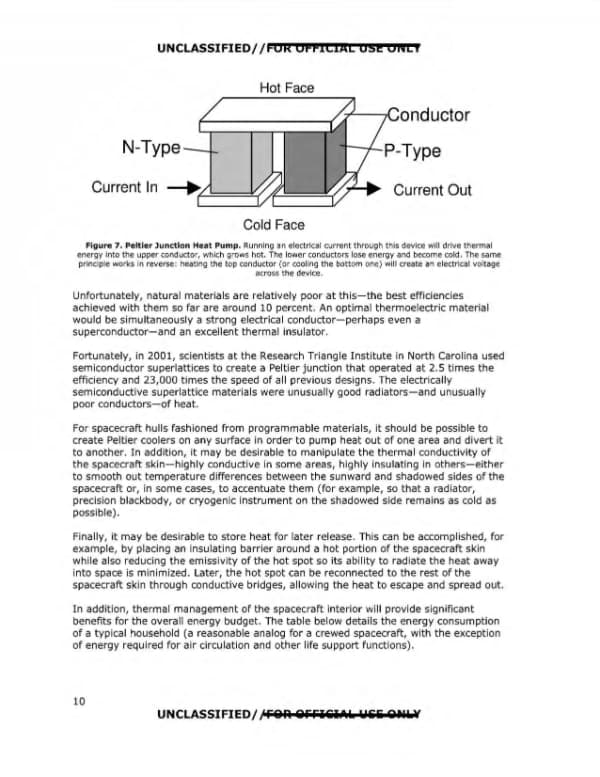
UNCLASSIFIED//FOR OFFICIAL USE ONLY Figure 7. Peltier Junction Heat Pump. Running an electrical current through this device will drive thermal energy into the upper conductor, which grows hot. The lower conductors lose energy and become cold. The same principle works in reverse: heating the top conductor (or cooling the bottom one) will create an electrical voltage across the device. Unfortunately, natural materials are relatively poor at this\u2014the best efficiencies achieved with them so far are around 10 percent. An optimal thermoelectric material would be simultaneously a strong electrical conductor\u2014perhaps even a superconductor\u2014and an excellent thermal insulator. Fortunately, in 2001, scientists at the Research Triangle Institute in North Carolina used semiconductor superlattices to create a Peltier junction that operated at 2.5 times the efficiency and 23,000 times the speed of all previous designs. The electrically semiconductive superlattice materials were unusually good radiators\u2014and unusually poor conductors\u2014of heat. For spacecraft hulls fashioned from programmable materials, it should be possible to create Peltier coolers on any surface in order to pump heat out of one area and divert it to another. In addition, it may be desirable to manipulate the thermal conductivity of the spacecraft skin\u2014highly conductive in some areas, highly insulating in others\u2014either to smooth out temperature differences between the sunward and shadowed sides of the spacecraft or, in some cases, to accentuate them (for example, so that a radiator, precision blackbody, or cryogenic instrument on the shadowed side remains as cold as possible). Finally, it may be desirable to store heat for later release. This can be accomplished, for example, by placing an insulating barrier around a hot portion of the spacecraft skin while also reducing the emissivity of the hot spot so its ability to radiate the heat away into space is minimized. Later, the hot spot can be reconnected to the rest of the spacecraft skin through conductive bridges, allowing the heat to escape and spread out. In addition, thermal management of the spacecraft interior will provide significant benefits for the overall energy budget. The table below details the energy consumption of a typical household (a reasonable analog for a crewed spacecraft, with the exception of energy required for air circulation and other life support functions). 10 UNCLASSIFIED//FOR OFFICIAL USE ONLY
Page 15

Page 15 of 20

A page from the AAWSAP DIRD report on aerospace applications of programmable matter, presenting a table of daily US household energy consumption and a section on energy-scavenging spacecraft skins, including photovoltaic efficiency figures.

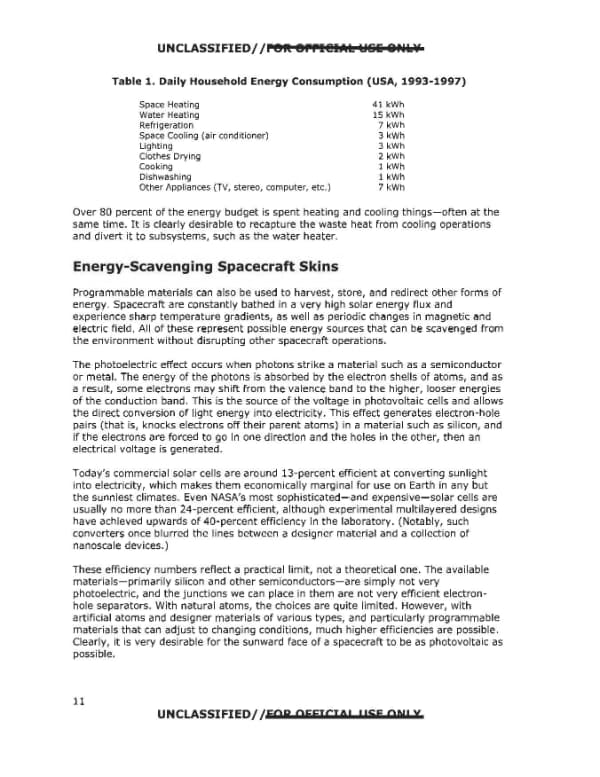
UNCLASSIFIED//FOR OFFICIAL USE ONLY Table 1. Daily Household Energy Consumption (USA, 1993-1997) Space Heating | 41 kWh Water Heating | 15 kWh Refrigeration | 7 kWh Space Cooling (air conditioner) | 3 kWh Lighting | 3 kWh Clothes Drying | 2 kWh Cooking | 1 kWh Dishwashing | 1 kWh Other Appliances (TV, stereo, computer, etc.) | 7 kWh Over 80 percent of the energy budget is spent heating and cooling things woften at the same time. It is clearly desirable to recapture the waste heat from cooling operations and divert it to subsystems, such as the water heater. Energy-Scavenging Spacecraft Skins Programmable materials can also be used to harvest, store, and redirect other forms of energy. Spacecraft are constantly bathed in a very high solar energy flux and experience sharp temperature gradients, as well as periodic changes in magnetic and electric field. All of these represent possible energy sources that can be scavenged from the environment without disrupting other spacecraft operations. The photoelectric effect occurs when photons strike a material such as a semiconductor or metal. The energy of the photons is absorbed by the electron shells of atoms, and as a result, some electrons may shift from the valence band to the higher, looser energies of the conduction band. This is the source of the voltage in photovoltaic cells and allows the direct conversion of light energy into electricity. This effect generates electron-hole pairs (that is, knocks electrons off their parent atoms) in a material such as silicon, and if the electrons are forced to go in one direction and the holes in the other, then an electrical voltage is generated. Today's commercial solar cells are around 13-percent efficient at converting sunlight into electricity, which makes them economically marginal for use on Earth in any but the sunniest climates. Even NASA's most sophisticated-and expensive-solar cells are usually no more than 24-percent efficient, although experimental multilayered designs have achieved upwards of 40-percent efficiency in the laboratory. (Notably, such converters once blurred the lines between a designer material and a collection of nanoscale devices.) These efficiency numbers reflect a practical limit, not a theoretical one. The available materials-primarily silicon and other semiconductors-are simply not very photoelectric, and the junctions we can place in them are not very efficient electron-hole separators. With natural atoms, the choices are quite limited. However, with artificial atoms and designer materials of various types, and particularly programmable materials that can adjust to changing conditions, much higher efficiencies are possible. Clearly, it is very desirable for the sunward face of a spacecraft to be as photovoltaic as possible. 11 UNCLASSIFIED//FOR OFFICIAL USE ONLY
Page 16

Page 16 of 20

This page, numbered 12, discusses energy harvesting and storage methods for programmable materials on spacecraft, including Peltier junctions, piezoelectric effects, capacitors and superconducting batteries, followed by advanced sensor and device applications of programmable materials. The page is marked UNCLASSIFIED//FOR OFFICIAL USE ONLY.

UNCLASSIFIED//FOR OFFICIAL USE ONLY In addition, sharp temperature discontinuities can be an energy source. A Peltier junction can be run in reverse so that heating one side of it and cooling the other produces a voltage. This seems quite straightforward at the sunlight terminator of a spacecraft\u2014the line dividing the sunward and shadowed faces. Here, although there exists very little direct solar energy, the temperature gradient can be quite steep, indicating a potentially quite large amount of harvestable energy that would otherwise go to waste. Still another way to harvest energy is through the piezoelectric effect\u2014a voltage generated when certain materials are under pressure. Because the atmosphere within the spacecraft exerts a constant outward pressure on the hull, this seems a good candidate for energy scavenging as well. In addition, for areas of the spacecraft interior that are expected to receive intermittent pressure (for example, because crew members bump up against them), this energy can be harvested as well. The total energy of these interactions may not be very large, but for programmable materials that would otherwise be sitting idle, energy scavenging is an excellent activity even at very low efficiency. Smart materials can also be used to store the energy they generate. A capacitor is simply a pair of conductors with an insulator between them, which can separate charges under the influence of a voltage, sending electrons to one side and holes to the other. This separation of charges, like the separation of chemical ions in a battery, stores energy. Automotive ultracapacitors have a bright future, and replacing their "holey carbon" with nanostructured programmable materials may allow storage of even more concentrated charges. Superconducting loop batteries are another possible storage mechanism, particularly on the shadowed side of the spacecraft, where cryogenic temperatures are easily achieved. Advanced Concepts in Programmable Materials Programmable materials can assume novel, unnatural configurations, but their primary advantage is that their properties can be changed on demand. Thus, it becomes possible, for example, to reconfigure a single spacecraft attitude sensor to operate as a sun sensor, horizon sensor, or star sensor, as required. The same technology can convert any black-and-white imaging sensor into a multispectral sensor\u2014at low cost and with no moving parts. In fact, a single device could be a receiver for optical or infrared signals, a tunable optical or infrared filter, or a precision light source for calibrating other sensors. In addition, when not in use, the device can serve as a photovoltaic cell, converting sunlight into additional electricity. In fact, the inherent re-programmability of the material properties means devices incorporating dynamic materials can be adapted to novel purposes that were not anticipated at the time of manufacture. In the future, dynamic materials may serve in such applications as polarizers, magnetic and electric field sensors, and color-changing solar sail controllers for station keeping. This open-ended flexibility has the potential to dramatically improve the value and performance of spacecraft that lie beyond our current capabilities. 12 UNCLASSIFIED//FOR OFFICIAL USE ONLY
Page 17

Page 17 of 20

This page continues a report on possible applications of programmable matter, discussing quantum computing and a hypothetical space station scenario with adaptive windows and solar energy collection. It is marked UNCLASSIFIED//FOR OFFICIAL USE ONLY and numbered page 13.

UNCLASSIFIED//FOR OFFICIAL USE ONLY Quantum computing is another possibility. Qbits were first demonstrated in 1995 by the National Institute of Standards and Technology in Boulder, Colorado, and by the California Institute of Technology in Pasadena. Because computing power increases exponentially with the number of qbits (versus linearly with the number of binary bits), a 64-qbit computer is roughly 18 billion billion times as powerful as a 64-bit binary one. In a quantum, programmable world, the concept of "operations per second" as a computing bottleneck may simply vanish. Opinions vary widely on how smart or intelligent or conscious a machine can ever be, but as IBM's chess champion Deep Blue demonstrates, even a stupid machine can appear brilliant if it runs fast enough. This is known in industry as "weak AI," but with the power of quantum computing behind it, the results could in fact be extremely powerful. Scenario for Possible Applications Imagine a space station in low-Earth orbit. It is in darkness, its running lights blinking, but as it clears the terminator and swings around into full sunlight, we can see that its surface is one big, dead-black solar collector. Its exterior drinks in sunlight, taking some of it as stored heat and pumping the rest into electrical wires, which shuffle it off into a bank of capacitors. If we could see through the hull, we could watch the capacitors swelling-literally growing larger as more energy becomes available and more of the station's mass is allocated to storing it. But we cannot see through the hull, there are no windows, and the station would be completely dark inside if not for dim little nightlights glowing here and there, lighting the way in case someone visits the galley in search of a nighttime snack. Beneath its layer of solar collectors, the hull is one big, opaque insulator, keeping the cold, bright "morning" of outer space at bay. Then, suddenly, the clock strikes 0600 Houston time, and an arrangement of diffusive portholes and mirrors gradually fades into existence, waking each of the station's inhabitants with the gentle morning sunlight. These fenestrations are not stationary; they crawl across the walls as the station moves in its orbit and changes its orientation to the sun. Greeted by the soft voice of the station's central computer, our astronauts awaken. While the astronauts eat their breakfast in a bright little galley, more portholes appear, looking down at Earth and at points of interest in the black sky above it. However, the crew's comfort and privacy are not compromised; through the mirrored glass, ground-based and space-based telescopes cannot see inside the station, and the amount of reflectivity is constantly controlled, balancing the needs of daylighting, solar heat gain, and the aesthetics of a good view. In a pinch, the station can even turn "invisible," taking light and heat from one side and emitting a matching signal on the other side. After breakfast, some of the crew settle into office niches to check their email, voice, and video messages. Almost any surface in the station can serve as a desk, keyboard, computer screen, video camera, or drafting table. Others proceed to scientific experiments and routine maintenance activities throughout the station. Portholes and skylights follow them around, but now they are looking out mainly from the station's 13 UNCLASSIFIED//FOR OFFICIAL USE ONLY
Page 18

Page 18 of 20

This page is a continuation of a narrative describing a space station's thermal and power management across orbital day and night, followed by a section titled 'Directions for Future Research' discussing spinoff technologies between aerospace and consumer markets. The page header and footer read UNCLASSIFIED//FOR OFFICIAL USE ONLY, with page number 14.

shady side, avoiding direct sunlight. The station has absorbed and stored all the heat and electricity it will need to get through the orbital "night" of Earth's shadow and is becoming stingy about accepting more energy. Soon, the station has converted almost its entire exterior into a mirror, keeping only a small solar collector for maintenance voltage and a few shaded portholes for light and aesthetics. The central computer idly browses its library and encyclopedia and the Internet, finding news, entertainment, and educational material it knows the astronauts will want to see, With the power of quantum computing, it is even able to analyze this information. Halfway through its hour-long orbital "day," despite every precaution, the station is in danger of becoming too hot. Peltier junctions begin to appear in the hull, their radiators-colored black and yellow and covered in HOT SURFACE warnings-swelling on the station's shadowed side. At the same time, a solar storm-predicted days agofinally begins to kick up. The hull compensates by generating a strong magnetic field to deflect the charged particles. This could be troublesome to the people and equipment inside the station, but the fields are deflected outside by sheets of superconducting material, cooled by still more Peltier junctions. The shields are up; the station is circling the Earth in its own little magnetic bubble. Soon enough, though, the station's orbit carries it back into the planet's shadow. Sunset is brief and spectacular; the solar heat and solar wind vanish. Now the station is living on stored charge and stored heat, Windows look down on Earth-a warm object that radiates brightly in the infrared-but not in the cold vacuum of space, The hull becomes thermally conductive for a few seconds to ease any temperature imbalances that have developed and then switches to an insulative, low-emissivity mode to conserve heat. Now the astronauts are followed around by electroluminescent task lighting, The station seems to relax and to take things a little slower until "dawn" breaks again and the cycle repeats itself. Hours later, the crew dines in the same galley where they breakfasted. As the sun sets, the station's interior lights come up dimmer than before, This is the astronauts' cue to begin getting ready for bed, so after a bit of conversation, they shuffle off to their respective cabins. At 2130 Houston time, the lights and portholes slide into an even dimmer setting, and the crew drifts off to sleep. Directions for Future Research Although the aerospace industry has traditionally been a source of spinoff technologies that are later adopted by consumers, in recent years the reverse trend has been equally prevalent, For example, although GPS technology was developed by and for the military, and integrated circuits were developed for the Apollo lunar missions, today the military o~en employs low-cost civilian GPS receivers, and Space Shuttle astronauts use laptop computers made for home and office use. This makes economic sense, as mass production for large consumer markets offers not only economies of scale but also vast potential for user feedback, design iteration, and direct measurement of the popularity (and, indirectly, the usefulness) of different designs, Thus, consumer
Page 19

Page 19 of 20

A page from a 2009 AAWSAP DIRD report on aerospace applications of programmable matter, discussing how consumer applications may drive development, near-term and long-term technical challenges such as fabrication and temperature sensitivity, and the expected commercial value of programmable materials. The page is printed with UNCLASSIFIED//FOR OFFICIAL USE ONLY markings and page number 15.

UNCLASSIFIED/ /FOR OFFICIAL USE ONLY products may be both cheaper than, and of superior quality to, those produced by the aerospace industry. Assuming this trend holds true across the next four decades and applies even to exotic technologies such as programmable materials, it is logical to suppose that consumer applications such as smart windows and multispectral night-vision sensors are more likely to spin off to the aerospace industry than the reverse. Therefore, advancement of smart materials technology for aerospace applications will likely depend on research and development for consumer applications. In addition, the "low-hanging fruit" applications, with the largest markets and thus the highest profit potential, will have the greatest accelerant effect on the technology. Therefore, near-term applications such as smart windows and energy-saving metapolarizers, which offer direct and immediate economic advantages (namely energy savings) and which dovetail neatly with existing infrastructure, should be considered the most promising for research over the next 5 years. Over the longer term, a number of problems must be overcome for fully programmable material devices to be constructed. In the case of metamaterials, the primary challenge is fabrication. Numerous nanopatterning techniques have been developed for producing regular patterns on a surface, including grids, gratings, and patterns of dots or holes. However, the resonant properties of metamaterials typically require more complex structures that are not easily mass produced on the scales necessary for optical wavelengths-typically 100 nanometers or less, and often as little as 10 nanometers. Promising candidate technologies include nanoindentation lithography, extreme ultraviolet photolithography, and photolithography using metamaterials-based "superlenses." Liquid crystal technology is more mature, but to survive in the harsh environment of outer space, it may need to evolve higher resistance to ultraviolet and other forms of ionizing radiation, Perhaps the most promising long-term technology is the addressable quantum dot array. However, for broadly programmable applications-particularly in aerospace-the issue of temperature sensitivity must be brought under control. This may involve direct temperature control of the active surfaces or development of high-bandgap material systems for which the coefficient of thermal expansion and bandgap versus temperature slope are both small, In addition, shielding the metallic nanostructures against interference from stray electric or magnetic fields will be very important and may rely on as-yet-undeveloped techniques or materials (for example, high-temperature superconductors), However, the vast potential of programmable materials and devices, as well as the clear advantages they hold in certain earthly and aerospace applications where traditional material limitations clearly constrain functionality, should not be underestimated. Building and vehicle skins, sensors, and windows are three areas that particularly lend themselves to enhancement with multifunctional materials, and the commercial advantages of developing these will be considerable. As with transistors, LEDs, LCDs, integrated circuits and other late 20th century technologies, the economic imperatives are likely to overcome many significant technological barriers, and by 2050 it seems likely that our grandchildren will have difficulty imagining a world where these objects are made from traditional, inert materials. Their relationship to material objects UNCLASSIFIED//FOR OFFICIAL USE ONLY 15 UNCLASSIFIED/ /FOR OFFICIAL USE ONLY
Page 20

Page 20 of 20

This is page 16 of a report on advanced programmable materials, ending with a Conclusions section and a numbered list of nine source references. The conclusions state that many elements of the preceding scenario are based on current and emerging technologies while others are speculative.

UNCLASSIFIED//FOR OFFICIAL USE ONLY may be analogous to our present-day relationships with electronic graphs, data files, and web pages and documents. We think nothing of "tweaking" these over and over again in a way that we could not if they were simply printed on paper; indeed, we expect such files to be "living documents" that change as frequently as the world around them changes. Most of us would have a difficult time adapting to the technology of even 30 years ago. Finally, with any emerging technology, the number and scope of "unknown unknowns" may be considerable. Some things that appear easy now may in fact turn out to be extremely difficult. Conversely, many seemingly daunting problems turn out to have remarkably simple solutions. Indeed, the problems faced by-and solved by!-advanced programmable materials in 2050 may be impossible to forecast today with any accuracy or confidence. Rather, we must roll up our sleeves and begin experimenting. Conclusions Many elements of the preceding scenario are based on current and emerging technologies; others are speculative. However, if even a fraction of these possibilities were to become reality in crewed and crewless spacecraft, the gains in energy efficiency, mass reduction, safety, comfort, and mission flexibility could be extremely significant and well worth pursuing. All that is needed is a commitment to develop the underlying technologies. 1. <en.wiktionary.org>: "atom" 2. McCarthy, Wil: Hacking Matter, Basic Books, March 2003 3. "Global Green Building Trends," McGraw-Hill Construction, 2008 4. Graham-Rowe, Duncan: Cool colours, man, New Scientist, 21 April 2001 5. Joshua Apte, Dariush Arasteh, and Yu Joe Huang: ASHRAE report KC-03-12-3, "Future Advanced Windows or Zero-Energy Homes," ASHRAE Transactions, Volume 109, Part 22003 6. Internal research & modeling at RavenBrick LLC, 2006-2009 7. Innovative Specialty Films corporate website, January 2003, <http://web.archive.org/web/20021121182945/http://www.isfilms.com/> 8. "At a Crossroad," Window Film, Volume 12, Issue 4 - July/August 2008 9. <http://www.articlesbase.com/environment-articles/the-most-efficient-solar-cell-in-the-world-853223.html> 16 UNCLASSIFIED//FOR OFFICIAL USE ONLY