$DECLASSwnMfUvY5KfUN2LbKgyHXwmh39mGpJd7bjJw5A71pumpBuy
Declassified
Releases / Release 06 / DOW-UAP-D117
Department of War

AAWSAP DIRD, Metallic Glasses for Aerospace Applications, December 2009

A December 2009 Defense Intelligence Reference Document produced under AAWSAP surveying metallic glasses and their prospects for aerospace use. It reviews structure, processing, mechanical properties and metallic-glass-matrix composites, and concludes composites are the most promising route, with wider use depending on progress over 20-50 years.

Record
DOW-UAP-D117
Release
Release 06 · Sep 18, 2026
Incident
2009-12-14 · Las Vegas, Nevada
Pages
30
Verdict
New
Source
war.gov ↗
Context · why this verdict

The technical content has no match in earlier releases; the only overlap is boilerplate on page 2 shared with another DIRD (DOW-UAP-D123, same release). It is a materials-science reference document with no UAP-specific content.

Findings in this document

3 findings

New SIG

Report says there are no good aluminum-rich glass-forming alloys; 20-50 year outlook

  • Verbatim
    there are no good aluminum-rich glass-forming alloys,
    DOW-UAP-D117 · Release 06 · page 5 · war.gov ↗
  • Verbatim
    It is highly likely that continued work over the next 20-50 years will result in significant advances in all these areas,
    DOW-UAP-D117 · Release 06 · page 6 · war.gov ↗
  • Inference · AI interpretation

    This may mean the authors treated lightweight aluminum-based glasses as a long-term research goal rather than a near-term capability.

New or already public? No earlier release matches this wording.

New SIG

DIRD concludes metallic glass composites could replace steels in space-limited parts

  • Verbatim
    could replace high-strength steels in certain load-limited structural components in aerospace vehicles where space is limited.
    DOW-UAP-D117 · Release 06 · page 28 · war.gov ↗
  • Context

    This is from the Summary and Recommendations section of a DIA reference document dated 14 December 2009, produced under AAWSAP.

  • Inference · AI interpretation

    This suggests the authors saw only narrow, niche structural uses in the near term rather than broad adoption.

New or already public? No earlier-release page matches this text; the overlap lists only page 2 boilerplate shared with DOW-UAP-D123.

New SIG

Report states metallic glass fatigue limit is about 5 percent of tensile strength

  • Verbatim
    The poor fatigue resistance of metallic glasses is a critical limitation for structural applications in aerospace
    DOW-UAP-D117 · Release 06 · page 15 · war.gov ↗
  • Verbatim
    for metallic glasses, it is only about 5 percent of the tensile strength (Figure 5).
    DOW-UAP-D117 · Release 06 · page 15 · war.gov ↗
  • Context

    The page compares this with about 40 percent for high-strength crystalline alloys, per the page summary.

New or already public? No matching pages in earlier releases.

Page by page

The pages and what the AI read on them

The transcription is the page reader's: black bars mark what the government redacted; hatched tags mark personal data we removed.

Page 1

Page 1 of 30

This is the cover page of a Defense Intelligence Agency Defense Intelligence Reference Document titled "Metallic Glasses: Status and Prospects for Aerospace Applications", dated 14 December 2009, with ICOD 1 December 2009 and document number DIA-08-0911-012. The page carries UNCLASSIFIED//FOR OFFICIAL USE ONLY markings at top and bottom.

UNCLASSIFIED//FOR OFFICIAL USE ONLY Defense Intelligence Reference Document Acquisition Threat Support 14 December 2009 ICOD: 1 December 2009 DIA-08-0911-012 Metallic Glasses: Status and Prospects for Aerospace Applications UNCLASSIFIED//FOR OFFICIAL USE ONLY
Page 2

Page 2 of 30 · 1 redaction

This is the title and administrative page of a Defense Intelligence Agency report on metallic glasses for aerospace applications, prepared by the Acquisition Support Division and authored by AAP Person 63. It gives a copyright warning and a contact address for comments, with the program manager's name appearing as a marked name field.

UNCLASSIFIED//FOR OFFICIAL USE ONLY Metallic Glasses: Status and Prospects for Aerospace Applications Prepared by: Acquisition Support Division (DWO-3) Defense Warning Office Directorate for Analysis Defense Intelligence Agency Author: AAP Person 63 Administrative Note COPYRIGHT WARNlNG: Further dissemination of the photographs in this publication is not authorized. This product is one in a series of advanced technology reports produced in FY 2009 under the Defense Intelligence Agency, Defense Warning Office's Advanced Aerospace Weapon System Applications (AAWSA) Program. Comments or 1 uestions pertaining to this document should be addressed to [REDACTED] AAP Person 1 , AAWSA Program Manager, Defense Intelligence Agency, ATTN: CLAR/DWO-3, Bldg 6000, Washington, DC 20340-5100. ii UNCLASSIFIED//FOR OFFICIAL USE ONLY
Page 3

Page 3 of 30

This is the table of contents page of a December 2009 AAWSAP DIRD report titled Metallic Glasses for Aerospace Applications, marked UNCLASSIFIED//FOR OFFICIAL USE ONLY. It lists the report's sections and their page numbers, from Summary through Other Applications.

UNCLASSIFIED//FOR OFFICIAL USE ONLY Contents Summary.................................................................................................................v Metallic Glasses...................................................................................................... 1 Structure ............................................................................................................ 1 Processing.......................................................................................................... 2 Glass-Forming Alloys...................................................................................... 2 Casting and Molding ....................................................................................... 4 Joining ........................................................................................................... 5 Foams ............................................................................................................. 5 Thin Films and Coatings ................................................................................. 5 Mechanical Behavior Near Room Temperature ............................................... 5 Stiffness: Elastic Deformation ........................................................................ 6 Strength and Ductility: Plastic Deformation ................................................... 6 Fracture Toughness ........................................................................................ 8 Fatigue ........................................................................................................... 9 Wear Resistance........................................................................................... 10 Corrosion and Stress-Corrosion Cracking ..................................................... 10 Mechanical Behavior at Elevated Temperature ............................................. 11 Other Properties: Magnetic, Electrical, Optical, Thermal, and Acoustic ........ 12 Metallic Glass Matrix Composites ......................................................................... 13 Processing and Structure of Composites .......................................................... 13 Ex Situ Composites........................................................................................... 14 In Situ Composites ........................................................................................... 14 Mechanical Properties of Composites ............................................................... 15 Strength and Ductility: Plastic Deformation ..................................................... 16 Fracture and Fatigue ........................................................................................ 16 Aerospace Applications of Metallic Glasses .......................................................... 16 Structural Applications ..................................................................................... 16 Other Applications............................................................................................ 19 iii UNCLASSIFIED//FOR OFFICIAL USE ONLY
Page 4

Page 4 of 30

This is the table of contents page (page iv) of a document on metallic glasses, listing chapter headings, figures and tables with page numbers. It is marked UNCLASSIFIED//FOR OFFICIAL USE ONLY.

UNCLASSIFIED//FOR OFFICIAL USE ONLY Current Challenges and Prospects for the Future ................................................. 20 Alloy Design ..................................................................................................... 20 Thermophysical Properties and Thermoplastic Processing ............................... 20 Composites and the Quest for Ductility ...................................................... ......... 21 Summary and Recommendations ......................................................................... 22 Figures 1. Amorphous Versus Crystalline Structure ............................................................ 1 2. Critical Cooling Rate ........................................................................................... 2 3. Examples of Processing of Metallic Glasses ........................................................ 4 4. Shear Bands ....................................................................................................... 8 5. Fatigue Limit of Metallic-Glass-Matrix Composites ........................................... 10 6. Deformation Map for a Metallic Glasses............................................................ 11 7. Cast Metallic Glass Wedge ................................................................................ 13 8. Microstructure of In Situ Metallic Glass Matrix Composite................................ 15 9. Materials Property Charts ................................................................................. 18 Tables 1. Selected Bulk Glass-Forming Alloys.................................................................... 3 2. Comparison of Strengths of Amorphous and Crystalline Aluminum Alloys ......... 7 iv UNCLASSIFIED//FOR OFFICIAL USE ONLY
Page 5

Page 5 of 30

This is page V of a report titled 'Metallic Glasses: Status and Prospects for Aerospace Applications', summarizing the strengths, processing advantages, and limitations of metallic glasses for aerospace structural use. The page is marked UNCLASSIFIED//FOR OFFICIAL USE ONLY and contains no redactions.

UNCLASSIFIED//FOR OFFICIAL USE ONLY Metallic Glasses: Status and Prospects for Aerospace Applications Summary Metallic glasses combine some of the advantageous mechanical properties of metals-strength, stiffness, and in some cases toughness-with the processing flexibility usually associated with thermoplastic polymers. The absence of crystalline defects allows metallic glasses to be much stronger than conventional alloys but also means they have near-zero tensile ductility and poor fatigue resistance. In structural applications, therefore, metallic glasses are most likely to be useful in the form of composites consisting of ductile crystalline dendrites in a metallic glass matrix. These dendritic composites sacrifice some strength but can have exceptionally high fracture toughness, as well as good fatigue resistance, and could replace high-strength steels in certain load-limited structural components in aerospace vehicles where space is limited. Because they are true glasses, thermoplastic forming near the glass transition temperature affords metallic glasses tremendous flexibility in processing. For instance, metallic glass components can be formed in a single step (for example, by injection molding) in complex geometries that would be difficult or impossible to produce with conventional alloys. In addition, metallic glass foams can be made with relative ease, raising the possibility of making structural foams with high strength and stiffness. Finally, because they lack a crystalline grain structure, metallic glasses can be used to form nanoscale features with high fidelity. This may make metallic glasses useful in a variety of micro-electromechanical systems (MEMS) applications. Metallic glasses also have significant limitations for aerospace applications, however. Foremost among these is a lack of good glass-forming alloys; in particular, there are no good aluminum-rich glass-forming alloys, the known titanium-based alloys are either relatively dense (owing to high concentrations of alloying elements) or contain beryllium, and the known magnesium- and iron-based alloys are all quite brittle, with low fracture toughness. Although metallic glass matrix composites can have outstanding properties (particularly strength and fracture toughness), the number of good composite systems known at present is also quite limited. Therefore, in order for metallic glasses (and their composites) to be of broad utility in aerospace structural applications, progress in the following areas is required: • Development of new lightweight alloys and composite systems, preferably by computational and/or combinatorial approaches rather than by trial and error. • Understanding of mechanical behavior, especially: V UNCLASSIFIED//FOR OFFICIAL USE ONLY
Page 6

Page 6 of 30

Page vi of a document on metallic glasses for aerospace applications, listing future research areas and concluding that continued work will advance these materials, with widespread aerospace use depending on new lightweight alloys. The page is marked UNCLASSIFIED//FOR OFFICIAL USE ONLY.

UNCLASSIFIED//FOR OFFICIAL USE ONLY - illegibleThe effect of alloy composition and structure on plastic deformation. - illegibleMicrostructural design of composites for optimal toughness. • Development of processing techniques, including thermophysical processing of complex and/or nanoscale features as well as production of metallic glass foams. It is highly likely that continued work over the next 20-50 years will result in significant advances in all these areas, and that metallic glasses and metallic glass matrix composites will see increasing acceptance as structural materials. Whether or not they achieve widespread use in aerospace applications, however, depends critically on the development of new, lightweight alloys. vi UNCLASSIFIED//FOR OFFICIAL USE ONLY
Page 7

Page 7 of 30

This is page 1 of a document titled "Metallic Glasses," section STRUCTURE, which explains that metallic glasses lack the long-range crystalline order of metals and alloys, with only short-range order, and that their structural defects and mechanical properties differ from crystalline alloys. The page includes a comparative figure of crystalline and amorphous atomic structures.

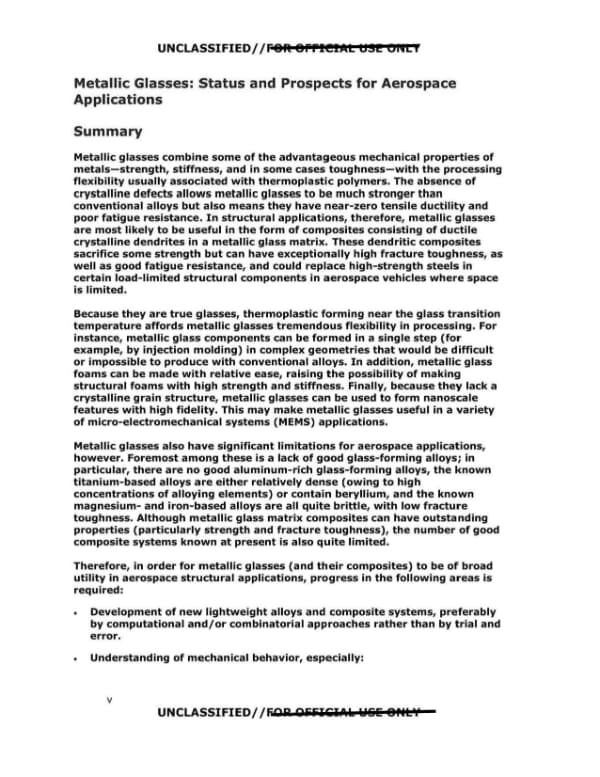
UNCLASSIFIED//FOR OFFICIAL USE ONLY Metallic Glasses STRUCTURE The atomic-scale structure of most metals and alloys is crystalline; that is, the atoms are arranged in a highly ordered manner on a lattice that is periodic in three dimensions, as depicted in Figure l(a). In contrast to this crystalline structure, metallic glasses lack the long-range order of a lattice and are therefore said to be amorphous, as depicted in Figure l(b). Although the word "amorphous" implies a complete lack of structural order, in fact the atomic structure of metallic glasses is not truly random. Constraints on atomic packing provide strong short-range order; for instance, on average the atoms have a particular number of nearest atomic neighbors at a well-defined distance. But this short-range order persists only over distances of a few atoms; there is no long-range order as there is in a crystalline alloy. In many ways, the atomic-scale structure of metallic glasses more closely resembles the highly disordered structure of a liquid than the structure of a crystalline alloy. Crystalline | Amorphous (glass) Figure 1. Amorphous Versus Crystalline Structure. Schematic atomic-scale structure of crystalline (a) and amorphous (b) metals. In a crystalline structure, order persists over long distances (many atomic dimensions). In a glass, there is short range order but no long-range order. A corollary of this difference in structure is that the nature of structural defects is quite different between crystalline and amorphous alloys. Crystalline alloys, for example, have extended linear defects in the crystal structure, called dislocations, that are (in large part) responsible for determining mechanical behavior. The lack of crystalline order precludes the existence of dislocations in metallic glasses, but other sorts of defects can be present and may influence properties and behavior. From an applications point of view, the amorphous structure of metallic glasses has two principal implications. First, the mechanical properties of amorphous alloys are significantly different from those of their crystalline counterparts; some of these differences are advantageous, but others are not. Second, because metallic glasses are 1 UNCLASSIFIED//FOR OFFICIAL USE ONLY
Page 8

Page 8 of 30

A page from a technical report on metallic glasses, covering glass-forming alloys, the role of cooling rate in preventing crystallization, and a critical cooling rate figure. It discusses how metals differ from silica and polymers in their tendency to crystallize.

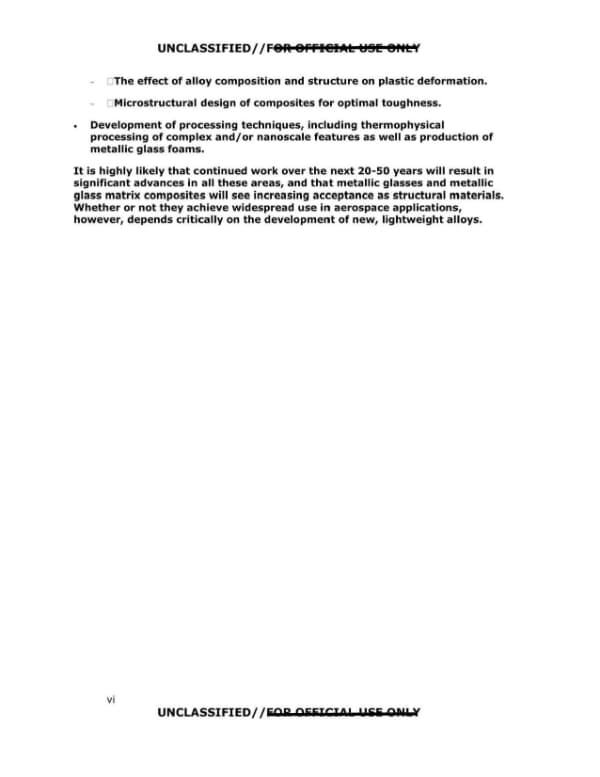
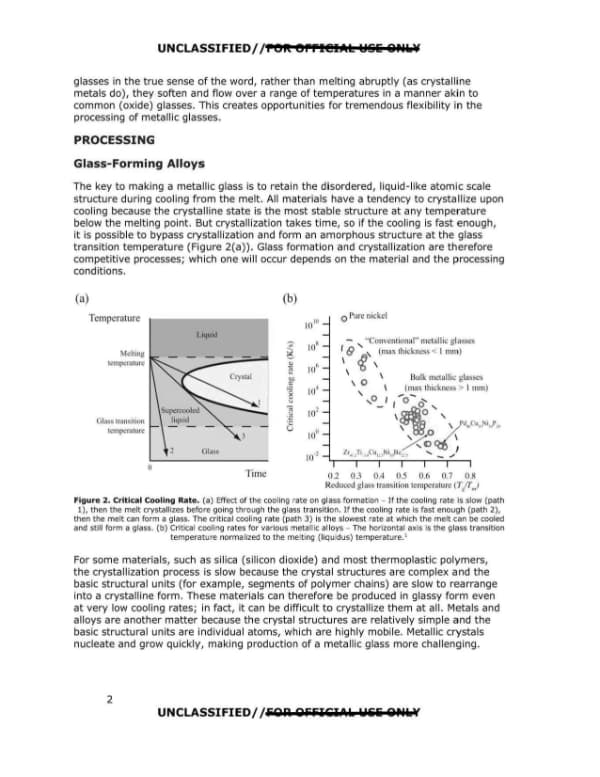
glasses in the true sense of the word, rather than melting abruptly (as crystalline metals do), they soften and flow over a range of temperatures in a manner akin to common (oxide) glasses. This creates opportunities for tremendous flexibility in the processing of metallic glasses. PROCESSING Glass-Forming Alloys The key to making a metallic glass is to retain the disordered, liquid-like atomic scale structure during cooling from the melt. All materials have a tendency to crystallize upon cooling because the crystalline state is the most stable structure at any temperature below the melting point. But crystallization takes time, so if the cooling is fast enough, it is possible to bypass crystallization and form an amorphous structure at the glass transition temperature (Figure 2(a)). Glass formation and crystallization are therefore competitive processes; which one will occur depends on the material and the processing conditions. (a) (b) Figure 2. Critical Cooling Rate. (a) Effect of the cooling rate on glass formation – If the cooling rate is slow (path 1), then the melt crystallizes before going through the glass transition. If the cooling rate is fast enough (path 2), then the melt can form a glass. The critical cooling rate (path 3) is the slowest rate at which the melt can be cooled and still form a glass. (b) Critical cooling rates for various metallic alloys – The horizontal axis is the glass transition temperature normalized to the melting (liquidus) temperature. 1 For some materials, such as silica (silicon dioxide) and most thermoplastic polymers, the crystallization process is slow because the crystal structures are complex and the basic structural units (for example, segments of polymer chains) are slow to rearrange into a crystalline form. These materials can therefore be produced in glassy form even at very low cooling rates; in fact, it can be difficult to crystallize them at all. Metals and alloys are another matter because the crystal structures are relatively simple and the basic structural units are individual atoms, which are highly mobile. Metallic crystals nucleate and grow quickly, making production of a metallic glass more challenging. 2
Page 9

Page 9 of 30

A technical page on metallic glass-forming ability, covering critical cooling rates, bulk metallic glass thresholds, and Table 1 listing selected bulk glass-forming alloys with their maximum casting thicknesses and references. It also notes that impurities and processing conditions affect glass-forming ability.

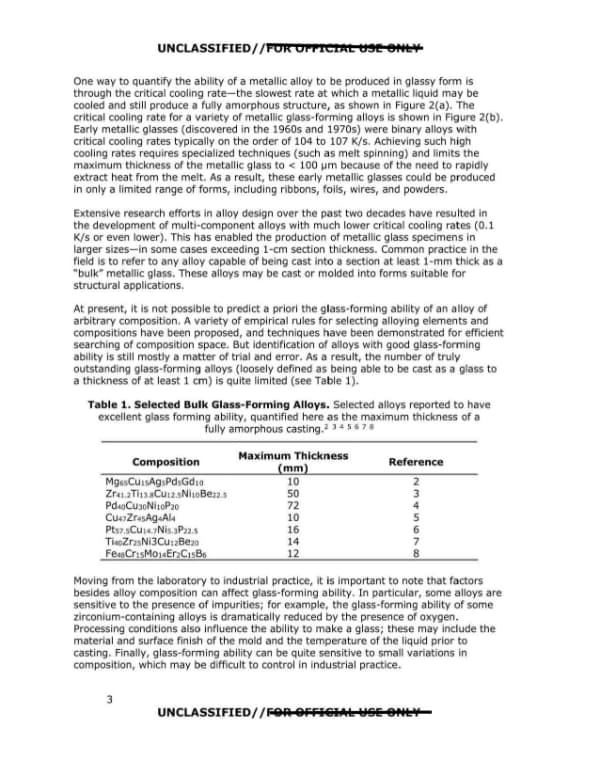
UNCLASSIFIED// FOR OFFICIAL USE ONLY One way to quantify the ability of a metallic alloy to be produced in glassy form is through the critical cooling rate- the slowest rate at which a metallic liquid may be cooled and still produce a fully amorphous structure, as shown in Figure 2(a). The critical cooling rate for a variety of metallic glass-forming alloys is shown in Figure 2(b). Early metallic glasses (discovered in the 1960s and 1970s) were binary alloys with critical cooling rates typically on the order of 104 to 107 K/s. Achieving such high cooling rates requires specialized techniques (such as melt spinning) and limits the maximum thickness of the metallic glass to < 100 µm because of the need to rapidly extract heat from the melt. As a result, these early metallic glasses could be produced in only a limited range of forms, including ribbons, foils, wires, and powders. Extensive research efforts in alloy design over the past two decades have resulted in the development of multi-component alloys with much lower critical cooling rates (0.1 K/s or even lower). This has enabled the production of metallic glass specimens in larger sizes-in some cases exceeding 1-cm section thickness. Common practice in the field is to refer to any alloy capable of being cast into a section at least 1-mm thick as a "bulk" metallic glass. These alloys may be cast or molded into forms suitable for structural applications. At present, it is not possible to predict a priori the glass-forming ability of an alloy of arbitrary composition. A variety of empirical rules for selecting alloying elements and compositions have been proposed, and techniques have been demonstrated for efficient searching of composition space. But identification of alloys with good glass-forming ability is still mostly a matter of trial and error. As a result, the number of truly outstanding glass-forming alloys (loosely defined as being able to be cast as a glass to a thickness of at least 1 cm) is quite limited (see Table 1). Table 1. Selected Bulk Glass-Forming Alloys. Selected alloys reported to have excellent glass forming ability, quantified here as the maximum thickness of a fully amorphous casting. 2 3 4 5 6 7 8 Composition | Maximum Thickness (mm) | Reference Mg65Cu15Ag5Pd5Gd10 | 10 | 2 Zr41.2Ti13.8Cu12.5Ni10Be22.5 | 50 | 3 Pd40Cu30Ni10P20 | 72 | 4 Cu47Zr45Ag4Al4 | 10 | 5 Pt57.5Cu14.7Ni5.3P22.5 | 16 | 6 Ti40Zr25Ni3Cu12Be20 | 14 | 7 Fe48Cr15Mo14Er2C15B6 | 12 | 8 Moving from the laboratory to industrial practice, it is important to note that factors besides alloy composition can affect glass-forming ability. In particular, some alloys are sensitive to the presence of impurities; for example, the glass-forming ability of some zirconium-containing alloys is dramatically reduced by the presence of oxygen. Processing conditions also influence the ability to make a glass; these may include the material and surface finish of the mold and the temperature of the liquid prior to casting. Finally, glass-forming ability can be quite sensitive to small variations in composition, which may be difficult to control in industrial practice. 3 UNCLASSIFIED// FOR OFFICIAL USE ONLY
Page 10

Page 10 of 30

A page from an AAWSAP DIRD report titled Metallic Glasses for Aerospace Applications, covering casting and molding of metallic glasses, with a Figure 3 showing a microspring and a thin-walled bottle and two limitations on processing in the supercooled liquid region. The page contains no redactions and no classification or exemption markings beyond the UNCLASSIFIED//FOR OFFICIAL USE ONLY headers.
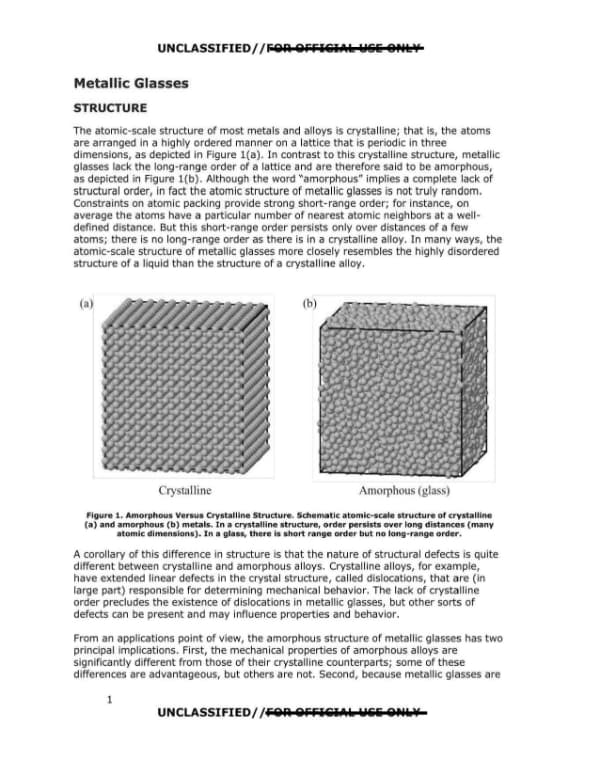
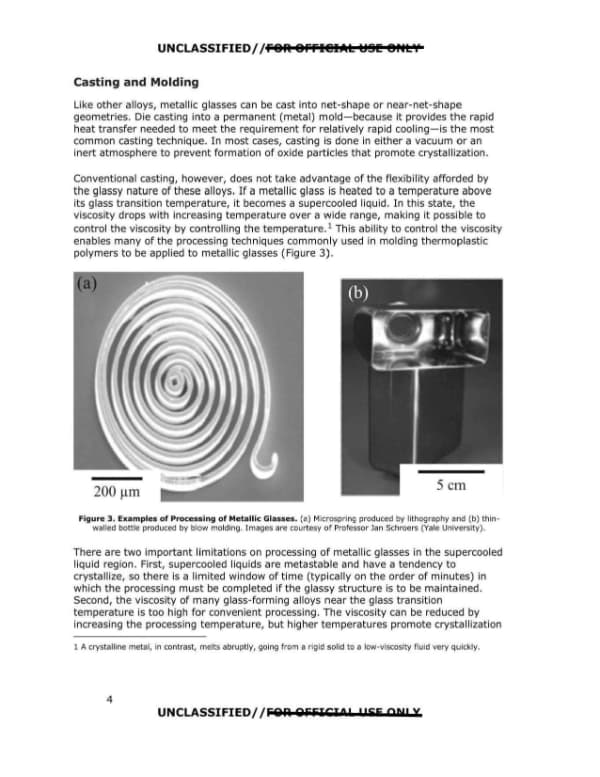
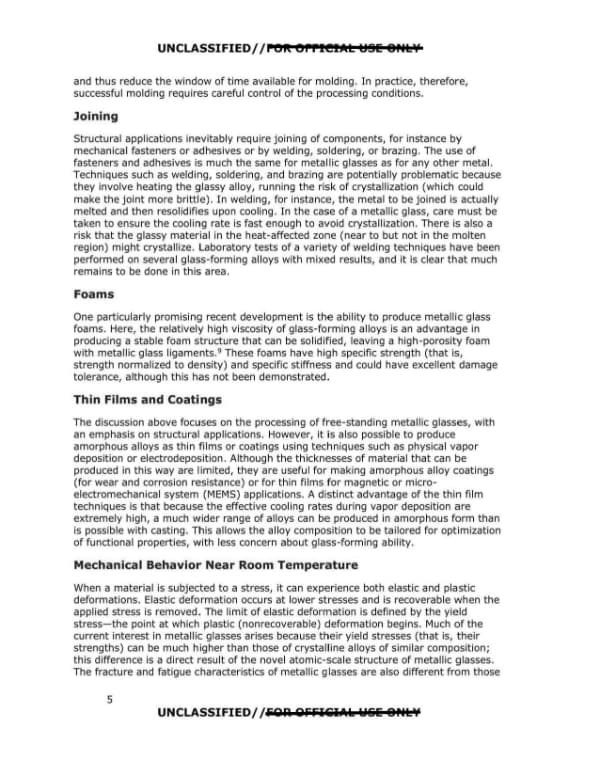
UNCLASSIFIED//FOR OFFl@IAL ~SI! 8HLY Casting and Molding Like other alloys, metallic glasses can be cast into net-shape or near-net-shape geometries. Die casting into a permanent (metal) mold-because it provides the rapid heat transfer needed to meet the requirement for relatively rapid cooling- ls the most common casting technique. In most cases, casting is done in either a vacuum or an inert atmosphere to prevent formation of oxide particles that promote crystallization. Conventional casting, however, does not take advantage of the flexibility afforded by the glassy nature of these alloys. If a metallic glass is heated to a temperature above its glass transition temperature, it becomes a supercooled liquid. In this state, the viscosity drops with increasing temperature over a wide range, making it possible to control the viscosity by controlling the temperature. 1 This ability to control the viscosity enables many of the processing techniques commonly used in molding thermoplastic polymers to be applied to metallic glasses (Figure 3). 200 µm Figure 3. Examples of Processing of Metallic Glasses. (a) Microsprlng produced by lithography and (b) thinwalled bottle produced by blow molding. Images are courtesy of Professor Jan Schroers (Yale University). There are two important limitations on processing of metallic glasses in the supercooled liquid region. First, supercooled liquids are metastable and have a tendency to crystallize, so there is a limited window of time (typically on the order of minutes) in which the processing must be completed if the glassy structure is to be maintained. Second, the viscosity of many glass-forming alloys near the glass transition temperature is too high for convenient processing. The viscosity can be reduced by increasing the processing temperature, but higher temperatures promote crystallization 1 A crystalline metal, In contrast, melts abruptly, going from a rigid solid to a low-viscosity fluid very quickly. 4 UNCLASSIFIED/ /FOA OJifilCIOP 1155 ON! X
Page 11

Page 11 of 30

A technical report page on metallic glasses covering joining methods, metallic glass foams, thin films and coatings, and mechanical behavior near room temperature. The page is marked UNCLASSIFIED//FOR OFFICIAL USE ONLY and numbered 5.
UNCLASSIFIED//FOR OFFICIAL USE ONLY and thus reduce the window of time available for molding. In practice, therefore, successful molding requires careful control of the processing conditions. Joining Structural applications inevitably require joining of components, for instance by mechanical fasteners or adhesives or by welding, soldering, or brazing. The use of fasteners and adhesives is much the same for metallic glasses as for any other metal. Techniques such as welding, soldering, and brazing are potentially problematic because they involve heating the glassy alloy, running the risk of crystallization (which could make the joint more brittle). In welding, for instance, the metal to be joined is actually melted and then resolidifies upon cooling. In the case of a metallic glass, care must be taken to ensure the cooling rate is fast enough to avoid crystallization. There is also a risk that the glassy material in the heat-affected zone (near to but not in the molten region) might crystallize. Laboratory tests of a variety of welding techniques have been performed on several glass-forming alloys with mixed results, and it is clear that much remains to be done in this area. Foams One particularly promising recent development is the ability to produce metallic glass foams. Here, the relatively high viscosity of glass-forming alloys is an advantage in producing a stable foam structure that can be solidified, leaving a high-porosity foam with metallic glass ligaments.9 These foams have high specific strength (that is, strength normalized to density) and specific stiffness and could have excellent damage tolerance, although this has not been demonstrated. Thin Films and Coatings The discussion above focuses on the processing of free-standing metallic glasses, with an emphasis on structural applications. However, it is also possible to produce amorphous alloys as thin films or coatings using techniques such as physical vapor deposition or electrodeposition. Although the thicknesses of material that can be produced in this way are limited, they are useful for making amorphous alloy coatings (for wear and corrosion resistance) or for thin films for magnetic or microelectromechanical system (MEMS) applications. A distinct advantage of the thin film techniques is that because the effective cooling rates during vapor deposition are extremely high, a much wider range of alloys can be produced in amorphous form than is possible with casting. This allows the alloy composition to be tailored for optimization of functional properties, with less concern about glass-forming ability. Mechanical Behavior Near Room Temperature When a material is subjected to a stress, it can experience both elastic and plastic deformations. Elastic deformation occurs at lower stresses and is recoverable when the applied stress is removed. The limit of elastic deformation is defined by the yield stress- the point at which plastic (nonrecoverable) deformation begins. Much of the current interest in metallic glasses arises because their yield stresses (that is, their strengths) can be much higher than those of crystalline alloys of similar composition; this difference is a direct result of the novel atomic-scale structure of metallic glasses. The fracture and fatigue characteristics of metallic glasses are also different from those 5 UNCLASSIFIED//FOR OFFICIAL USE ONLY
Page 12

Page 12 of 30

Page 6 of a 2009 AAWSAP DIRD report on metallic glasses for aerospace applications, covering their stiffness relative to crystalline alloys and their strength and ductility. The page states that metallic glasses are 20-30 percent less stiff than crystalline alloys of similar composition and that some aluminum-based and iron-based amorphous alloys have strengths two or three times greater than conventional high-strength alloys.

of conventional alloys. In this section, we review the mechanical behavior of metallic glasses, with particular attention to properties of interest for aerospace applications. We consider actual properties in detail in the section below on applications, where we compare the properties of metallic glasses with those of other advanced structural materials. Stiffness: Elastic Deformation Stiffness is the resistance of a material to elastic deformation and is quantified by either the elastic modulus (for tensile or compressive loads) or the shear modulus (for shear loading). Metallic glasses tend to be somewhat (20-30 percent) less stiff than crystalline alloys of similar composition. The lower modulus is a consequence of the amorphous structure, in which atoms are (on average) slightly farther apart than in a crystalline alloy, enabling certain atomic relaxations that are not possible in a crystal. The lower modulus of amorphous alloys is clearly a concern in applications where stiffness is a primary criterion, but it does present some advantages. For instance, some applications (springs, for example) require the ability to store elastic strain energy (resilience), and here metallic glasses do quite well. Resilience is also a key figure of merit for snap-fit assembly of materials without fasteners. Overall, however, for structural applications, the low stiffness of metallic glasses is a disadvantage. Strength and Ductility: Plastic Deformation The theoretical strength of perfect, defect-free crystalline metals is several orders of magnitude larger than strengths measured in typical laboratory experiments. The difference exists because metallic crystals inevitably have crystalline defects (dislocations) that are able to move at relatively low stresses and cause plastic (nonrecoverable) deformation. Because dislocations cannot exist in an amorphous structure, in principle the strength of amorphous alloys should approach theoretical limits based on the inherent strength of the atomic bonds. As shown in Table 2, the strength of aluminum-based metallic glasses can be two or three times greater than those of conventional (crystalline) high-strength aluminum alloys. Similarly high strengths are seen for other amorphous alloys; for instance, the best iron-based alloys have a strength of approximately 4 GPa-again, two or three times greater than those of conventional high-strength steels. 10 Such high strengths create great interest in potential structural applications of metallic glasses. 6 UNCLASSIFIED//FOR OFFICIAL USE ONLY