Page 5 of 30
This is page V of a report titled 'Metallic Glasses: Status and Prospects for Aerospace Applications', summarizing the strengths, processing advantages, and limitations of metallic glasses for aerospace structural use. The page is marked UNCLASSIFIED//FOR OFFICIAL USE ONLY and contains no redactions.
UNCLASSIFIED//FOR OFFICIAL USE ONLY
Metallic Glasses: Status and Prospects for Aerospace Applications
Summary
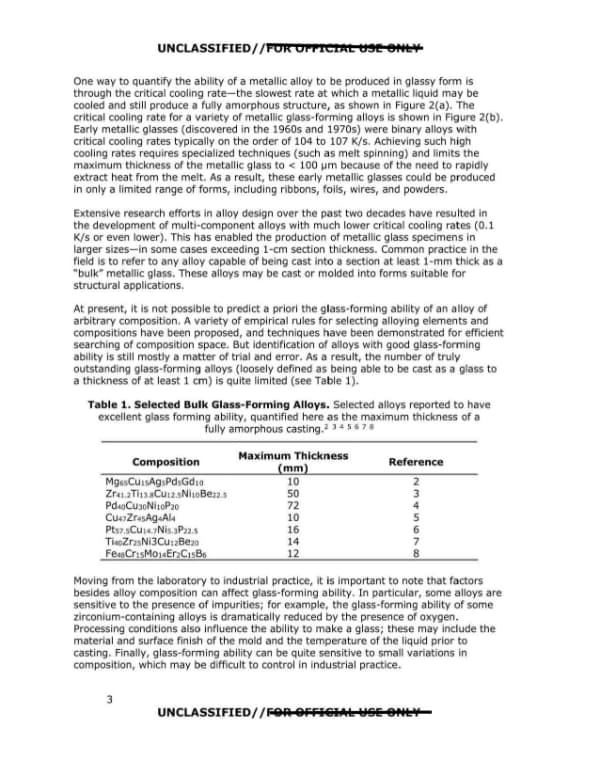
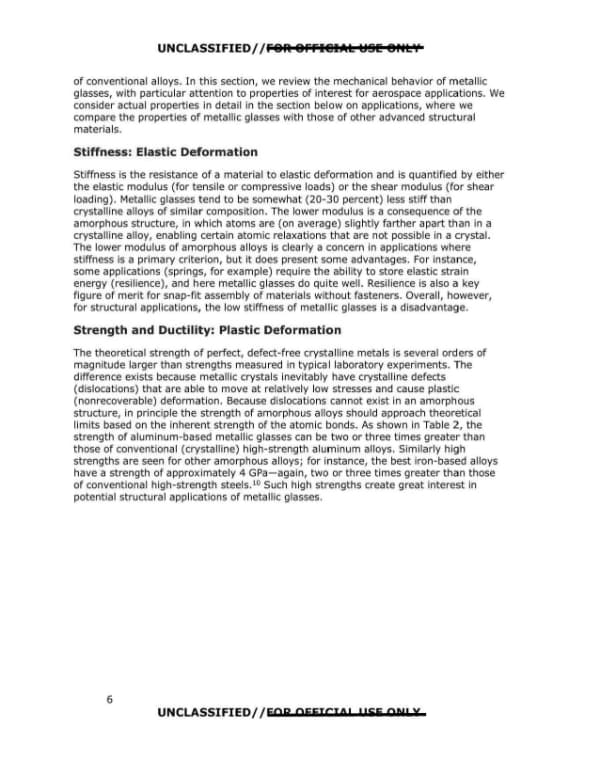
Metallic glasses combine some of the advantageous mechanical properties of metals-strength, stiffness, and in some cases toughness-with the processing flexibility usually associated with thermoplastic polymers. The absence of crystalline defects allows metallic glasses to be much stronger than conventional alloys but also means they have near-zero tensile ductility and poor fatigue resistance. In structural applications, therefore, metallic glasses are most likely to be useful in the form of composites consisting of ductile crystalline dendrites in a metallic glass matrix. These dendritic composites sacrifice some strength but can have exceptionally high fracture toughness, as well as good fatigue resistance, and could replace high-strength steels in certain load-limited structural components in aerospace vehicles where space is limited.
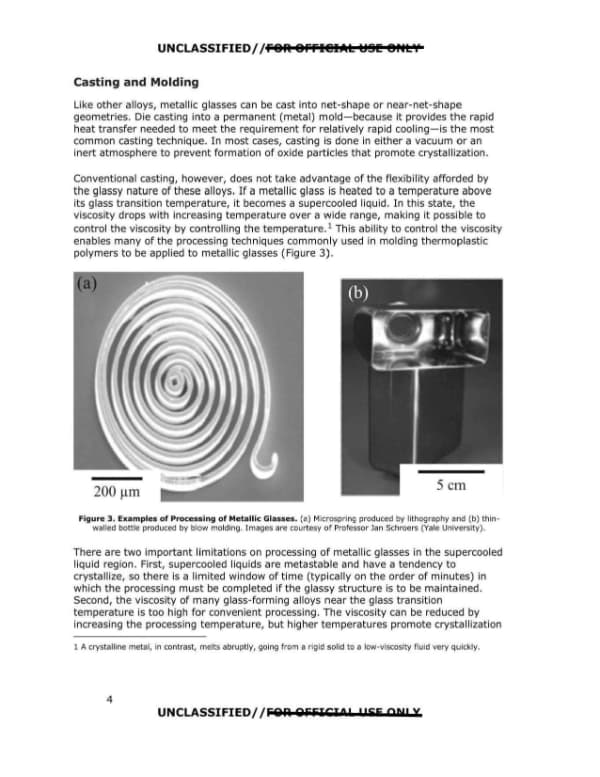
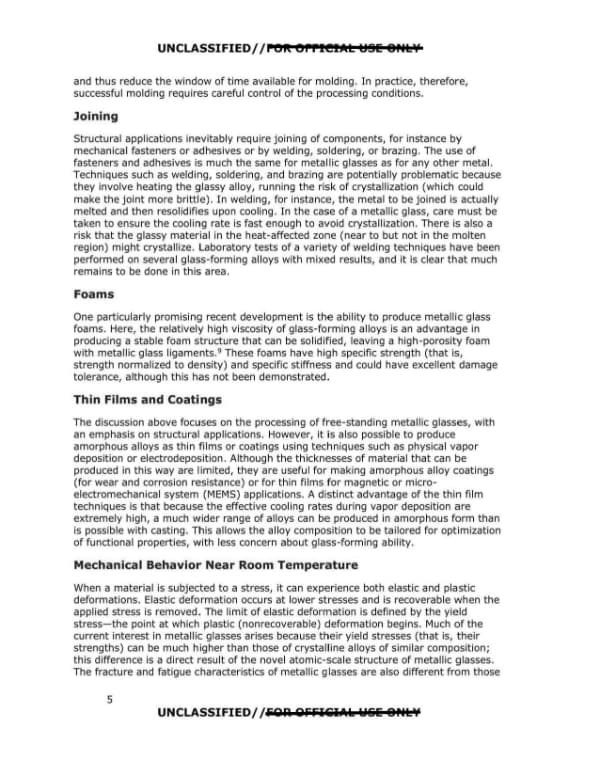
Because they are true glasses, thermoplastic forming near the glass transition temperature affords metallic glasses tremendous flexibility in processing. For instance, metallic glass components can be formed in a single step (for example, by injection molding) in complex geometries that would be difficult or impossible to produce with conventional alloys. In addition, metallic glass foams can be made with relative ease, raising the possibility of making structural foams with high strength and stiffness. Finally, because they lack a crystalline grain structure, metallic glasses can be used to form nanoscale features with high fidelity. This may make metallic glasses useful in a variety of micro-electromechanical systems (MEMS) applications.
Metallic glasses also have significant limitations for aerospace applications, however. Foremost among these is a lack of good glass-forming alloys; in particular, there are no good aluminum-rich glass-forming alloys, the known titanium-based alloys are either relatively dense (owing to high concentrations of alloying elements) or contain beryllium, and the known magnesium- and iron-based alloys are all quite brittle, with low fracture toughness. Although metallic glass matrix composites can have outstanding properties (particularly strength and fracture toughness), the number of good composite systems known at present is also quite limited.
Therefore, in order for metallic glasses (and their composites) to be of broad utility in aerospace structural applications, progress in the following areas is required:
• Development of new lightweight alloys and composite systems, preferably by computational and/or combinatorial approaches rather than by trial and error.
• Understanding of mechanical behavior, especially:
V
UNCLASSIFIED//FOR OFFICIAL USE ONLY