$DECLASSwnMfUvY5KfUN2LbKgyHXwmh39mGpJd7bjJw5A71pumpBuy
Declassified
Releases / Release 06 / DOW-UAP-D126
Department of War

AAWSAP DIRD, Advanced Nuclear Propulsion for Manned Deep Space Missions, March 2010

This document is a Defense Intelligence Reference Document (DIRD), a technical reference format used by the Defense Intelligence Agency (DIA) to capture baseline knowledge on a specific topic for later analytic use. DIRDs are best understood as reference and synthesis products rather than as original research. It is one of 38 DIRDs produced under the Advanced Aerospace Weapon System Applications Program (AAWSAP) between 2009 and 2011. Because AAWSAP’s scope permitted a broad range of supporting topics, not every DIRD in the series directly concerns aerospace systems or future threat assessment. The following summary reflects the DIRD’s scope and framing at the time of writing and should…

Catalogue description by the publishing agency.

Record
DOW-UAP-D126
Release
Release 06 · Sep 18, 2026
Incident
2010-03-11 · Las Vegas, Nevada
Pages
37
Verdict
not judged yet
Source
war.gov ↗
Page by page

The pages and what the AI read on them

The transcription is the page reader's: black bars mark what the government redacted; hatched tags mark personal data we removed.
Page 13

Page 13 of 37

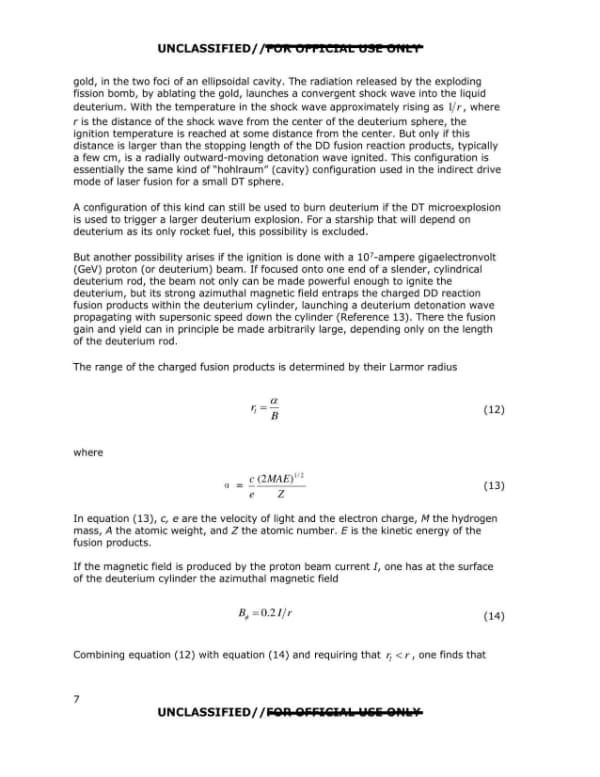
A page from a 2010 AAWSAP DIRD report on advanced nuclear propulsion that describes a hohlraum-based deuterium ignition configuration and a proton or deuterium beam ignition concept using a magnetic field to propagate a deuterium detonation wave along a cylinder. It includes equations (12) through (14) for the Larmor radius and azimuthal magnetic field.
gold, in the two foci of an ellipsoidal cavity. The radiation released by the exploding fission bomb, by ablating the gold, launches a convergent shock wave into the liquid deuterium. With the temperature in the shock wave approximately rising as 1/r, where r is the distance of the shock wave from the center of the deuterium sphere, the ignition temperature is reached at some distance from the center. But only if this distance is larger than the stopping length of the DD fusion reaction products, typically a few cm, is a radially outward-moving detonation wave ignited. This configuration is essentially the same kind of "hohlraum" (cavity) configuration used in the indirect drive mode of laser fusion for a small DT sphere. A configuration of this kind can still be used to burn deuterium if the DT microexplosion is used to trigger a larger deuterium explosion. For a starship that will depend on deuterium as its only rocket fuel, this possibility is excluded. But another possibility arises if the ignition is done with a 10^7-ampere gigaelectronvolt (GeV) proton (or deuterium) beam. If focused onto one end of a slender, cylindrical deuterium rod, the beam not only can be made powerful enough to ignite the deuterium, but its strong azimuthal magnetic field entraps the charged DD reaction fusion products within the deuterium cylinder, launching a deuterium detonation wave propagating with supersonic speed down the cylinder (Reference 13). There the fusion gain and yield can in principle be made arbitrarily large, depending only on the length of the deuterium rod. The range of the charged fusion products is determined by their Larmor radius [EQUATION (12): r_i = alpha / B] where [EQUATION (13): alpha = (c / e)(2MAE)^(1/2) / Z] In equation (13), c, e are the velocity of light and the electron charge, M the hydrogen mass, A the atomic weight, and Z the atomic number. E is the kinetic energy of the fusion products. If the magnetic field is produced by the proton beam current I, one has at the surface of the deuterium cylinder the azimuthal magnetic field [EQUATION (14): B_phi = 0.2 I / r] Combining equation (12) with equation (14) and requiring that r_i < r, one finds that 7
Page 14

Page 14 of 37

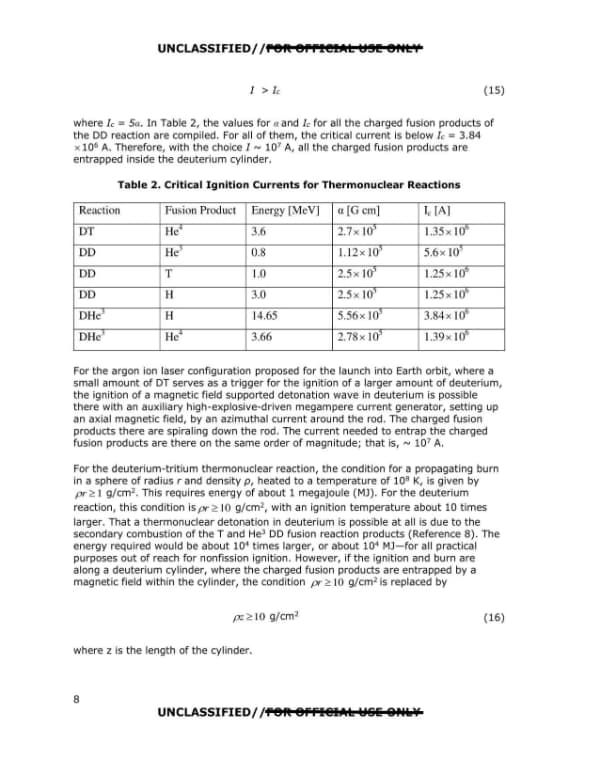
A technical page from a 2010 advanced nuclear propulsion study discussing critical ignition currents for thermonuclear reactions, with Table 2 listing fusion products and their energies, alpha values and critical currents. It also discusses ignition conditions for deuterium-tritium and deuterium reactions in spheres and cylinders.
UNCLASSIFIED//FOR OFFICIAL USE ONLY I > Ic (15) where Ic = 5α. In Table 2, the values for α and Ic for all the charged fusion products of the DD reaction are compiled. For all of them, the critical current is below Ic = 3.84 x 10^6 A. Therefore, with the choice I ~ 10^7 A, all the charged fusion products are entrapped inside the deuterium cylinder. Table 2. Critical Ignition Currents for Thermonuclear Reactions Reaction | Fusion Product | Energy [MeV] | α [G cm] | Ic [A] DT | He^4 | 3.6 | 2.7 x 10^5 | 1.35 x 10^6 DD | He^3 | 0.8 | 1.12 x 10^5 | 5.6 x 10^5 DD | T | 1.0 | 2.5 x 10^5 | 1.25 x 10^6 DD | H | 3.0 | 2.5 x 10^5 | 1.25 x 10^6 DHe^3 | H | 14.65 | 5.56 x 10^5 | 3.84 x 10^6 DHe^3 | He^4 | 3.66 | 2.78 x 10^5 | 1.39 x 10^6 For the argon ion laser configuration proposed for the launch into Earth orbit, where a small amount of DT serves as a trigger for the ignition of a larger amount of deuterium, the ignition of a magnetic field supported detonation wave in deuterium is possible there with an auxiliary high-explosive-driven megampere current generator, setting up an axial magnetic field, by an azimuthal current around the rod. The charged fusion products there are spiraling down the rod. The current needed to entrap the charged fusion products are there on the same order of magnitude; that is, ~ 10^7 A. For the deuterium-tritium thermonuclear reaction, the condition for a propagating burn in a sphere of radius r and density ρ, heated to a temperature of 10^8 K, is given by ρr ≥ 1 g/cm^2. This requires energy of about 1 megajoule (MJ). For the deuterium reaction, this condition is ρr ≥ 10 g/cm^2, with an ignition temperature about 10 times larger. That a thermonuclear detonation in deuterium is possible at all is due to the secondary combustion of the T and He^3 DD fusion reaction products (Reference 8). The energy required would be about 10^4 times larger, or about 10^4 MJ—for all practical purposes out of reach for nonfission ignition. However, if the ignition and burn are along a deuterium cylinder, where the charged fusion products are entrapped by a magnetic field within the cylinder, the condition ρr ≥ 10 g/cm^2 is replaced by ρz ≥ 10 g/cm^2 (16) where z is the length of the cylinder. 8 UNCLASSIFIED//FOR OFFICIAL USE ONLY
Page 15

Page 15 of 37

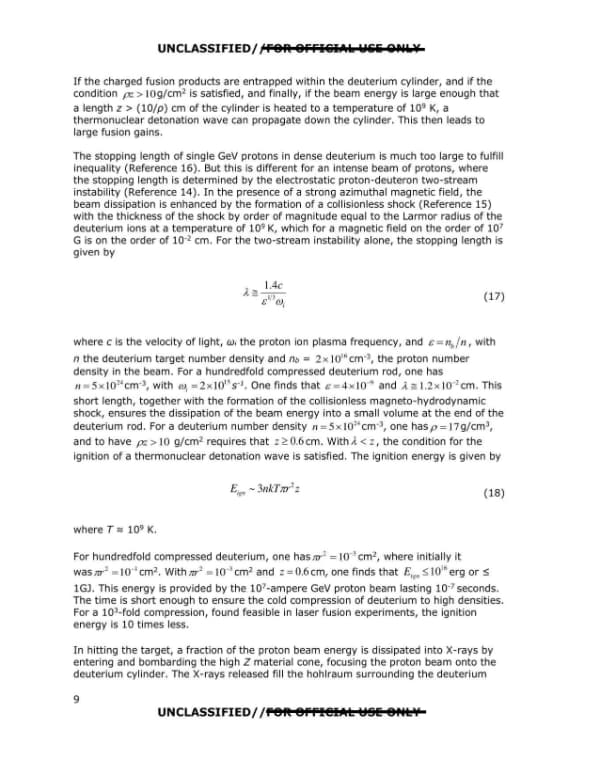
A page from a 2010 AAWSAP DIRD report on advanced nuclear propulsion that describes theoretical conditions for a thermonuclear detonation wave in a compressed deuterium cylinder driven by a GeV proton beam. Header and footer carry UNCLASSIFIED / FOR OFFICIAL USE ONLY markings.

If the charged fusion products are entrapped within the deuterium cylinder, and if the condition ho z > 10 g/cm2 is satisfied, and finally, if the beam energy is large enough that a length z > (10/ ho) cm of the cylinder is heated to a temperature of 10^9 K, a thermonuclear detonation wave can propagate down the cylinder. This then leads to large fusion gains. The stopping length of single GeV protons in dense deuterium is much too large to fulfill inequality (Reference 16). But this is different for an intense beam of protons, where the stopping length is determined by the electrostatic proton-deuteron two-stream instability (Reference 14). In the presence of a strong azimuthal magnetic field, the beam dissipation is enhanced by the formation of a collisionless shock (Reference 15) with the thickness of the shock by order of magnitude equal to the Larmor radius of the deuterium ions at a temperature of 10^9 K, which for a magnetic field on the order of 10^7 G is on the order of 10^-2 cm. For the two-stream instability alone, the stopping length is given by (17) where c is the velocity of light, \omega_i the proton ion plasma frequency, and \varepsilon = n_b/n, with n the deuterium target number density and n_b = 2 x 10^16 cm^-3, the proton number density in the beam. For a hundredfold compressed deuterium rod, one has n = 5 x 10^24 cm^-3, with \omega_i = 2 x 10^15 s^-1. One finds that \varepsilon = 4 x 10^-9 and \lambda >= 1.2 x 10^-2 cm. This short length, together with the formation of the collisionless magneto-hydrodynamic shock, ensures the dissipation of the beam energy into a small volume at the end of the deuterium rod. For a deuterium number density n = 5 x 10^24 cm^-3, one has \rho = 17 g/cm^3, and to have \rho z > 10 g/cm^2 requires that z >= 0.6 cm. With \lambda < z, the condition for the ignition of a thermonuclear detonation wave is satisfied. The ignition energy is given by E_ign ~ 3nkT\pi r^2 z (18) where T ~ 10^9 K. For hundredfold compressed deuterium, one has \pi r^2 = 10^-3 cm^2, where initially it was \pi r^2 = 10^-1 cm^2. With \pi r^2 = 10^-3 cm^2 and z = 0.6 cm, one finds that E_ign <= 10^16 erg or <= 1GJ. This energy is provided by the 10^7-ampere GeV proton beam lasting 10^-7 seconds. The time is short enough to ensure the cold compression of deuterium to high densities. For a 10^3-fold compression, found feasible in laser fusion experiments, the ignition energy is 10 times less. In hitting the target, a fraction of the proton beam energy is dissipated into X-rays by entering and bombarding the high Z material cone, focusing the proton beam onto the deuterium cylinder. The X-rays released fill the hohlraum surrounding the deuterium
Page 16

Page 16 of 37

A page of a technical report on nuclear propulsion that covers proton-beam return-current physics with equations (19)-(21) and begins a section on propulsion options. The page is marked UNCLASSIFIED with a struck-through FOR OFFICIAL USE ONLY legend.
cylinder, compressing it to high densities, while the bulk of the proton beam energy heats and ignites the deuterium cylinder at its end, launching in it a detonation wave. If the GeV -10^7-ampere proton beam passes through background hydrogen plasma with a particle number density n, it induces in the plasma a return current carried by its electrons, where the electrons move in the same direction as the protons. But because the current of the proton beam and the return current of the plasma electrons are in opposite directions, they repel each other. Since the stagnation pressure of the GeV -10^7-ampere proton beam is much larger than that of the electron return current, the return current electrons will be repelled from the proton beam toward the surface of the proton beam. The stagnation pressure of a GeV proton beam is (M_H proton mass) p_i ≅ ρ_i c^2 = n_b M_H c^2 (19) For n_b ≅ 2x10^16 cm^-3, one obtains p_i ≅ 3x10^13 dyn/cm^3. For the electron return current, one has (m electron mass) p_e = n_e m v^2 (20) With the return current condition n_e e v_e = n_i e v_i, where for GeV protons v_i ≅ c, one has v_e/c = n_i/n_e (21) Taking the value n_e = 5x10^22 cm^-3, valid for uncompressed solid deuterium, one obtains v_e ≅ 10^4 cm/s and hence p_e ≅ 5x10^3 dyn/cm^2. This is negligible against p_i, even if n_e is 10^3 times larger, as in highly compressed deuterium. The assumption that the magnetic field of the proton beam is sufficiently strong to entrap the charged fusion products within the deuterium cylinder is therefore well justified. Solution in Between Two Extremes With chemical propulsion, manned space flight to the Moon is barely possible and only with massive multistage rockets. For manned space flight beyond the Moon, nuclear propulsion is indispensible. Nuclear thermal propulsion is really not much better than advanced chemical propulsion. Ion propulsion, using a nuclear reactor to drive an electric generator, has a much higher specific impulse but not enough thrust for short interplanetary transit times needed for manned missions. This leaves propulsion by a chain of fission bombs (or fission-triggered fusion bombs) as the only credible option. There the thrust and specific impulse are comparatively huge, but a comparatively small explosive yield is desirable. Making the yield too small, the bombs become 10
Page 17

Page 17 of 37

A page from an AAWSAP DIRD report on advanced nuclear propulsion that discusses thermonuclear microexplosion ignition methods for DT, DD and He3-D reactions, with Figure 1 comparing ignition energy and density-radius requirements for three approaches. The page is marked UNCLASSIFIED / FOR OFFICIAL USE ONLY.
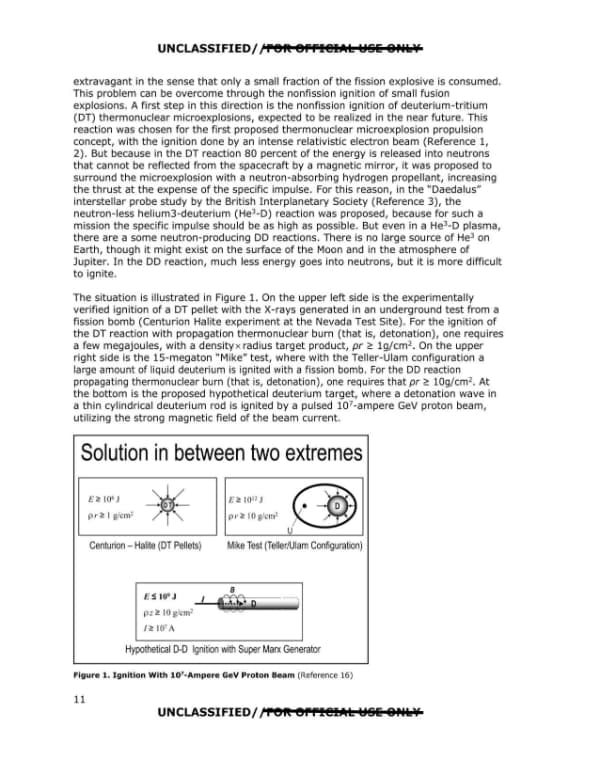
UNCLASSIFIED/ /FOR OFFICIAL USE ONLY extravagant in the sense that only a small fraction of the fission explosive is consumed. This problem can be overcome through the nonfission ignition of small fusion explosions. A first step in this direction is the nonfission ignition of deuterium-tritium (DT) thermonuclear microexplosions, expected to be realized in the near future. This reaction was chosen for the first proposed thermonuclear microexplosion propulsion concept, with the ignition done by an intense relativistic electron beam (Reference 1, 2). But because in the DT reaction 80 percent of the energy is released into neutrons that cannot be reflected from the spacecraft by a magnetic mirror, it was proposed to surround the microexplosion with a neutron-absorbing hydrogen propellant, increasing the thrust at the expense of the specific impulse. For this reason, in the "Daedalus" interstellar probe study by the British Interplanetary Society (Reference 3), the neutron-less helium3-deuterium (He3-D) reaction was proposed, because for such a mission the specific impulse should be as high as possible. But even in a He3-D plasma, there are a some neutron-producing DD reactions. There is no large source of He3 on Earth, though it might exist on the surface of the Moon and in the atmosphere of Jupiter. In the DD reaction, much less energy goes into neutrons, but it is more difficult to ignite. The situation is illustrated in Figure 1. On the upper left side is the experimentally verified ignition of a DT pellet with the X-rays generated in an underground test from a fission bomb (Centurion Halite experiment at the Nevada Test Site). For the ignition of the DT reaction with propagation thermonuclear burn (that is, detonation), one requires a few megajoules, with a density x radius target product, pr~ lg/cm2 . On the upper right side is the 15-megaton "Mike" test, where with the Teller-Ulam configuration a large amount of liquid deuterium is ignited with a fission bomb. For the DD reaction propagating thermonuclear burn (that is, detonation), one requires that pr~ 10g/cm2. At the bottom is the proposed hypothetica l deuterium target, where a detonation wave in a thin cylindrical deuterium rod is ignited by a pulsed 107 -ampere GeV proton beam, utilizing the strong magnetic field of the beam current. Solution in between two extremes £~ l06J £~!012 J pr~ I g/cm2 * /j pr~ 10 g/cm2 u @ Centurion - Halite (DT Pellets) Mike Test (Teller/Ulam Configuration) B E S 109 J I ...... • ..\.t ~ n ·, pz ~ 10 g/cm2 --- I~ 101 A Hypothetical D-D Ignition with Super Marx Generator Figure 1. Ignition With 107-Ampere GeV Proton Beam (Reference 16) UNCLASSIFIED/ /FOR. 0PPl@IAL Y§lii 8PUzlf 11
Page 18

Page 18 of 37

A page from a technical report on advanced nuclear propulsion that works through an order-of-magnitude estimate of thrust, mass flow, propulsion power and rocket-equation velocity for a hypothetical fusion-bomb-driven spacecraft. The page is numbered 12 and carries UNCLASSIFIED and FOR OFFICIAL USE ONLY banners.
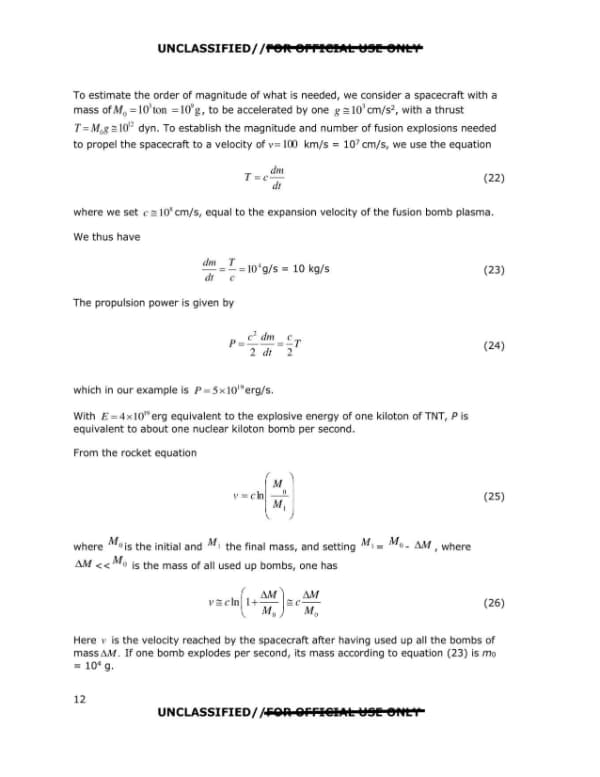
UNCLASSIFIED/ /FOR OFFICIAL USE ONLY To estimate the order of magnitude of what is needed, we consider a spacecraft with a mass of M0 = 10^3 ton = 10^9 g, to be accelerated by one g ≅ 10^3 cm/s^2, with a thrust T = M0 g ≅ 10^12 dyn. To establish the magnitude and number of fusion explosions needed to propel the spacecraft to a velocity of v= 100 km/s = 10^7 cm/s, we use the equation T = c dm/dt (22) where we set c ≅ 10^8 cm/s, equal to the expansion velocity of the fusion bomb plasma. We thus have dm/dt = T/c = 10^4 g/s = 10 kg/s (23) The propulsion power is given by P = (c^2/2) dm/dt = (c/2) T (24) which in our example is P = 5 x 10^19 erg/s. With E = 4 x 10^19 erg equivalent to the explosive energy of one kiloton of TNT, P is equivalent to about one nuclear kiloton bomb per second. From the rocket equation v = c ln(M0/M1) (25) where M0 is the initial and M1 the final mass, and setting M1 = M0 - ΔM, where ΔM << M0 is the mass of all used up bombs, one has v ≅ c ln(1 + ΔM/M0) ≅ c ΔM/M0 (26) Here v is the velocity reached by the spacecraft after having used up all the bombs of mass ΔM. If one bomb explodes per second, its mass according to equation (23) is m0 = 10^4 g. 12 UNCLASSIFIED/ /FOR OFFICIAL USE ONLY
Page 19

Page 19 of 37

A numbered page from a 2010 advanced nuclear propulsion study discussing energy estimates for fusion-bomb spacecraft propulsion and a concept for nonfission ignition of deuterium explosives using charged particle beams. The page is marked UNCLASSIFIED//FOR OFFICIAL USE ONLY with the FOUO legend struck through.
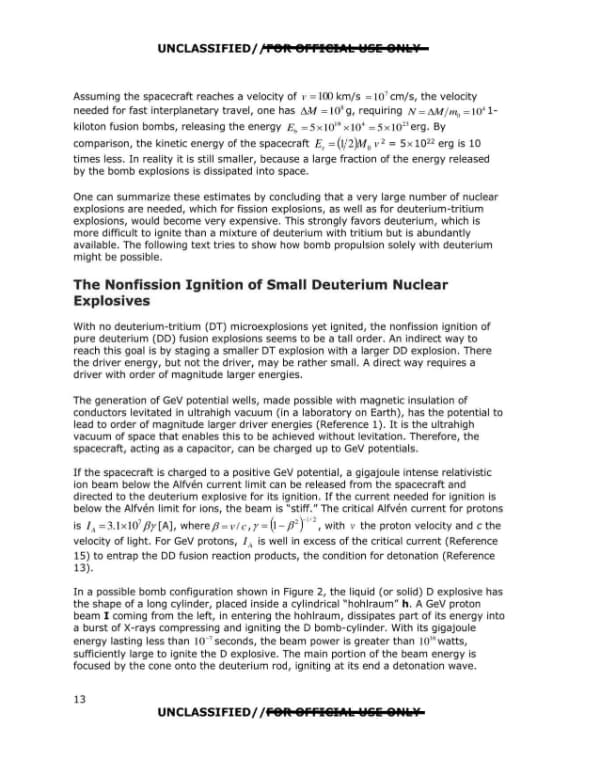
Assuming the spacecraft reaches a velocity of v = 100 km/s = 10^7 cm/s, the velocity needed for fast interplanetary travel, one has ΔM = 10^8 g, requiring N = ΔM/m0 = 10^4 1-kiloton fusion bombs, releasing the energy E_b = 5x10^19 x 10^4 = 5 x 10^23 erg. By comparison, the kinetic energy of the spacecraft E_s = (1/2)M0 v^2 = 5x 10^22 erg is 10 times less. In reality it is still smaller, because a large fraction of the energy released by the bomb explosions is dissipated into space. One can summarize these estimates by concluding that a very large number of nuclear explosions are needed, which for fission explosions, as well as for deuterium-tritium explosions, would become very expensive. This strongly favors deuterium, which is more difficult to ignite than a mixture of deuterium with tritium but is abundantly available. The following text tries to show how bomb propulsion solely with deuterium might be possible. The Nonfission Ignition of Small Deuterium Nuclear Explosives With no deuterium-tritium (DT) microexplosions yet ignited, the nonfission ignition of pure deuterium (DD) fusion explosions seems to be a tall order. An indirect way to reach this goal is by staging a smaller DT explosion with a larger DD explosion. There the driver energy, but not the driver, may be rather small. A direct way requires a driver with order of magnitude larger energies. The generation of GeV potential wells, made possible with magnetic insulation of conductors levitated in ultrahigh vacuum (in a laboratory on Earth), has the potential to lead to order of magnitude larger driver energies (Reference 1). It is the ultrahigh vacuum of space that enables this to be achieved without levitation. Therefore, the spacecraft, acting as a capacitor, can be charged up to GeV potentials. If the spacecraft is charged to a positive GeV potential, a gigajoule intense relativistic ion beam below the Alfven current limit can be released from the spacecraft and directed to the deuterium explosive for its ignition. If the current needed for ignition is below the Alfven limit for ions, the beam is "stiff." The critical Alfven current for protons is I_A = 3.1 x 10^7 βγ [A], where β = v/c, γ = (1 - β^2)^-1/2, with v the proton velocity and c the velocity of light. For GeV protons, I_A is well in excess of the critical current (Reference 15) to entrap the DD fusion reaction products, the condition for detonation (Reference 13). In a possible bomb configuration shown in Figure 2, the liquid (or solid) D explosive has the shape of a long cylinder, placed inside a cylindrical "hohlraum" h. A GeV proton beam I coming from the left, in entering the hohlraum, dissipates part of its energy into a burst of X-rays compressing and igniting the D bomb-cylinder. With its gigajoule energy lasting less than 10^-7 seconds, the beam power is greater than 10^16 watts, sufficiently large to ignite the D explosive. The main portion of the beam energy is focused by the cone onto the deuterium rod, igniting at its end a detonation wave. 13 UNCLASSIFIED//FOR OFFICIAL USE ONLY
Page 20

Page 20 of 37

This page is a report page describing a pure deuterium fusion explosion propulsion concept, with Figure 2 showing the ignition setup and Figure 3 showing neutron screening of a spacecraft by a boron diaphragm. It discusses the effects of deuterium cylinder diameter on yield and thrust, and states that 38 percent of the energy is released as neutrons.

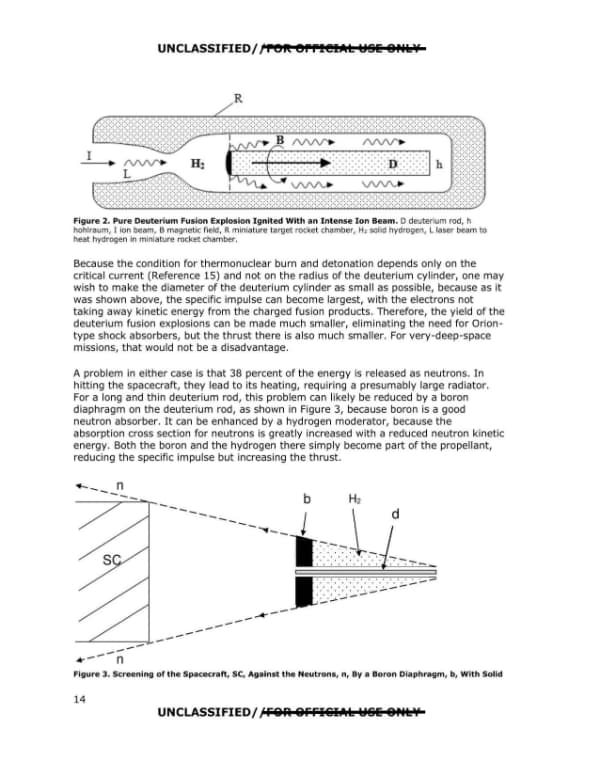
UNCLASSIFIED/ /FOR OFFICIAL USE ONLY Figure 2. Pure Deuterium Fusion Explosion Ignited With an Intense Ion Beam. D deuterium rod, h hohlraum, I ion beam, B magnetic field, R miniature target rocket chamber, H2 solid hydrogen, L laser beam to heat hydrogen in miniature rocket chamber. Because the condition for thermonuclear burn and detonation depends only on the critical current (Reference 15) and not on the radius of the deuterium cylinder, one may wish to make the diameter of the deuterium cylinder as small as possible, because as it was shown above, the specific impulse can become largest, with the electrons not taking away kinetic energy from the charged fusion products. Therefore, the yield of the deuterium fusion explosions can be made much smaller, eliminating the need for Orion-type shock absorbers, but the thrust there is also much smaller. For very-deep-space missions, that would not be a disadvantage. A problem in either case is that 38 percent of the energy is released as neutrons. In hitting the spacecraft, they lead to its heating, requiring a presumably large radiator. For a long and thin deuterium rod, this problem can likely be reduced by a boron diaphragm on the deuterium rod, as shown in Figure 3, because boron is a good neutron absorber. It can be enhanced by a hydrogen moderator, because the absorption cross section for neutrons is greatly increased with a reduced neutron kinetic energy. Both the boron and the hydrogen there simply become part of the propellant, reducing the specific impulse but increasing the thrust. Figure 3. Screening of the Spacecraft, SC, Against the Neutrons, n, By a Boron Diaphragm, b, With Solid 14 UNCLASSIFIED/ /FOR OFFICIAL USE ONLY
Page 21

Page 21 of 37

Not read yet.

Page 22

Page 22 of 37

Not read yet.

Page 23

Page 23 of 37

Not read yet.

Page 24

Page 24 of 37

Not read yet.