$DECLASSwnMfUvY5KfUN2LbKgyHXwmh39mGpJd7bjJw5A71pumpBuy
Declassified
Releases / Release 06 / DOW-UAP-D126
Department of War

AAWSAP DIRD, Advanced Nuclear Propulsion for Manned Deep Space Missions, March 2010

This document is a Defense Intelligence Reference Document (DIRD), a technical reference format used by the Defense Intelligence Agency (DIA) to capture baseline knowledge on a specific topic for later analytic use. DIRDs are best understood as reference and synthesis products rather than as original research. It is one of 38 DIRDs produced under the Advanced Aerospace Weapon System Applications Program (AAWSAP) between 2009 and 2011. Because AAWSAP’s scope permitted a broad range of supporting topics, not every DIRD in the series directly concerns aerospace systems or future threat assessment. The following summary reflects the DIRD’s scope and framing at the time of writing and should…

Catalogue description by the publishing agency.

Record
DOW-UAP-D126
Release
Release 06 · Sep 18, 2026
Incident
2010-03-11 · Las Vegas, Nevada
Pages
37
Verdict
not judged yet
Source
war.gov ↗
Page by page

The pages and what the AI read on them

The transcription is the page reader's: black bars mark what the government redacted; hatched tags mark personal data we removed.
Page 1

Page 1 of 37

This is the cover page of a Defense Intelligence Reference Document titled "Advanced Nuclear Propulsion for Manned Deep Space Missions", dated 11 March 2010, with ICOD 1 December 2009 and document number DIA-08-1003-007. The page is marked UNCLASSIFIED//FOR OFFICIAL USE ONLY and bears the Defense Intelligence Agency seal.
UNCLASSIFIED// /FOR OFFICIAL USE ONLY Defense Intelligence Reference Document Acquisition Threat Support 11 March 2010 ICOD: 1 December 2009 DIA-08-1003-007 Advanced Nuclear Propulsion for Manned Deep Space Missions UNCLASSIFIED// /FOR OFFICIAL USE ONLY
Page 2

Page 2 of 37 · 1 redaction

This is the title and administrative note page of a Defense Intelligence Agency report on advanced nuclear propulsion for manned deep space missions, prepared by the Defense Warning Office and authored by AAP Person 72. It gives the AAWSA program context and a copyright warning about the photographs, with the contact name redacted.
UNCLASSIFIED//FOR OFFICIAL USE ONLY Advanced Nuclear Propulsion for Manned Deep Space Missions Prepared by: Acquisition Support Division (DWO-3) Defense Warning Office Directorate for Analysis Defense Intelligence Agency Author: AAP Person 72 Administrative Note COPYRIGHT WARNING: Further dissemination of the photographs in this publication is not authorized. This product is one in a series of advanced technology reports produced in FY 2009 under the Defense Intelligence Agency, Defense Warning Office's Advanced Aerospace Weapon System Applications (AAWSA) Program. Comments or questions pertaining to this document should be addressed to [REDACTED] AAWSA Program Manager, Defense Intelligence Agency, ATTN: CLAR/DWO-3, Bldg 6000, Washington, DC 20340-5100. ii UNCLASSIFIED//FOR OFFICIAL USE ONLY
Page 3

Page 3 of 37

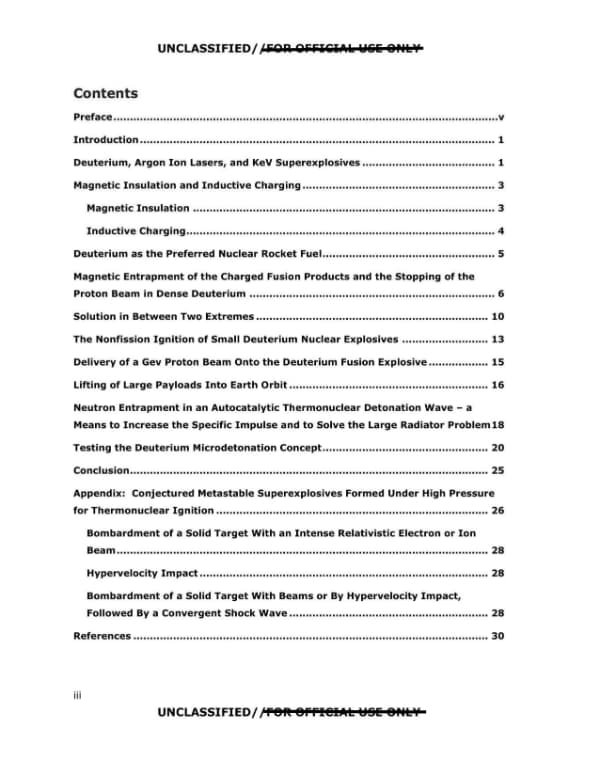
This page is the table of contents of a report, listing its sections, subsections and page numbers from Preface through References. It carries the UNCLASSIFIED/FOR OFFICIAL USE ONLY marking at top and bottom.
UNCLASSIFIED/ /FOR OFFICIAL USE ONLY Contents Preface.....v Introduction.....1 Deuterium, Argon Ion Lasers, and KeV Superexplosives .....1 Magnetic Insulation and Inductive Charging .....3 Magnetic Insulation .....3 Inductive Charging .....4 Deuterium as the Preferred Nuclear Rocket Fuel .....5 Magnetic Entrapment of the Charged Fusion Products and the Stopping of the Proton Beam in Dense Deuterium .....6 Solution in Between Two Extremes .....10 The Nonfission Ignition of Small Deuterium Nuclear Explosives .....13 Delivery of a Gev Proton Beam Onto the Deuterium Fusion Explosive .....15 Lifting of Large Payloads Into Earth Orbit .....16 Neutron Entrapment in an Autocatalytic Thermonuclear Detonation Wave - a Means to Increase the Specific Impulse and to Solve the Large Radiator Problem18 Testing the Deuterium Microdetonation Concept .....20 Conclusion.....25 Appendix: Conjectured Metastable Superexplosives Formed Under High Pressure for Thermonuclear Ignition .....26 Bombardment of a Solid Target With an Intense Relativistic Electron or Ion Beam.....28 Hypervelocity Impact .....28 Bombardment of a Solid Target With Beams or By Hypervelocity Impact, Followed By a Convergent Shock Wave .....28 References .....30 iii UNCLASSIFIED/ /FOR OFFICIAL USE ONLY
Page 4

Page 4 of 37

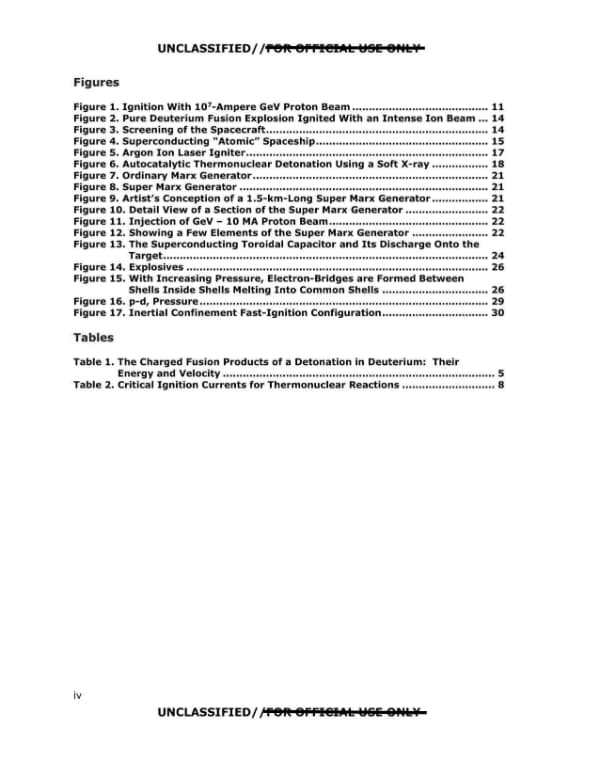
This is the list of figures and tables page (page iv) of a report on advanced nuclear propulsion concepts, with entries and page numbers. The page is marked UNCLASSIFIED with a struck-through FOR OFFICIAL USE ONLY legend.
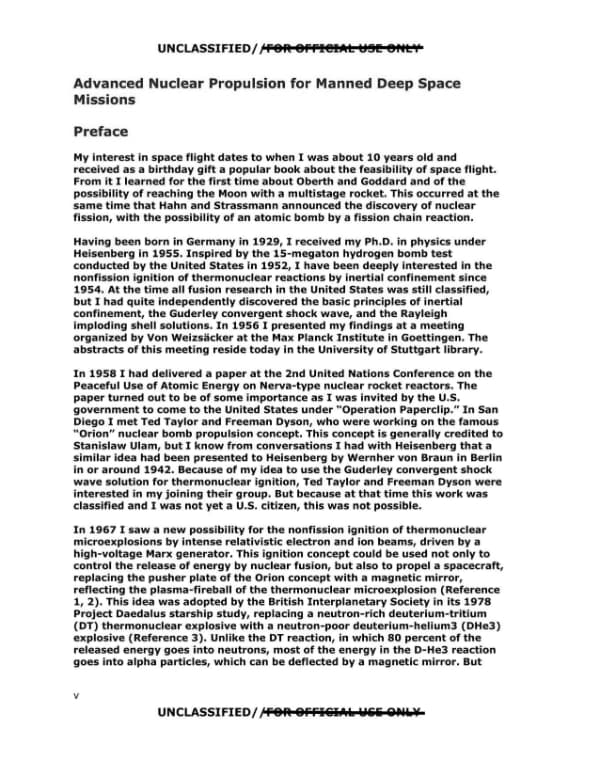
UNCLASSIFIED/ /Pelt eFFl@IAL l:ISIE 8HLY Figures Figure 1. Ignition With 107 -Ampere GeV Proton Beam ......................................... 11 Figure 13. The Superconducting Toroidal Capacitor and Its Discharge Onto the Figure 15. With Increasing Pressure, Electron-Bridges are Formed Between Figure 2. Pure Deuterium Fusion Explosion Ignited With an Intense Ion Beam ... 14 Figure 3. Screening of the Spacecraft................................................................... 14 Figure 4. Superconducting "Atomic" Spaceship.................................................... 15 Figure 5. Argon Ion Laser Igniter......................................................................... 17 Figure 6. Autocatalytic Thermonuclear Detonation Using a Soft X-ray ................. 18 Figure 7. Ordinary Marx Generator....................................................................... 21 Figure 8. Super Marx Generator ........................................................................... 21 Figure 9. Artist's Conception of a 1.5-km-Long Super Marx Generator ................. 21 Figure 10. Detail View of a Section of the Super Marx Generator ......................... 22 Figure 11. Injection of GeV - 10 MA Proton Beam ................................................ 22 Figure 12. Showing a Few Elements of the Super Marx Generator ....................... 22 Target.................................................................................................. 24 Figure 14. Explosives ........................................................................................... 26 Shells Inside Shells Melting Into Common Shells ................................ 26 Figure 16. p-d, Pressure ....................................................................................... 29 Figure 17. Inertial Confinement Fast-Ignition Configuration ................................ 30 Tables Table 1. The Charged Fusion Products of a Detonation in Deuterium: Their Energy and Velocity .................................................................................. 5 Table 2. Critical Ignition Currents for Thermonuclear Reactions ............................ 8 UNCLASSIFIED/ /Felt 8Ffl@IAI: l:l&lii &PU.¥ iv
Page 5

Page 5 of 37

Page v of a report titled Advanced Nuclear Propulsion for Manned Deep Space Missions, containing the author's preface describing his background in nuclear physics, his work on inertial confinement fusion, his 1958 Operation Paperclip invitation, and his 1967 propulsion concept.
UNCLASSIFIED/ /FOR OFFl@IAL l::l!H! 8HL'I Advanced Nuclear Propulsion for Manned Deep Space Missions Preface My interest in space flight dates to when I was about 10 years old and received as a birthday gift a popular book about the feasibility of space flight. From it I learned for the first time about Oberth and Goddard and of the possibility of reaching the Moon with a multistage rocket. This occurred at the same time that Hahn and Strassmann announced the discovery of nuclear fission, with the possibility of an atomic bomb by a fission chain reaction. Having been born in Germany in 1929, I received my Ph.D. in physics under Heisenberg in 1955. Inspired by the 15-megaton hydrogen bomb test conducted by the United States in 1952, I have been deeply interested in the nonfission ignition of thermonuclear reactions by inertial confinement since 1954. At the time all fusion research in the United States was still classified, but I had quite independently discovered the basic principles of inertial confinement, the Guderley convergent shock wave, and the Rayleigh imploding shell solutions. In 1956 I presented my findings at a meeting organized by Von Weizsacker at the Max Planck Institute in Goettingen. The abstracts of this meeting reside today in the University of Stuttgart library. In 1958 I had delivered a paper at the 2nd United Nations Conference on the Peaceful Use of Atomic Energy on Nerva-type nuclear rocket reactors. The paper turned out to be of some importance as I was invited by the U.S. government to come to the United States under "Operation Paperclip." In San Diego I met Ted Taylor and Freeman Dyson, who were working on the famous "Orion" nuclear bomb propulsion concept. This concept is generally credited to Stanislaw Ulam, but I know from conversations I had with Heisenberg that a similar idea had been presented to Heisenberg by Wernher von Braun in Berlin in or around 1942. Because of my idea to use the Guderley convergent shock wave solution for thermonuclear ignition, Ted Taylor and Freeman Dyson were interested in my joining their group. But because at that time this work was classified and I was not yet a U.S. citizen, this was not possible. In 1967 I saw a new possibility for the nonfission ignition of thermonuclear microexplosions by intense relativistic electron and ion beams, driven by a high-voltage Marx generator. This ignition concept could be used not only to control the release of energy by nuclear fusion, but also to propel a spacecraft, replacing the pusher plate of the Orion concept with a magnetic mirror, reflecting the plasma-fireball of the thermonuclear microexplosion (Reference 1, 2). This idea was adopted by the British Interplanetary Society in its 1978 Project Daedalus starship study, replacing a neutron-rich deuterium-tritium (OT) thermonuclear explosive with a neutron-poor deuterium-helium3 (DHe3) explosive (Reference 3). Unlike the OT reaction, in which 80 percent of the released energy goes into neutrons, most of the energy in the D-He3 reaction goes into alpha particles, which can be deflected by a magnetic mirror. But UNCLASSIFIED/,'FOR OFFI&I.t.k Wliliii QfslL¥ V UNCLASSIFIED/ /FOR OFFICIAL USE ONLY
Page 6

Page 6 of 37

This is page vi, the closing portion of a preface to a document on nuclear propulsion, discussing antimatter propulsion, the Project Orion concept, and a recounted dream of Ted Taylor. The top and bottom of the page are marked UNCLASSIFIED//FOR OFFICIAL USE ONLY, with the FOUO portion struck through.
because He3 is not abundantly available everywhere, it was proposed to "mine" it from Jupiter's atmosphere. Studies have been conducted on spacecraft propulsion with the matter-antimatter annihilation reaction, however, it is an enormous technical challenge to produce antimatter in appreciable quantities. The idea of using nano-gram amounts of antimatter for the ignition of fission-fusion microexplosions appears to have credible potential, but even there the production and storage of nano-gram quantities of antimatter pose serious technical problems (Reference 4). We have little reason to expect that new fundamental laws of physics that could lead to a breakthrough in propulsion still await discovery. Very much as America was discovered only once, it is quite possible that all the fundamental laws of physics relevant to propulsion have been discovered, challenging our imagination to find out if they are sufficient to invent propulsion systems that ultimately might bring us to Earthlike planets of nearby solar systems. I conclude this preface with an imaginary talk by Ted Taylor to Freeman Dyson as recorded by the latter's son, George Dyson, in his book Project Orion - The True Story of the Atomic Spaceship (Reference 5), followed by a dream of Ted Taylor's. "Freeman's hope for the Orion had rested on the fact that there seems to be no law of nature forbidding the construction of fission-free bombs," and on the belief that "improvements in the design of the nuclear devices (by reducing the fraction of total yield due to fission) might achieve reduction factors of 10^2 to 10^3. This belief in small, fission-free bombs has largely evaporated." "One exception is Ted (Taylor). He remains convinced that small, clean bombs could propel Orion - but he still fears more than ever that such devices would be irresistible as weapons, until we outgrow the habit of war. There are lots of different routes to that final result of a very clean bomb." "Could you make a one-kiloton explosion in which the fission yield was zero, which is bad news on the proliferation front, but could turn Orion into something quite clean?" "Freeman thinks Ted is wrong - and Ted hopes Freeman is right." I for my part think Freeman is wrong. Many years later, shortly before his death, Ted Taylor reported: "I had a dream last night, about a new form of nuclear weapon, and I am really scared of it." He reported that when he woke up, he wrote down his dream, and it appeared scientifically sound and feasible. What was it? We never will know with certainty, but I have a guess: it is the possibility of chemical superexplosives (explained in the appendix) powerful enough to ignite a thermonuclear bomb. vi UNCLASSIFIED//FOR OFFICIAL USE ONLY
Page 7

Page 7 of 37

Page 1 of a paper arguing that deuterium thermonuclear rockets could reach the outer solar system and nearby star systems, opening with the Introduction and a section on deuterium fuel versus DT and DHe3 reactions. The page is marked UNCLASSIFIED / FOR OFFICIAL USE ONLY in its header and footer.
UNCLASSIFIED/;'FOR OFFl&I.t.k Wlilii QNL¥ Introduction As Hermann Oberth proved for chemical rockets in his 1923 book The Rocket into Planetary Space (Reference 6), this paper will try to prove for thermonuclear rockets the following: • At the present state of science and technology one can build spaceships driven by deuterium thermonuclear reactions, able to reach the outer limits of the solar system. • Such spaceships permit the manned exploration of the entire solar system and beyond, with the ultimate potential to reach nearby solar systems. • The cost in research and development to build such spaceships will be high but still well within what is economically feasible. • Using the same physical principles as for deuterium fusion rockets will also lead to the realization of clean nuclear energy, justifying the expenditures for these large projects. Deuterium can be used as the rocket fuel of choice in addition to any inert material that is suitable as a propellant. This propellant material is available on most planetary bodies and particularly on the comets of the Oort cloud. The main idea is that by gradual radial expansion from the Sun by building bridges over the Oort clouds, which presumably surround all suns, Earthlike planets in neighboring solar systems can eventually be reached. The first and most important step toward this goal is to reach the focus of the Einstein gravitational lens at 550 AU (astronomical units). At this location, one can use the Sun as the lens of a super telescope, an idea first proposed by Claudio Maccone in 1993. Present knowledge is that there are planets in nearby solar systems that are likely Earthlike planets. It is only with this gigantic telescope that one can determine if life on these planets is possible. But because of the complexity of this task, a manned mission to the Einstein gravitational lens focus is likely to be needed, possible only with advanced nuclear rocket propulsion. Deuterium, Argon Ion Lasers, and KeV Superexplosives The goal is a spacecrah that can be refueled while landing on a planetary body, which can be a planet, an asteroid, or a comet. With heavy water available on many planetary bodies but in particular on comets, this suggests the use of deuterium (D) as the thermonuclear rocket fuel. Ignition of deuterium though, is more difficult than ignition of the deuterium-tritium (DT) reaction or of the deuterium-helium3 (DHe3) reaction. The DT reaction is the easiest to ignite, but 80 percent of the energy goes into neutrons, which cannot be deflected by a magnetic mirror. In the DHe3 reaction all the energy goes into charged fusion products, but in a mixture of D with He3 there are still some neutron-producing deuterium-deuterium (DD) reactions. More important is the fact that, unlike deuterium, He3 is largely unavailable. There is some indication of He3 on the surface of Moon. In the Daedalus starship study by the British Interplanetary UNCLASSIFIED/ /FOR 8FFl@IAL t:191!! 8HL t 1
Page 8

Page 8 of 37

A continuation page of a nuclear propulsion study that discusses helium-3 recovery costs, deuterium extraction from water in three steps, the Orion bomb propulsion project, and two possible ignition approaches. The page is marked UNCLASSIFIED with a struck-through FOR OFFICIAL USE ONLY legend and carries page number 2.
Society, it was proposed to "mine" He3 from the atmosphere of Jupiter. In either case, the cost to recover appreciable amounts of He3 would be very high. For the DD reaction, the situation is quite different because there the instantaneous burn with deuterium of the T- and He3- reaction products of deuterium makes possible a detonation wave in dense deuterium. In this detonation wave, only 38 percent of the energy released goes into neutrons, compared with 80 percent for the DT reaction. Deuterium can be extracted from water with relative ease in three steps: • Water is electrolytically split into hydrogen and oxygen. • The hydrogen gas, composed of H2 and HD, is cooled down until it liquefies, whereby the heavier HD is separated by the force of gravity from the lighter H2. • The newly produced HD is heated and passed through a catalyst, splitting HD into H2 and D2, according to the equation (Reference 7) 2HD---+ H2 + D2. Since the gravitational field on the surface of a comet or small planet, from which the D2 shall be extracted, is small, the apparatus separating the liquid HD from H2 must be set into rapid rotation. The comparatively small amount of energy needed for the separation can ideally be drawn from a ferroelectric capacitor (for example, a barium-titanate capacitor with a dielectric constant c: ::::: 5,000), to be charged up to many kilovolts by a small fraction of the electric energy drawn from the deuterium fusion explosions through a magneto hydrodynamic loop (Reference 2). One can also draw this energy from a small on-board nuclear reactor requiring only a small radiator, slowly charging the capacitor. Alternatively, one may store the needed energy in the magnetic field of a superconductor. For the launching of the spacecraft into Earth orbit, a very different scheme is proposed. It requires special materials that are readily available on Earth but not on extraterrestrial bodies serving as landing points to refuel the spacecraft. There the primary resource is water from which deuterium is obtained. In the Orion bomb propulsion project, a large number of fission bombs, or fissiontriggered fusion bombs, were proposed to lift the spacecraft into space. Since this would release a large amount of highly radioactive fission products into the atmosphere, it was one of the causes that killed Orion. Even though large payloads can be brought into Earth orbit by chemical rockets, this rema ins very expensive, and an acceptable less expensive nuclear alternative is highly desirable. There appear to be two possibilities: • A laser driven by a high explosive, powerful enough to ignite a DT microexplosion, which in turn can initiate a thermonuclear detonation in deuterium (Reference 8). • A second, more speculative possibility is the conjectured existence of chemical kiloelectronvolt (keV) superexplosives. These are chemical compounds formed under high pressure, resulting in keV bridges between inner electron shells and able to 2 UNCLASSIFIED//[FOR OFFICIAL USE ONLY]
Page 9

Page 9 of 37

Page 3 of a technical report discussing laser pumping of argon and high-pressure concepts for thermonuclear ignition, then introducing magnetic insulation and the drift velocity relation for field-emitted electrons. The page carries a UNCLASSIFIED//FOR OFFICIAL USE ONLY banner at top and bottom, with the FOUO wording struck through.
release intense bursts of keV X-rays capable of igniting a DT thermonuclear reaction, which in turn could ignite a larger deuterium detonation. To realize the first possibility, one might consider pumping a solid argon rod with a convergent cylindrical shock wave driven by a high explosive (Reference 9). If the argon rod is placed in the center of convergence and reaches a temperature of 90,000 °K, the upper ultraviolet laser level of the argon will be populated. Following this heating, the argon cylinder radially expands and cools, with the upper laser level frozen into the argon. The energy thus stored in the upper laser level can then be removed from the rod by a small Q-switched laser, the resulting powerful laser pulse optically focused onto a thermonuclear target. To realize the second possibility, one would have to subject suitable materials to very high pressure (Reference 10, 11). These energetic states can be reached only if during their compression the materials are not appreciably heated, because such heating would prevent the electrons from forming the bridges between the inner electron shells. Details of the second possibility are provided in the appendix. Magnetic Insulation and Inductive Charging Two concepts are of great importance for the envisioned realization of a deuterium fusion-driven starship: • The concept of magnetic insulation, which permits the attainment of ultrahigh voltages in high vacuum (Reference 1). • The concept of inductive charging, by which a magnetically insulated conductor can be charged up to very high electric potentials (Reference 12). MAGNETIC INSULATION In a greatly simplified way, magnetic insulation can be understood as follows: if the electric field on the surface of a negatively charged conductor reaches a critical field on the order of Ec ~ 10^7 V/cm, the conductor becomes the source of electrons emitted by field emission. The critical electric field for the emission of ions from a positively charged conductor is ~ 10^8 V/cm. Therefore, if in a high-voltage diode the electric field reaches ~10^7 V/cm, breakdown will occur by electric field emission from the cathode to the anode. But if a magnetic field of strength B measured in gauss is applied in a direction parallel to the negatively charged surface, and if B > E, where E (like B) is measured in electrostatic cgs units, the field-emitted electrons make a drift motion parallel to the surface of the conductor with the velocity. v_d = c (E × B)/B^2 = c E/B (1) To keep vd/c < 1 then requires that E < H. Let us assume that H ≈ 2 x 10^4 G, which can be reached with ordinary electromagnets, means that E ≤ 2 x 10^4 esu = 6 x 10^6 V/cm.
Page 10

Page 10 of 37

Page 4 of a DIRD report on advanced nuclear propulsion, covering the inductive charging concept for a spacecraft: an induced azimuthal electric field, electron cloud buildup, and the Brillouin density limit, with equations (2) through (6). The page is marked UNCLASSIFIED//FOR OFFICIAL USE ONLY and contains no redactions.
UNCLASSIFIED//FOR OFFICIAL USE ONLY For a conductor with a radius of λ~10m = 10^3 cm, an example for a small starship configuration, one can reach a voltage on the order of Eλ ≤ 6 ×10^9 volts. INDUCTIVE CHARGING To charge the spacecraft to the required gigavolt potentials, we choose for its architecture a large but hollow cylinder, which at the same time acts as a large magnetic field coil. If thermionic electron emitters are placed inside this coil and the magnetic field of the coil rises in time, Maxwell's equation ∇×E = -(1/c)∂B/∂t induces an azimuthal electric field inside the coil: E_φ = -(r/2c) Ḃ_z (2) where B = B_z is directed along the z-axis, with r the radial distance from the axis of the coil. In combination with the axial magnetic field, the electrons from the thermionic emitters make a radial inward-directed motion v_r = c E_φ/B_z = -(r/2) Ḃ_z/B_z (3) By Maxwell's equation div E = 4πne, this leads to the buildup of an electron cloud inside the cylinder, resulting in the radial electric field E_r = 2πner (4) This radial electric field leads to an additional azimuthal drift motion v_φ = cE_r/B_z (5) superimposed on the radially directed inward drift motion v_r. For the newly formed electron cloud to be stable, its maximum electron number density must be below the Brillouin limit: n < n_max = B²/4πmc² (6) where mc² = 8.2 × 10^-7 erg is the electron rest mass energy. For B = 2×10^4 G, one finds that n_max ≈ 4×10^13 cm^-3. To reach with a cylindrical electron cloud of radius R a 4 UNCLASSIFIED//FOR OFFICIAL USE ONLY
Page 11

Page 11 of 37

This page is page 5 of a report that discusses deuterium as a preferred nuclear rocket fuel, covering the energy distribution of deuterium-deuterium fusion products, an average exhaust velocity formula, and Table 1 listing six charged fusion products with their energies and velocities. The page also opens with a calculation of electron number density for a given potential and radius.
potential equal to V requires an electron number density n~v/ neR2 . For V = 109 volts ::::l 3x 10⁶ esu and R = 103cm, one finds that n ~ 2x 109 cm-3, well below nmax, Deuterium as the Preferred Nuclear Rocket Fuel To appreciate the importance of deuterium as the preferred and abundantly available nuclear rocket fuel, one must consider the secondary reactions with D of the He3 and T reaction products from D-D fusion. Taking these reactions into account, one obtains from 6 deuterium nuclei an energy of 26.8 megaelectronvolts (MeV) in charged fusion products, made up of He3 and H, and an energy of 16.55 MeV in neutrons. This means 62 percent of the energy is released into charged fusion products and 38 percent into neutrons-a substantial improvement over the DT reaction, in which only 20 percent of the energy goes into He4 . Of interest also is the average velocity, averaged over the momentum of the charged fusion products, because it is a measure of the maximum specific impulse, respectively the maximum exhaust velocity: v = sum(i=1 to 6) m_i v_i / sum(i=1 to 6) m_i (7) For the six charged fusion reaction products (given in Table 1), one obtains v = 1.5 x 10^9 cm/s. Table 1. The Charged Fusion Products of a Detonation in Deuterium: Their Energy and Velocity Fusion Product | Energy [MeV] | Velocity 10^9 [cm/s] He3 | 0.8 | 1.23 H | 3.0 | 2.40 H | 14.7 | 5.30 He4 | 3.6 | 1.31 He4 | 3.7 | 1.33 T | 1.0 | 0.80 UNCLASSIFIED//FOR OFFICIAL USE ONLY 5 UNCLASSIFIED//FOR OFFICIAL USE ONLY
Page 12

Page 12 of 37

A technical page on a thermonuclear propulsion concept, covering electron energy sharing with fusion products, an escape-time comparison yielding r0 < 0.4 cm, and the start of a section on magnetic entrapment. The page is numbered 6 and carries FOUO markings at top and bottom.

UNCLASSIFIED//FOR OFFICIAL USE ONLY Because the 6 charged fusion products are accompanied by 9 electrons, they have to share their kinetic energy with 9 electrons. This reduces the maximum specific impulse by the factor √((6+9)/6) = √2.5 to v̄ = 0.95×10^9 cm/s. A reduction of the specific impulse does not occur if the electrons have enough time to escape the burning plasma behind the detonation front; that is, in a time shorter than the time for them to be heated by the charged fusion products. The time needed for the electrons to be heated by the charged fusion reaction products can be computed from the range λ0 of the charged fusion products and their velocity v in a plasma at the temperature T. For the He4 fusion products, the range is given by λ0 = a(kT)^3/2 / n , a = 2.5×10^34 [cgs] (8) This time is τ = λ0/v = a(kT)^3/2 / (nv) (9) It then has to be compared with the time the electron can escape the burning plasma behind the detonation front, given by t_esc ≈ r0/v_e (10) where r0 is the radius of the burning deuterium cylinder, and v_e the electron velocity. One thus has t_esc/τ = (v/v_e) · nr0 / a(kT)^3/2 (11) Putting n = 10^23 cm^-3, T ≈ 10^8 K with v_e ~ 10^9 cm/s, v ~ 10^9 cm/s, one finds t_esc/τ ~ 2.5 r0. Therefore, t_esc < τ requires that r0 < 0.4 cm. To reach the highest specific impulse possible, one should make the deuterium cylinder as thin as possible. Magnetic Entrapment of the Charged Fusion Products and the Stopping of the Proton Beam in Dense Deuterium If a fission bomb is used to trigger a thermonuclear detonation, so much energy is available that almost any radiation implosion configuration is likely going to work. As an example, one may place a fission bomb and a sphere of solid deuterium in a shell of 6 UNCLASSIFIED//FOR OFFICIAL USE ONLY