AAWSAP DIRD, Pulsed High-Power Microwave Source Technology, January 2010
This document is a Defense Intelligence Reference Document (DIRD), a technical reference format used by the Defense Intelligence Agency (DIA) to capture baseline knowledge on a specific topic for later analytic use. DIRDs are best understood as reference and synthesis products rather than as original research. It is one of 38 DIRDs produced under the Advanced Aerospace Weapon System Applications Program (AAWSAP) between 2009 and 2011. Because AAWSAP’s scope permitted a broad range of supporting topics, not every DIRD in the series directly concerns aerospace systems or future threat assessment. The following summary reflects the DIRD’s scope and framing at the time of writing and should…
Catalogue description by the publishing agency.
- Record
- DOW-UAP-D121
- Release
- Release 06 · Sep 18, 2026
- Incident
- 2010-01-28 · Las Vegas, Nevada
- Pages
- 37
- Verdict
- not judged yet
- Source
- war.gov ↗
The pages and what the AI read on them
The transcription is the page reader's: black bars mark what the government redacted; hatched tags mark personal data we removed.
Page 13 of 37
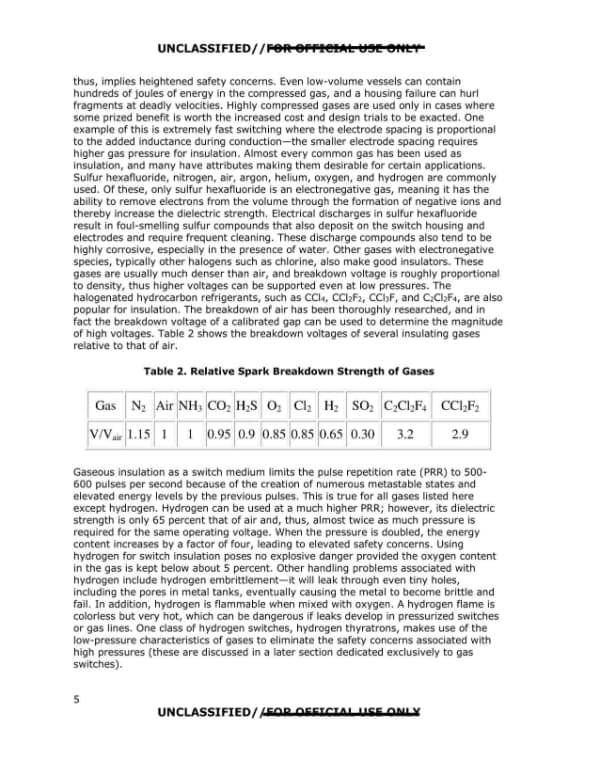
A technical page on gaseous insulation for high-voltage switches, covering properties of sulfur hexafluoride, halogenated gases, and hydrogen, with Table 2 listing relative spark breakdown strengths of several gases. The page is marked UNCLASSIFIED//FOR OFFICIAL USE ONLY and numbered 5.
Page 14 of 37
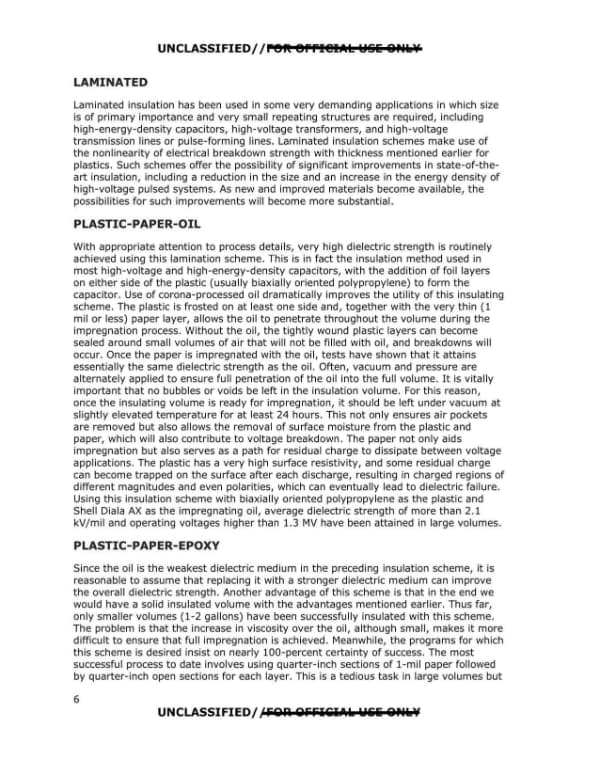
Page 6 of a document on laminated insulation schemes, covering plastic-paper-oil and plastic-paper-epoxy insulation methods and their dielectric strength characteristics. The page is printed with an UNCLASSIFIED//FOR OFFICIAL USE ONLY banner and contains no redactions.
Page 15 of 37
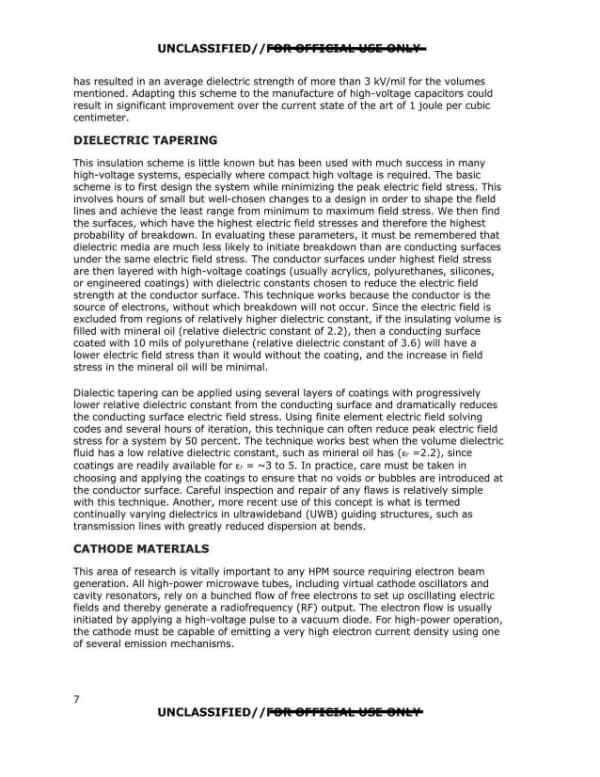
Page 7 of a technical report on pulsed high-power microwave source technology, covering dielectric strength results, the dielectric tapering insulation technique, and the opening of a section on cathode materials. The page contains no redactions.

Page 16 of 37
This page is a technical discussion of cathode emission mechanisms and ideal cathode characteristics for high-power microwave (HPM) tubes, marked UNCLASSIFIED//FOR OFFICIAL USE ONLY. It cites J. R. Pierce (1946) for the characteristics of an ideal cathode and lists materials currently under investigation.
Page 17 of 37
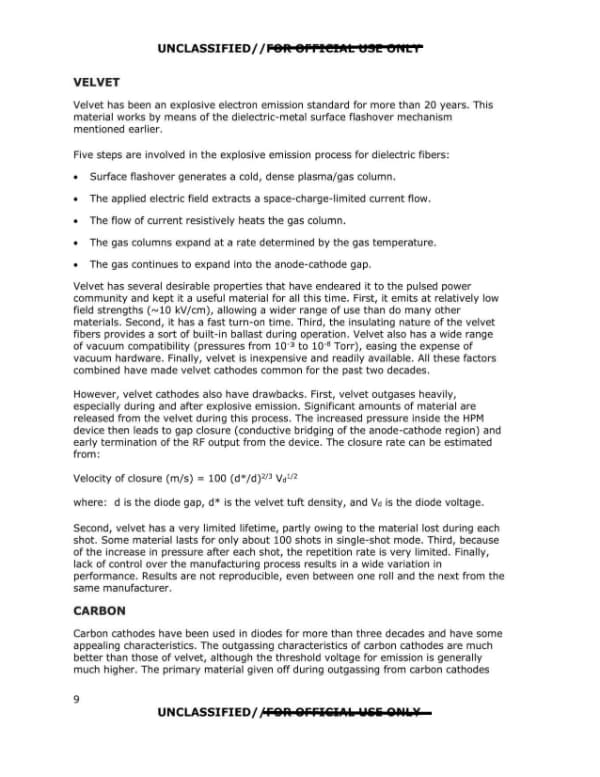
Page 9 of a technical report section comparing explosive electron emission cathode materials, describing the properties and drawbacks of velvet cathodes and beginning a section on carbon cathodes. The page contains no redactions.
Page 18 of 37
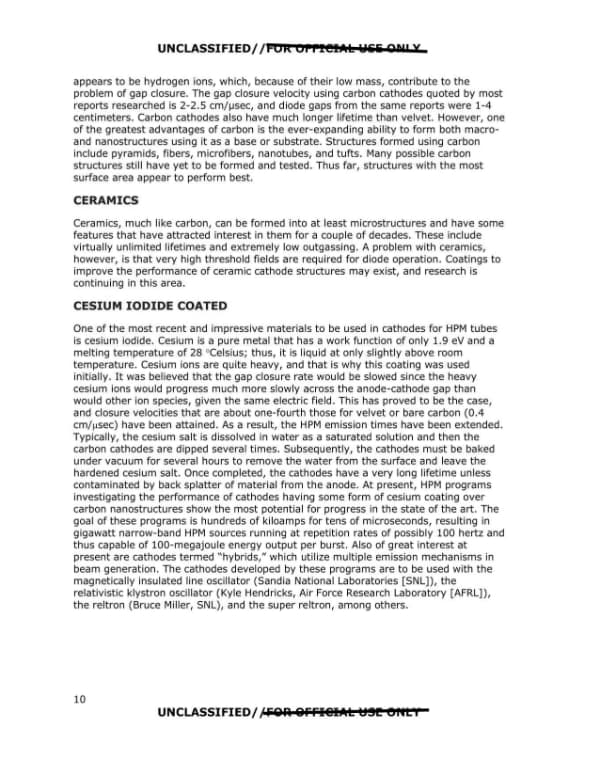
This is a page of a technical report on cathode materials for pulsed high-power microwave tubes, covering carbon, ceramic and cesium iodide coated cathodes. It describes gap closure velocities, cathode lifetimes and the programs and laboratories using these cathodes.
Page 19 of 37
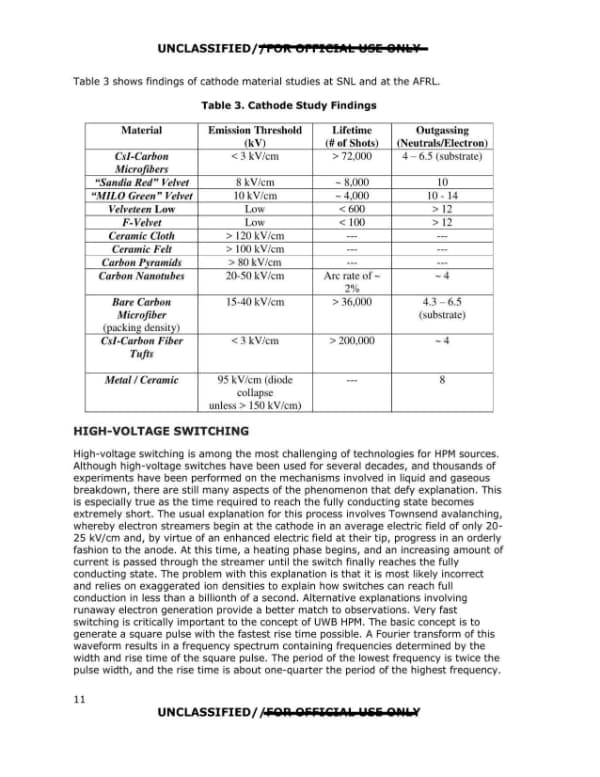
A page from a technical report presenting Table 3, cathode material study findings from SNL and AFRL, followed by a section on high-voltage switching for HPM sources. The page carries the report's UNCLASSIFIED/FOR OFFICIAL USE ONLY markings and page number 11.
Page 20 of 37
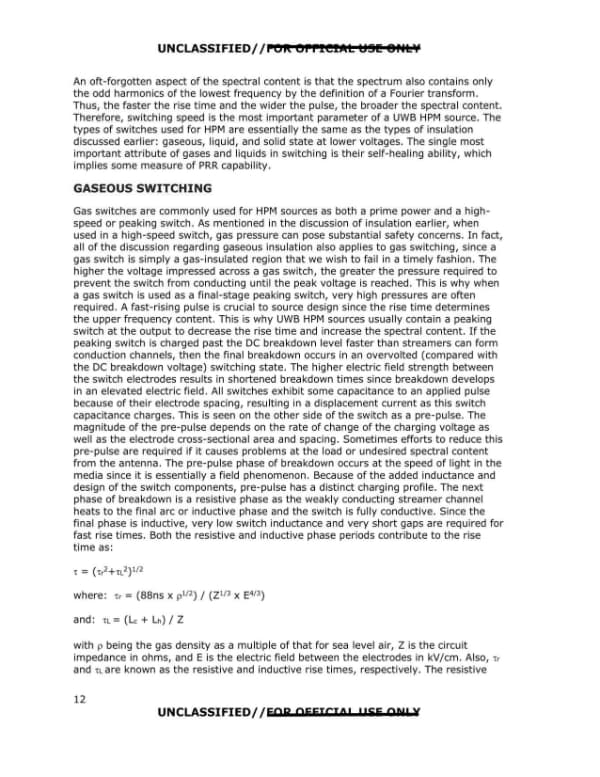
Page 12 of a technical discussion of pulsed high-power microwave source switching, covering gaseous switch behavior, peaking switches, pre-pulse, and rise-time equations. The page ends mid-sentence describing the resistive rise time.
Page 21 of 37
Not read yet.

Page 22 of 37
Not read yet.

Page 23 of 37
Not read yet.

Page 24 of 37
Not read yet.